
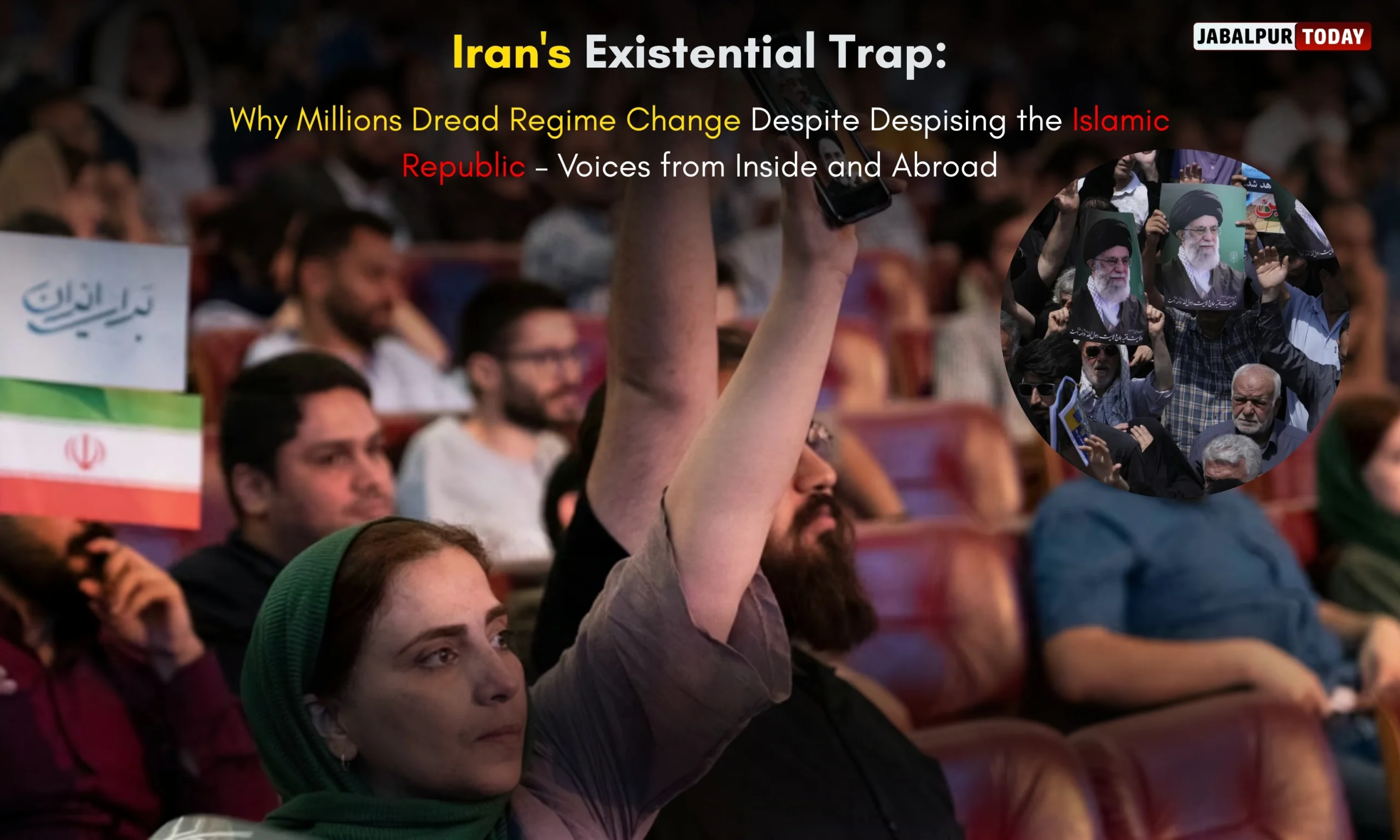
Iran faces an existential crisis as citizens demand regime change but fear chaos like Iraq and Libya. This deep analysis explores economic collapse, human rights abuses, public protests, foreign pressure, and the uncertain path toward self-led transformation in 2026
New Delhi: In an emotional comment shared on platforms like YouTube and X (formerly Twitter), an anonymous Iranian (people of Iran) explained the country’s deep crisis in simple but powerful words: “As an Iranian, I can tell you the situation is no longer just political — it’s existential. We are trapped between two collapsing structures: one internal, one external.”
This message, reposted by users like @thecyrusjanssen and @ImtiazMadmood, reflects a harsh truth. Many Iranians strongly dislike their government because of corruption and repression. But at the same time, they fear that if the government falls, the country could fall into even worse chaos — like what happened in Iraq and Libya.
In 2026, after the 2025 Israel-Iran war and fresh threats from the United States, this fear has become central to discussions inside Iran. Based on surveys, expert opinions, and voices from ordinary people, this article explains why regime change in Iran is both desired and feared. It also looks at the psychological strength of the people, economic suffering, and the hope for change led by Iranians themselves.
The Internal Collapse: A Regime Weakening Itself
Iran’s Islamic Republic, led by Supreme Leader Ali Khamenei, is facing serious internal problems.
Years of poor economic management have led to:
- Hyperinflation (over 50% in 2025)
- A sharply weakened currency
- Rising poverty
After the United States withdrew from the nuclear deal (JCPOA) in 2018 and reimposed sanctions, Iran’s oil exports dropped sharply. Millions of people are now struggling just to survive.
Human Rights Watch (HRW) reports a wave of human rights abuses in early 2026, including:
- Over 1,000 arbitrary arrests
- Enforced disappearances
- 85 executions in January alone
Protests restarted in December 2025 due to economic hardship. These protests were heavily suppressed, similar to the 2022 Mahsa Amini movement. This time, many protests are being led by university students in Tehran.
Key Internal Failures
- Economic Mismanagement
The Iranian rial collapsed again in 2025. Many citizens are angry that money is being spent on regional groups like Hezbollah and Hamas instead of helping Iranians. A 2021 GAMAAN survey (still relevant in 2026) showed 73% supported the slogan:
“Not Gaza, not Lebanon, I only give my life for Iran.”
- Suppression of Dissent
HRW reports torture, denial of medical care, and complete lack of accountability for the 2022 crackdown.
- Ideological Alienation
Young people under 30 make up about 60% of the population. Most do not trust elections and see them as fake. Surveys show a majority now want full regime change.
These problems are not just moral — they are structural. Reports from Western media suggest that even powerful groups like the Revolutionary Guard (IRGC) are competing internally for influence as Khamenei’s authority appears weaker.
Public Sentiment: Change Is Wanted — But At What Price?
Surveys in 2026 show that 70–80% of Iranians believe regime change is necessary for progress. Most prefer protests over elections.
However, only about 40% trust foreign pressure to help. Many believe foreign involvement could make things worse.
Social media posts reflect this fear:
“A bad government is survivable. No government is not.”
Since February 21, 2026, there have been at least 32 anti-regime protests, mostly led by students.
Iranians living abroad add another perspective. Many say real change could take a generation and warn against expecting quick solutions.
The Paradox of Fear: Lessons from Neighboring Countries
Iranians are deeply affected by what happened in nearby countries after foreign interventions. These examples shape their fears:
Iraq
After the 2003 US invasion, Iraq experienced sectarian civil war and the rise of ISIS. Although Saddam Hussein was removed, the country faced years of violence and instability. Many Iranians see this as proof that foreign “freedom” can bring chaos.
Libya
After NATO airstrikes in 2011 removed Muammar Qaddafi, Libya fell into civil war and militia control. Instead of stability, the country descended into disorder.
Syria
Since 2011, Syria has faced a long proxy war involving many foreign powers. Millions were displaced. Iranians fear becoming another battleground for global powers.
Afghanistan
After 20 years of US occupation, the Taliban returned to power in 2021. The sudden collapse created economic disaster. This is seen as an example of foreign powers leaving countries unstable after intervention.
Because of these cases, many Iranians do not trust promises from the US or Israel about “freedom.” In 2026, strong rhetoric from leaders like Donald Trump is often viewed as a push for regime change that could cause long-term instability.
Why Is There So Much Fear?
- A sudden power vacuum could lead to civil war.
- The Revolutionary Guard might split into factions.
- Foreign countries may act in their own interests, not for democracy.
- Neighboring countries fear instability spilling across borders.
Psychological Resilience and Possible Paths Forward
Despite fear, something important is changing inside Iran. According to analysts, fear among the public is slowly decreasing. Young people and women are showing more social defiance.
The economy adds to the urgency. Iran’s GDP per capita in 2026 is around $4,000 — similar to Libya before its collapse.
However, Iran’s security system is deeply connected to the regime, making a peaceful transition difficult.
Possible Future Scenarios
- Internal-Led Change
Some experts suggest encouraging defections from within institutions like the army (Artesh). Surveys show some Iranians would accept foreign support — but only if it does not involve military intervention.
- External Pressure Risks
Limited military strikes by the US could actually strengthen hardliners and unite people behind the regime.
3. Global Mediation
Human rights groups suggest UN mediation and targeted sanctions instead of broad intervention. Many warn against “weaponizing freedom.”
Regional and Global Impact
Ironically, Iran’s current stability — even if flawed — prevents wider regional chaos. Countries like Turkey fear migration waves and terrorism if Iran collapses.
In Washington, experts debate policy. Many warn that pushing regime change could empower rivals like Russia and China instead.
A Nation Trapped — But Not Without Hope
Iran’s “existential trap” is real. The people feel stuck inside a system they dislike, yet they fear what could replace it.
But this situation is not hopeless. As one social media user wrote:
“We’re cautious because we’ve learned.”
The best path forward may not be foreign intervention, but careful international support that strengthens Iranian civil society and respects the people’s right to shape their own future.
Without that balance, the crisis surrounding this “hated house” could spread beyond Iran’s borders — affecting the entire region.
Also Read on jabalpur today: Explainer on the 2026 US-Israel attack on Iran: Khamenei’s assassination, nuclear conflict roots, casualties, country roles, and global fallout
