
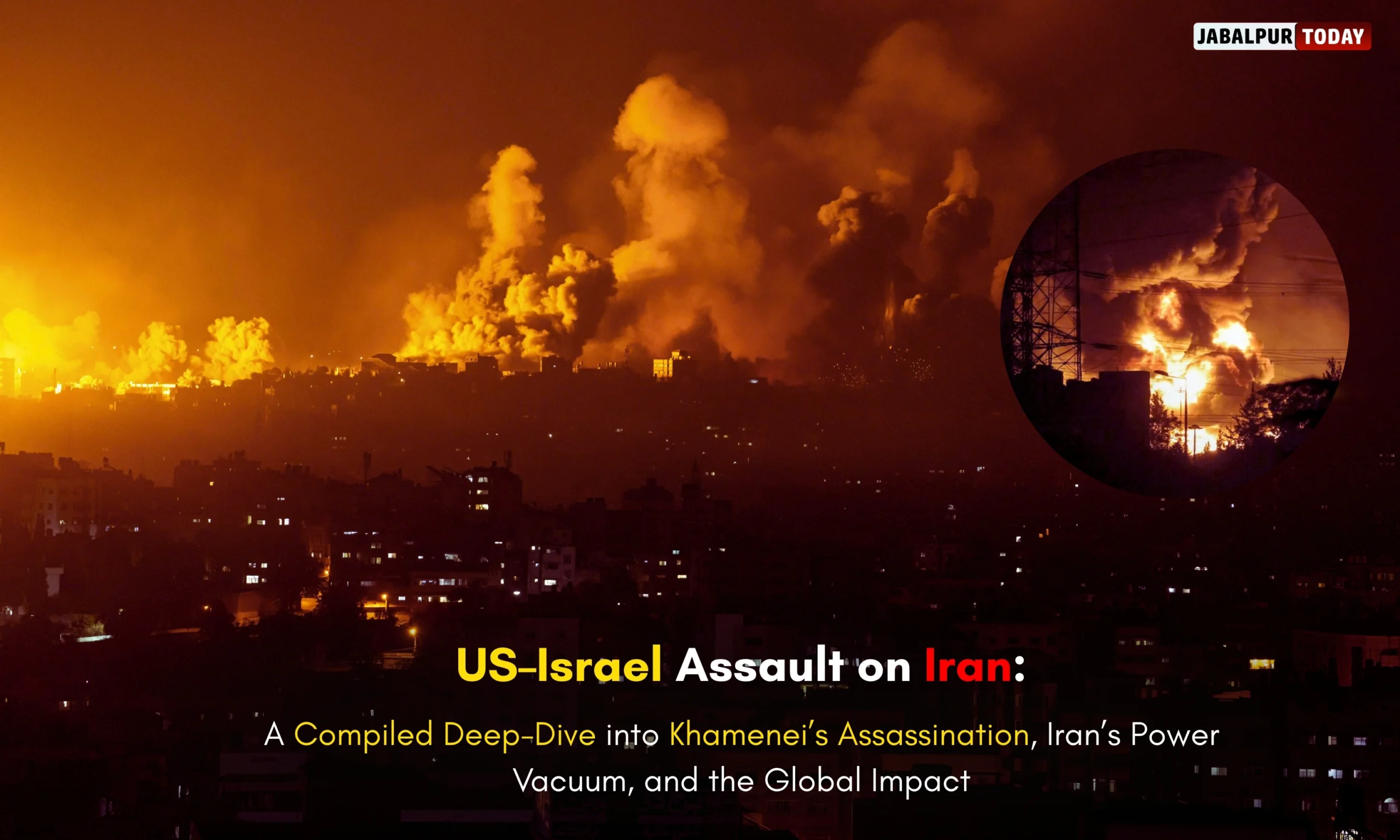
An in-depth explainer on the 2026 US-Israel attack on Iran, covering Khamenei’s assassination, the nuclear crisis, civilian casualties, global reactions, and its impact on the Middle East.
New Delhi: In the early hours of February 28, 2026, the United States and Israel carried out a joint air attack on Iran. Israel called the operation “Operation Roaring Lion,” while the US named it “Epic Fury.” The strikes hit important military, nuclear, and government locations in several Iranian cities.
The most shocking outcome was the confirmed killing of Iran’s Supreme Leader, Ayatollah Ali Khamenei, inside his office in Tehran. This was the biggest escalation between the US and Iran since the 12-day war in June 2025. What had been a tense nuclear dispute quickly turned into a full regional crisis.
This conflict is different from earlier ones. It is not only about missiles and airstrikes. It has created a power vacuum in Iran, with no clear leader to replace Khamenei. Inside the country, some people publicly celebrated his death while the government declared national mourning. These reactions show deep cracks within Iran’s political system.
Using reports from Iranian state media, US officials, and regional experts, this article explains why the attack happened, what each side wants, the human cost, and how this moment could reshape power in the Middle East.
Background: How the Crisis Built Up
Iran’s nuclear program has caused tension for many years, but things worsened sharply between 2025 and 2026.
- In 2018, the US left the 2015 nuclear deal (JCPOA) and brought back heavy sanctions, badly hurting Iran’s economy.
- By 2025, Iran broke nuclear limits by enriching uranium close to weapons-grade levels and revealing secret facilities.
- Israel responded in June 2025 by attacking Iranian nuclear sites, leading to a short but intense war.
In early 2026, talks failed again.
- The US demanded that Iran stop uranium enrichment completely.
- Iran demanded full sanctions relief.
Neither side backed down. At the same time, Iran faced large internal protests over economic hardship and government repression. Reports say more than 7,000 people were killed in recent months during unrest.
Khamenei strongly opposed the US and Israel and supported armed groups like Hezbollah and Hamas. Because of this, he became a main target. The goal of the strikes was not just to damage nuclear facilities, but also to remove Iran’s top leadership, similar to past US strategies in Iraq—but with much higher risks.
Main Triggers for the Attack
- Iran’s advanced nuclear activities and support for attacks on Israel through proxy groups.
- Strong pressure from Israel and Saudi Arabia for early military action.
- US President Trump’s repeated statements that he would never allow Iran to get nuclear weapons and his call for Iranians to overthrow their leadership.
Timeline: What Happened (February 28 – March 1, 2026)
February 28 – Morning (Tehran Time)
- US and Israeli forces strike Tehran, Isfahan, Karaj, Kermanshah, Qom, and Tabriz.
- Targets include nuclear sites, missile factories, and leadership buildings.
- Khamenei is killed, along with IRGC commander Mohammed Pakpour and Defense Minister Amir Nasirzadeh.
February 28 – Afternoon
- Iranian state media denies Khamenei’s death at first and shows repeated old footage.
- Iran fires missiles at Israel (Tel Aviv, Jerusalem) and US bases in Bahrain, Kuwait, Qatar, Saudi Arabia, the UAE, and Iraq.
- Explosions are reported in Dubai and Doha.
- A girls’ school in Minab, Iran, is hit in what Iran claims is an Israeli strike.
28 February – Evening
- President Trump posts on Truth Social, confirming Khamenei’s death and announcing “major combat operations.”
- Iran declares 40 days of mourning, but celebrations break out in cities like Tehran and Izeh.
March 1 – Early Morning
- Iran officially confirms Khamenei’s death on state television.
- Israel launches new strikes on central Tehran.
- Iran targets 27 US bases and key Gulf infrastructure.
- Russia calls for an emergency UN Security Council meeting.
- Protests in Pakistan and Iraq turn violent.
March 1 – Ongoing
- Airports across the Gulf shut down.
- Oil shipments through the Strait of Hormuz are disrupted.
- Casualty numbers rise.
- Trump warns of a “devastating” response if Iran escalates further.
This fast-moving conflict unfolded much quicker than the 2025 war.
Countries Involved: Who Is Doing What—and Why
| Country/Group | Role | Reasons for Involvement | Demands |
|---|---|---|---|
| United States | Lead attacker (airstrikes, coordination) | Prevent nuclear weapon acquisition; counter proxy threats (e.g., Hezbollah attacks on Israel). Historical enmity since 1979 revolution. | Permanent end to uranium enrichment; dismantle nuclear facilities; end support for proxies (Hamas, Hezbollah, Houthis); ballistic missile limits. Offers minimal sanctions relief in talks. |
| Israel | Co-attacker (missile strikes, intelligence) | Existential threat from Iran’s nuclear program and proxies; preemptive defense after 2025 war. | Full nuclear dismantlement; regime change implied; halt to proxy funding. |
| Iran | Defender/retaliator (missile/drone strikes) | Sovereignty violation; assassination of leaders; response to sanctions and prior strikes. | Full US/UN sanctions relief; no facility destruction; retain low-level enrichment for “medical purposes”; economic incentives (e.g., US investments in oil). |
| Gulf States (Bahrain, Kuwait, Qatar, Saudi Arabia, UAE) | Hosts US bases; targeted by Iran | Host US troops; economic ties to West; fear Iranian dominance. Supported strikes quietly but urged de-escalation. | Stability; end to Iranian aggression; secure oil routes (Strait of Hormuz). |
| Iraq | Site of US bases; PMF (Iran-backed) hit | Internal divisions: Pro-Iran militias vs. US presence. | Expel US forces; end foreign interference. |
| Russia/China | Diplomatic supporters of Iran | Geopolitical allies; oppose US unilateralism. Russia calls UN meeting. | Ceasefire; multilateral talks; no regime change. |
| European Union (e.g., France, Germany) | Observers/mediators | Fear wider war; economic ties (oil). Macron calls UNSC meeting. | De-escalation; return to JCPOA-like deal. |
Casualties and Human Cost
Iran
- 201–610 killed, mostly civilians.
- 700+ injured.
- A major tragedy occurred when a girls’ school in Minab was hit, killing 85–148 people, many of them children.
- Senior figures killed include Khamenei, Pakpour, Nasirzadeh, and several nuclear scientists.
Israel
- 1 civilian killed, 121 injured by missile attacks.
Gulf States and Iraq
- Minor military injuries.
- Civilians injured in the UAE due to debris near airports.
Protests Abroad
- 9 killed during protests in Pakistan and Iraq.
- Over 25 injured.
Total estimated casualties: More than 800 people killed or injured.
Current Situation: High Risk, No Resolution
As of March 1, 2026, attacks continue. Israel is striking deep inside Tehran, and Iran promises strong revenge. Oil prices are rising sharply, flights are canceled, and the UN Security Council is in emergency session. Protests are spreading globally, including celebrations among parts of the Iranian diaspora.
What Makes This Different: Iran’s Power Vacuum
Iran now faces a serious leadership crisis. Khamenei left no clear successor, especially after President Raisi died in a helicopter crash in 2024. The IRGC may try to take control, increasing the risk of civil war or separatist movements.
Globally, oil prices could reach $150 per barrel, US politics could become more divided, and Russia and China may get more involved. Humanitarian risks include refugees and sectarian violence.
There is still a possible path to peace through back-channel talks via Oman or Qatar, but extreme demands on both sides make compromise difficult.
This conflict is more than a military clash—it is a gamble that Iran’s system will collapse from within. If escalation continues, the consequences could be catastrophic for the region and the world. Diplomacy remains the only way to stop the crisis from turning into something far worse.

Mansi Sharma is a journalist covering Global Affairs, and wellness, known for turning complex ideas into sharp, engaging narratives. Her work is driven by curiosity, depth, and a constant urge to question and explore. When she’s not writing, you’ll often find her diving into new ideas—preferably with a cup of coffee in hand, one sip at a time.