
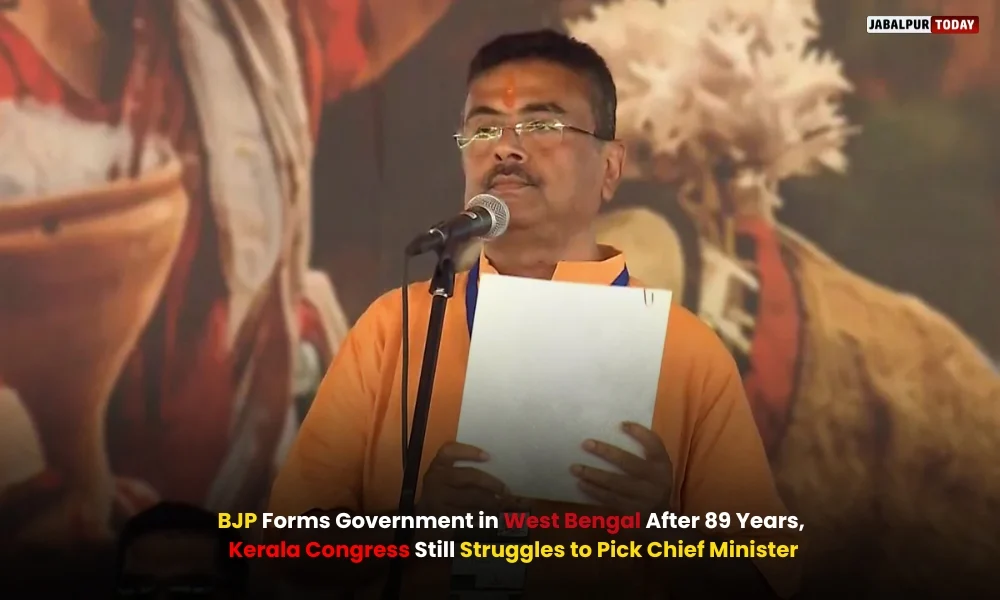
While BJP swiftly forms government in Bengal after a landmark victory, Congress struggles to finalise Chief Minister despite a strong mandate in Kerala
Kolkata/Thiruvananthapuram: India witnessed two very different political situations on the same day. In West Bengal, the BJP formed its government after a historic victory, ending nearly nine decades of non-right-wing rule. At the same time in Kerala, the Congress-led alliance won a clear majority but is still unable to decide who will become the Chief Minister. These two developments show how differently political parties handle power after elections.
Bengal: BJP Creates History After 89 Years
At Brigade Parade Grounds in Kolkata, a huge crowd gathered to watch Suvendu Adhikari take oath as the first BJP Chief Minister of West Bengal. The oath was administered by Governor R. N. Ravi in the presence of Prime Minister Narendra Modi, Home Minister Amit Shah, Defence Minister Rajnath Singh and other senior leaders.
Along with him, BJP leaders Dilip Ghosh, Agnimitra Paul, Ashok Kirtania, Nisith Pramanik and Kshudiram Tudu also took oath as ministers.
This comes after BJP won 207 out of 294 seats in the election, while the All India Trinamool Congress dropped to 80 seats from its earlier 215. The voter turnout was a record 92.93%, the highest ever in the state.
Suvendu Adhikari’s Political Journey
Suvendu Adhikari’s rise has been dramatic. Once a close aide of Mamata Banerjee in the Trinamool Congress, he joined BJP in 2020. In 2021, he defeated Banerjee in Nandigram, making him a key face of BJP in Bengal.
Over the years, he raised issues like corruption, law and order, and political violence. In the latest elections, he won from both Nandigram and Bhabanipur, strengthening his position as the party’s top leader in the state.
Why This Victory Is Important
West Bengal has long been dominated by left and centrist politics. The Communist Party of India (Marxist) ruled for 34 years (1977–2011), followed by Mamata Banerjee’s 15-year rule.
The BJP’s growth has been steady — from just 3 seats in 2016 to 77 in 2021, and now a clear majority.
Several factors contributed to this win:
• Anti-incumbency after long rule
• Allegations of corruption like the school recruitment scam
• Concerns over jobs and law and order
• Border and security issues
• Controversy over voter list revision
Mamata Banerjee Refuses to Resign
Despite losing both her seat and majority, Mamata Banerjee has refused to step down as Chief Minister. She alleged irregularities in elections and blamed the Election Commission, even claiming EVM tampering.
She challenged the Centre to impose President’s Rule instead of forcing her resignation. This has created a constitutional situation, as normally a leader must resign after losing majority.
Meanwhile, reports of post-election violence have emerged from different parts of the state, making the transition of power tense.
Kerala: Big Win, But No Chief Minister Yet
While Bengal moved quickly, Kerala is facing delays. The Congress-led United Democratic Front won 102 out of 140 seats, ending the rule of the Left Democratic Front.
The Indian National Congress alone secured 63 seats. Even BJP opened its account with three seats.
Despite this strong mandate, the Congress has not announced a Chief Minister yet.
Who Could Be Kerala’s CM?
Several leaders are being considered:
• V. D. Satheesan – Seen as the frontrunner
• Ramesh Chennithala – Senior Congress leader
• K. C. Venugopal – Close to party leadership
• Shashi Tharoor – MP from Thiruvananthapuram
The delay is mainly due to internal discussions and the absence of a clear leader after the death of former CM Oommen Chandy.
The final decision will be taken by Congress president Mallikarjun Kharge and the party high command.
Two States, Two Different Situations
The developments highlight a clear contrast:
• In Bengal, BJP quickly formed government and showed decisive leadership.
• In Kerala, Congress is still deciding its leader despite a strong win.
Bengal’s new government begins amid tension and violence. Kerala’s government, on the other hand, is yet to take shape.
A re-election in the Falta seat in West Bengal is scheduled soon, while Kerala is expected to get its Chief Minister in the coming days.
Overall, the situation shows two sides of Indian democracy — one acting quickly after victory, and the other still working through internal decisions before moving forward.

Mansi Sharma is a journalist covering Global Affairs, and wellness, known for turning complex ideas into sharp, engaging narratives. Her work is driven by curiosity, depth, and a constant urge to question and explore. When she’s not writing, you’ll often find her diving into new ideas—preferably with a cup of coffee in hand, one sip at a time.