
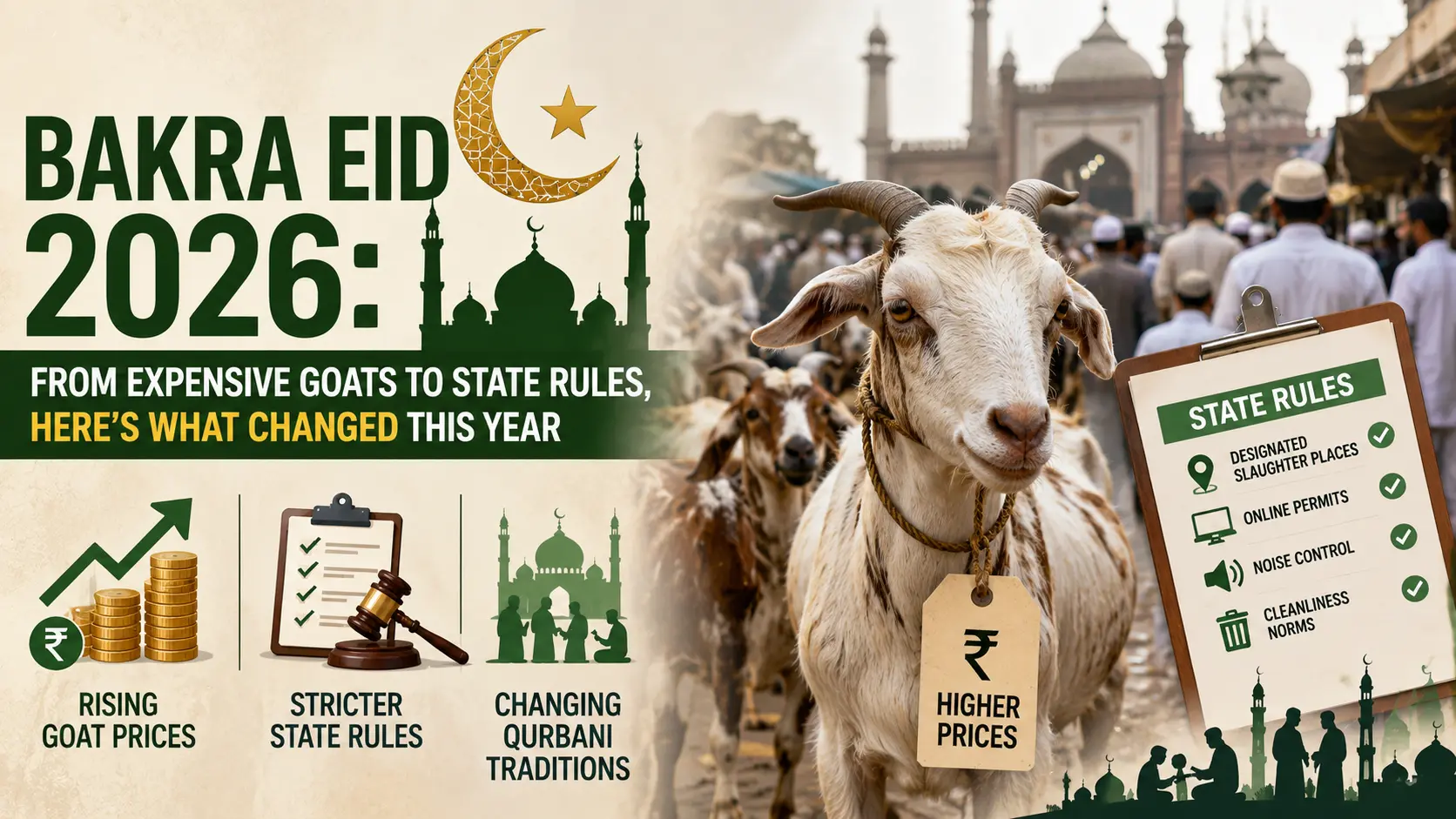
Bakra Eid 2026 sees rising goat prices, stricter state rules, and changing Qurbani traditions as Muslim communities adapt across India
New Delhi: In Lucknow’s busy livestock markets, buyers spent hours comparing prices and negotiating with traders as the cost of sacrificial animals rose sharply this year. One regular buyer, who has visited these markets for nearly two decades, said inflation has hit families hard. “The most expensive goat here costs between ₹2.5 lakh and ₹3 lakh,” he told reporters.
At the same time, Muslim families in West Bengal woke up on May 13 to news that the state government had issued a strict notification under the Animal Slaughter Control Act, making it extremely difficult to sacrifice bulls, bullocks, buffaloes, cows, or calves ahead of Eid al-Adha. In Delhi, BJP minister Kapil Mishra warned on social media that sacrificing “bovine species, cows, calves, camels, and other prohibited animals” could lead to criminal cases.
Bakra Eid 2026, observed on May 27–28 in India, arrived this year under the pressure of rising animal prices, stricter laws, and court rulings defining what qualifies as an essential Islamic religious practice. Despite these challenges, Muslim communities across the country continue to adapt quietly while keeping the traditions of Eid alive.
The Rising Cost of Qurbani
The ritual sacrifice of animals, known as Qurbani, remains one of the central parts of Eid al-Adha. But in 2026, many middle- and lower-income Muslim families faced serious financial pressure while preparing for the festival.
In Lucknow, livestock markets saw large crowds, but many buyers reduced their budgets because of rising prices. Demand for high-quality goats remained strong, but traders confirmed that prices had increased sharply across almost all categories of animals. A regular buyer said he had not seen inflation affect the markets this badly in years.
The rising prices also have a larger reason behind them. In many Indian states, stricter cattle slaughter laws have pushed buyers toward goats and sheep. These animals are more expensive because one goat or sheep usually counts as the sacrifice for only one person. In comparison, a cow or buffalo can traditionally be shared among seven people, making it a more affordable option for larger families or groups.
As states tightened restrictions on cattle slaughter, many families lost access to this shared and cheaper option. This increased the financial burden on individual households. Similar patterns had already appeared in Karnataka after the enforcement of stricter cattle protection laws in 2022. By 2026, this situation had become common across many parts of India.
West Bengal and Delhi Lead Stricter Enforcement
The biggest legal developments before Bakra Eid 2026 took place in West Bengal. Although the state is governed by Mamata Banerjee’s Trinamool Congress and not the BJP, the government issued one of its strictest Eid-related notifications in recent years.
On May 13, the West Bengal government enforced provisions under the West Bengal Animal Slaughter Control Act, 1950. The rules required veterinary authorities to issue “fit-for-slaughter” certificates before any bull, bullock, cow, calf, or buffalo could be slaughtered. Officials said only animals above 14 years of age or permanently unfit would qualify for such certificates.
In practice, the notification acted as a near-complete restriction on cattle sacrifice during Eid.
The move immediately reached the Calcutta High Court through several petitions, including one filed by Trinamool Congress MP Mahua Moitra and another by TMC MLA Akhruzzaman. Akhruzzaman argued that buffalo and bull sacrifices remain the only affordable way for many Muslims to perform Qurbani because goat and sheep prices rise sharply during Eid season.
However, on May 21, a Division Bench led by Chief Justice Sujoy Paul and Justice Partha Sarathi Sen refused to interfere with the notification. The court said the May 13 order followed an earlier 2018 High Court ruling that had already settled the matter legally.
During the hearing, the Additional Solicitor General representing the Union government argued that animal sacrifice during Bakrid is an optional practice and not a fundamental right protected under Article 21 of the Constitution.
The court also repeated a position that Indian courts have increasingly taken in recent years — that cow sacrifice is neither an essential nor compulsory religious practice in Islam.
Delhi Issues Strict Warning
In Delhi, BJP minister Kapil Mishra issued a public advisory on May 22 warning that the sacrifice of cows, calves, camels, and other prohibited animals was completely illegal.
He stated that authorities would register criminal cases against violators. The government also banned sacrifices on roads, streets, and other public places. Officials prohibited people from dumping blood or animal waste into drains and asked citizens to report violations directly to the police.
States including Andhra Pradesh, Telangana, Bihar, Jharkhand, Tamil Nadu, Karnataka, Odisha, Goa, Assam, and West Bengal also continued enforcing various cattle protection laws and slaughter restrictions.
Together, these measures reflected a nationwide regulatory pattern that has grown stronger over the past few years and became more visible during Bakra Eid 2026.
The Constitutional Debate Behind the Restrictions
Behind these legal actions lies a larger constitutional debate: can courts decide what is “essential” to a religion and then use that definition to limit religious practices?
In West Bengal, the state government and the Union government argued that the issue had already been settled through the Calcutta High Court’s 2018 judgment. The 2026 ruling simply reinforced the same legal position.’
The petitioners argued that Section 12 of the West Bengal Animal Slaughter Control Act gives the government the power to allow exemptions for religious purposes through special orders. They said the government had not used this provision.
Although the court acknowledged the argument, it declined to intervene. The judges observed that no one had yet applied for slaughter certificates and said the government had the authority to examine whether such a system existed.
For many ordinary Muslims preparing for Eid, however, these legal details provided little relief.
Markets Show Frustration but Also Determination
Away from the courts, the livestock markets reflected both frustration and resilience.
Many buyers in Lucknow admitted they expected higher prices this year, but the actual rates still shocked them. Even so, families continued purchasing animals because Qurbani remains deeply important for religious, social, and community reasons.
For many Muslims, the ritual is not only about sacrifice but also about identity, participation, and generosity. Families traditionally divide Qurbani meat into three parts — one for themselves, one for relatives and friends, and one for the poor and needy.
As a result, the financial pressure extends beyond buying an animal. Families who cannot afford Qurbani may also feel unable to take part in one of the community’s biggest acts of giving and sharing.
How Muslim Communities Are Adapting
Across India, Muslim communities have quietly started adjusting to the changing situation.
In places where cattle sacrifice remains legally possible, families increasingly share the cost of one animal together. In states with tighter restrictions, people are buying smaller goats collectively or using online Qurbani services that arrange sacrifices in states with fewer restrictions.
Religious organisations and scholars in some states have also encouraged Muslims to avoid cow sacrifice voluntarily in order to maintain communal harmony. For example, Assam’s Jamiat Ulema has appealed in previous years for Muslims to use other animals instead of cows so that religious sentiments are not hurt.
Meanwhile, urban areas are seeing a gradual shift toward slaughter at licensed abattoirs instead of neighbourhood or home-based sacrifices. Both the Kolkata Municipal Corporation and Delhi authorities ordered people to perform Qurbani only at approved locations.
This marks not only a legal change but also a cultural one. Traditionally, many families perform sacrifices close to home and immediately distribute meat within the neighbourhood. Moving the process to licensed facilities changes the experience, even if the religious purpose remains the same.
The Bigger Question Emerging in 2026
Bakra Eid 2026 has highlighted a larger debate about religious freedom and the role of the state in defining its limits.
Indian courts have repeatedly ruled that only “essential religious practices” receive constitutional protection. Courts have also consistently stated that bovine sacrifice does not fall into that category.
However, many Muslims argue that while the type of animal may vary according to financial circumstances and Islamic rules, Qurbani itself remains an important religious obligation for those who can afford it. For many believers, government and court decisions about which animals are acceptable feel like interference in religious practice.
Despite all these challenges, Bakra Eid celebrations continue across India. Markets in Lucknow, Hyderabad, Mumbai, and Kolkata remain crowded. Families continue gathering for prayers, sharing meals, and distributing meat among relatives and the poor.
India’s more than 200 million Muslims have faced similar pressures before — during the COVID-19 pandemic, through legal controversies, and amid changing political debates. This year, too, communities are adapting while keeping the spirit of the festival alive.
Bakra Eid 2026 may be more expensive, more regulated, and more debated than previous years — but it is still being celebrated.
