
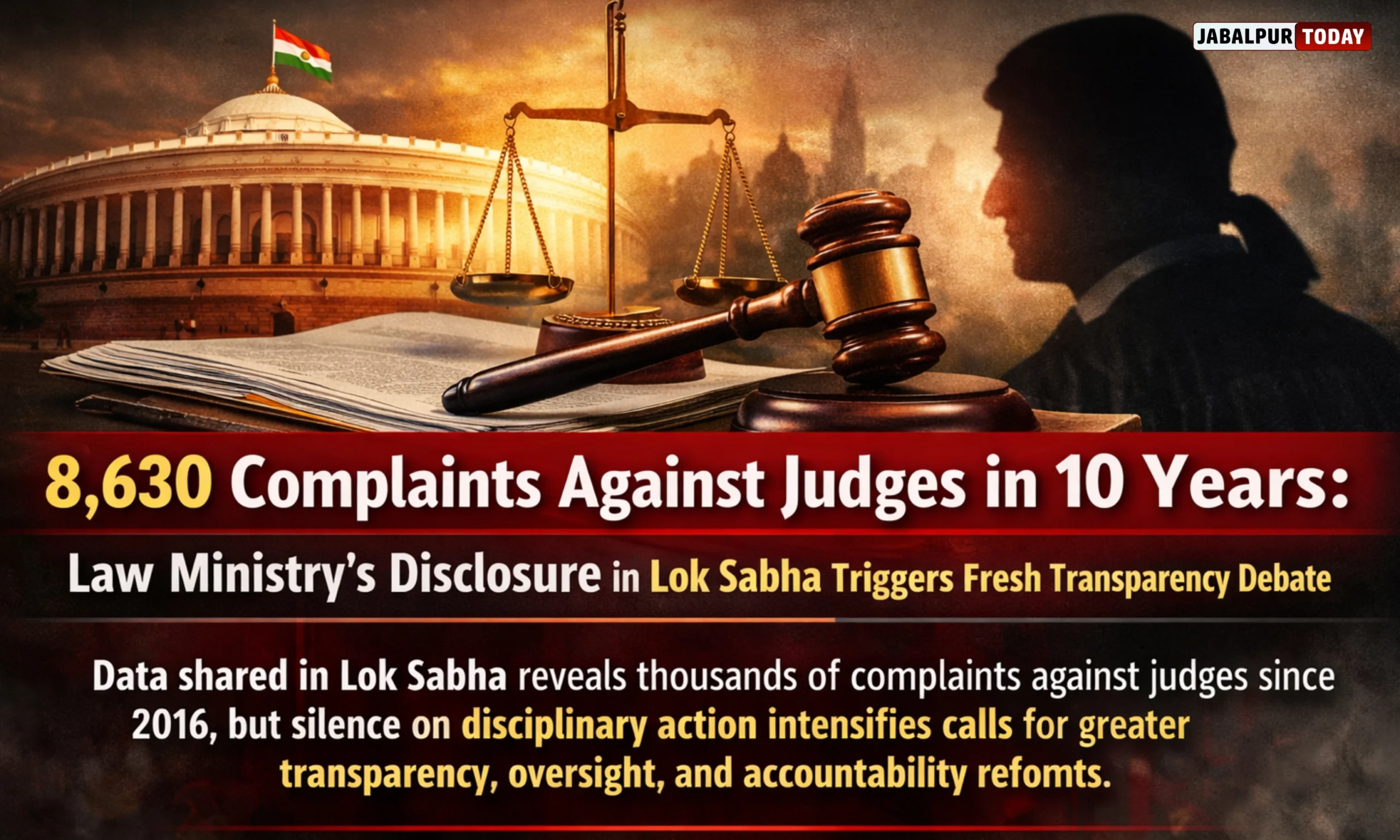
Data shared in Lok Sabha reveals thousands of complaints against judges since 2016, but silence on disciplinary action intensifies calls for greater transparency, oversight, and accountability reforms.
New Delhi: The office of the Chief Justice of India (CJI) received 8,630 complaints against sitting Supreme Court and High Court judges over the last 10 years (2016–2025). Arjun Ram Meghwal shared this information in the Lok Sabha on February 13, 2026.
Although many people have raised concerns about judges, the government did not disclose what action it took on these complaints.
This lack of clarity has triggered a fresh debate on transparency and accountability in the judiciary. The discussion has intensified after recent controversies, including the NCERT textbook issue related to alleged corruption in the judiciary.
How This Information Came Out
DMK MP Matheswaran VS revealed the data through a starred question, in which he sought details about complaints filed against judges and the process followed to handle them. In response, Minister Meghwal shared a year-wise list showing that people sent 8,630 complaints to the CJI’s office between 2016 and 2025.
Authorities rarely share such detailed figures publicly. Experts say that better digital access and growing public awareness about court procedures may have contributed to the rise in complaints in recent years.
Year-Wise Data: Complaints Over the Years
The number of complaints has gone up and down, but overall shows an increase, especially after 2022:
• 2016: 729
• 2017: 682
• 2018: 717
• 2019: 1,037
• 2020: 518 (lowest, likely due to COVID-19 lockdowns)
• 2021: 686
• 2022: 1,012
• 2023: 977
• 2024: 1,170 (highest)
• 2025: 1,102
Total: 8,630 complaints
The Law Ministry said the complaints include allegations such as misconduct, bias, delays in judgments, and other issues. However, no detailed breakdown or specific examples were shared.
How Complaints Are Handled
The Supreme Court of India adopted its “in-house procedure” in 1997 as part of the “Restatement of Values of Judicial Life” and handles complaints internally:
• The CJI examines complaints against Supreme Court judges.
• The respective Chief Justices handle complaints against judges of their High Courts.
If the government receives a complaint, it forwards the matter to the judiciary. Arjun Ram Meghwal stressed that the Constitution protects judicial independence and that the government does not interfere in the judiciary’s internal affairs.
However, the reply did not clarify whether records of outcomes are publicly available or whether any judge faced action.
Past Cases and Judicial Accountability
Questions about accountability in India’s judiciary are not new.
• Only two judges have faced impeachment proceedings: Justice V. Ramaswami (1993, motion failed) and Justice Soumitra Sen (2011, resigned before removal).
• In 2018, four Supreme Court judges held a rare press conference alleging issues in court administration.
• In 2024, there were calls for investigations into alleged bench-fixing in some cases.
Recently, in February 2026, a chapter on “corruption in judiciary” was removed from an NCERT Class 8 textbook after objections from the CJI, which again brought attention to how judicial issues are discussed in public.
Reactions from Different Groups
- Opposition Leaders:
DMK MP Matheswaran VS asked for a more structured oversight system. Congress leaders demanded revival of the National Judicial Appointments Commission (NJAC), which was struck down in 2015, to improve both appointments and accountability.
- Judicial Voices:
Some former Chief Justices, including Justice B. R. Gavai, have acknowledged that isolated cases of misconduct may occur but emphasized that the judiciary must regulate itself to protect its independence.
- Legal Experts:
Senior advocate Prashant Bhushan said the high number of complaints shows a lack of transparency and suggested creating an independent Judicial Complaints Commission.
Some Bar Council members defended the current in-house system, saying it works effectively but is confidential for valid reasons.
- Public and Activists:
On social media, many people demanded online tracking of complaints. RTI activists pointed out that such data is often denied under judicial exemption.
Key Concerns Raised
The disclosure has raised important questions:
1. Lack of Transparency:
Without information on what happened to the complaints, people do not know whether any action was taken. This affects public trust, especially when courts are handling over five crore pending cases.
2. Increase in Complaints:
Experts say the sharp rise in 2024 and 2025 may be due to post-COVID case backlogs and increased social media discussion of court decisions.
3. International Comparison:
In countries like the US, there are public Judicial Conduct Commissions. In the UK, a Judicial Conduct Investigations Office publishes annual reports. India’s system remains internal and confidential.
What Could Happen Next?
With discussions continuing in Parliament, opposition parties may push again for a Judicial Standards and Accountability Bill, which lapsed in 2012. Possible reforms could include:
• Mandatory annual reports on complaints
• Greater transparency in outcomes
• A mixed or independent oversight body
At a time when India is also facing more than 5,000 vacancies in the judiciary, many believe reforms are needed to improve both accountability and efficiency.
In a democracy where the judiciary is seen as the final protector of rights, these 8,630 complaints highlight one clear message: public trust depends on transparency as much as independence.

Mansi Sharma is a journalist covering Global Affairs, and wellness, known for turning complex ideas into sharp, engaging narratives. Her work is driven by curiosity, depth, and a constant urge to question and explore. When she’s not writing, you’ll often find her diving into new ideas—preferably with a cup of coffee in hand, one sip at a time.