

New Delhi, The Department of Science and Technology (DST), in collaboration with the Federation of Indian Chambers of Commerce and Industry (FICCI), hosted a high-level workshop to discuss the National Survey on Resources Devoted to Scientific and Technological (S&T) Activities for 2024-25. The event stressed the critical need for private sector involvement in sharing reliable data to strengthen India’s science, technology, and innovation framework.
Participants from government agencies, industry, research bodies, and international organizations emphasized that robust, comprehensive data is essential for evidence-based S&T policies. Dr. Arvind Kumar, Advisor and Head of the National Science, Technology & Management Information System (NSTMIS) at DST, urged industrial groups to actively contribute data, noting that higher response rates and data accuracy are vital for the survey’s effectiveness.
“In advanced economies, the corporate sector contributes 70-75% of gross R&D expenditures; in India, it accounts for about 36.5%,” Dr. Kumar said, pointing out that India’s R&D investment stands at around 0.64% of GDP. However, he highlighted positive trends, with gross expenditure on R&D (GERD) more than doubling from ₹60,196.8 crore in FY2010-11 to ₹127,381 crore in FY2020-21.
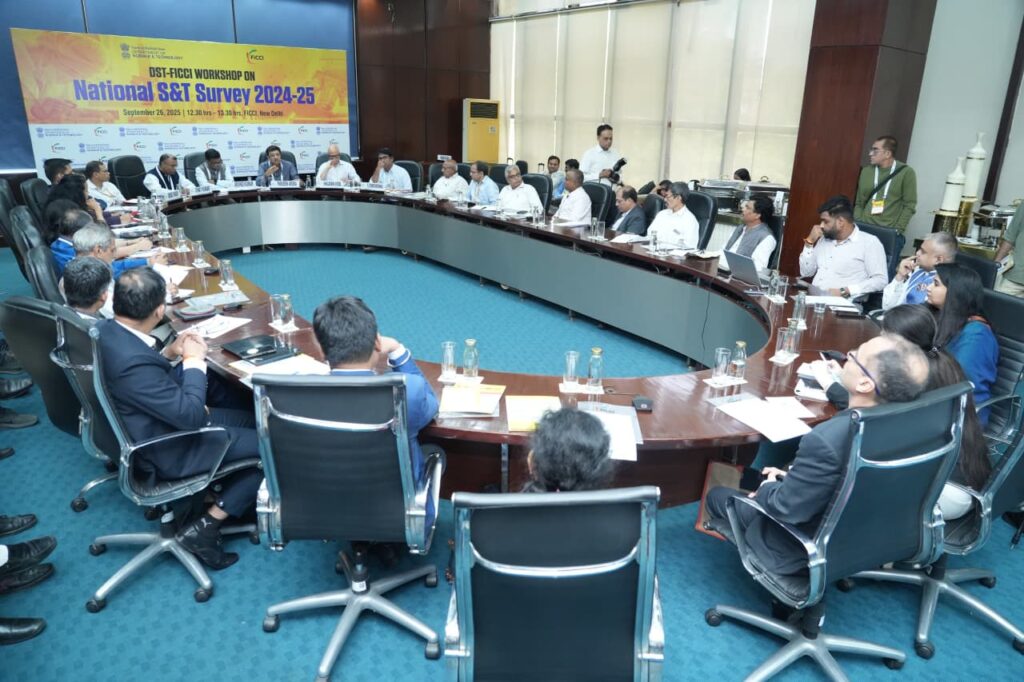
Dr. Kumar also spotlighted government initiatives to boost private sector innovation, including a proposed ₹1 lakh crore Research, Development & Innovation (RDI) Fund. This fund aims to provide long-term concessional financing to companies and startups in priority areas like energy transition, AI, robotics, quantum computing, bio-manufacturing, medical devices, and digital agriculture. By reducing risks in early-stage investments, it seeks to increase corporate contributions to GERD.
Shri Vinay Kumar, Head of the Industrial R&D Promotion Programme (IRDPP) at the Department of Scientific and Industrial Research (DSIR), reviewed ongoing efforts to encourage industrial R&D. He noted that while India has over 300,000 registered firms, only about 40,000 are tracked in the CMIE database—roughly 19,000 public and 21,000 private. He called on industry leaders to view data submission as a national duty.
Shailendra Sigdel, Regional Statistical Advisor at the UNESCO Institute for Statistics in New Delhi, discussed challenges in data collection for developing nations. He advocated for incentives to encourage providers and compliance with global standards like the Frascati Manual, warning that subpar data leads to unreliable outcomes.
Dr. Praveen Arora, former Head of NSTMIS, addressed India’s low R&D investment and limited private engagement. He encouraged companies to share data despite competitive concerns and suggested simplifying survey tools to boost participation.
Industry representatives shared their perspectives. Shri Sankalp Sinha, General Manager at IBM India, noted that despite India’s low per capita GDP, the country is approaching global R&D output benchmarks. He called for clearer definitions in R&D reporting and broader sharing of survey results to foster trust.
Shri S. Venkatakrishnan, CTO and Head of R&D at Forus Health, advocated for long-term investments in high-impact sectors. He emphasized that accurate data is key for both policy and industry growth, and incentives should frame data sharing as a collaborative effort rather than a chore.
Ayekansh Tyagi from Mankind Pharma outlined reasons for data sharing, potential motivators, and implementation strategies. He referenced China’s success through fiscal incentives, land grants, and supply chain advantages, urging India to protect its competitive position. Suggestions included tying data submission to grant access, using student interns for data collection, and conducting regular progress reviews.
The workshop ended with agreement that improving private sector participation and data quality in the National S&T Survey is crucial for evidence-driven policies, innovation, and India’s development goals.
The National Science and Technology Management Information System (NSTMIS) under DST conducts periodic surveys on S&T resources, primarily R&D, in India. These produce reports on national R&D indicators for policy and assessment.
The 2024-25 survey targets around 8,000 organizations, including public and private sectors, multinationals, higher education institutions, Scientific and Industrial Research Organizations (SIROs), and NGOs. It uses a structured questionnaire aligned with international standards, covering general information, S&T expenditures, and R&D manpower.
Conducted via a web-based platform for efficiency, the survey assigns unique usernames and passwords to respondents to ensure data authenticity.
