
US-Israel-Iran War Live Updates: Iran fires fresh missiles at Israel, Israel expands strikes into Lebanon, and a US submarine sinks an Iranian warship as the Middle East crisis deepens
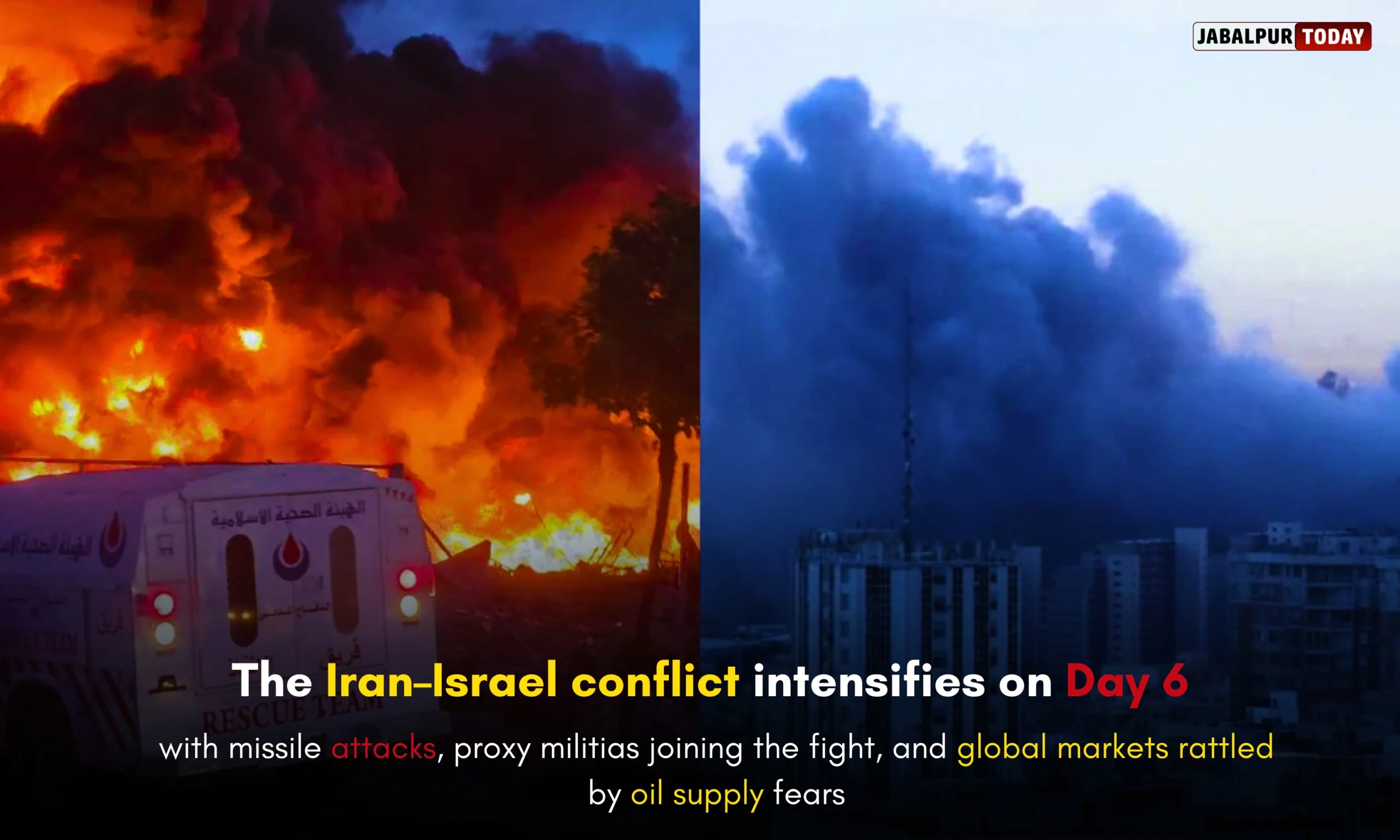
Delhi: The war between Iran and Israel has entered its sixth day, and the situation is becoming more dangerous. Early Thursday morning, Iran fired another wave of missiles that lit up the skies over Jerusalem. Some missiles managed to break through Israel’s strong air-defense system, killing at least four more people.
The conflict started after a joint US-Israel strike on Iran’s nuclear and missile facilities. Since then, it has turned into an intense aerial battle between the two sides. Militias connected to Iran have also started getting involved, and global markets are reacting with fear.
At the same time, a Kuwaiti oil tanker explosion has created a large oil spill in the Gulf. This spill is threatening marine life and major energy shipping routes. The incident shows that this conflict is not just between two countries—it could affect the entire world.
Unlike the secret “shadow wars” that happened in the past decade, this is now an open war. The conflict began after the assassination of Iran’s Supreme Leader Ali Khamenei, which shocked Iran’s leadership. With modern weapons like hypersonic missiles and limited defense supplies, many experts say the balance of deterrence is breaking down.
US President Donald Trump has promised to escalate the response, while Iran is mobilizing its “Axis of Resistance.” This raises a serious question: Could this war expand into a global conflict, or will it eventually force negotiations?
How the War Began: From First Strike to Full Conflict
The conflict started on February 28, 2026, when US and Israeli forces launched Operation Iron Resolve. More than 200 precision strikes hit Iran’s IRGC command centers, the Parchin military complex, and suspected nuclear sites near Natanz.
During these strikes, Ali Khamenei was killed inside a bunker in Tehran. Iranian state media confirmed his death, which shook the leadership of the Islamic Republic. Soon after, Iranian leaders promised “eternal revenge.”
Timeline of Events
Day 1 – Feb 28
The first attacks killed more than 150 IRGC commanders and members. Iran responded by launching about 150 drones, but most were intercepted.
Day 2 – Feb 29 to Mar 1
Lebanon-based Hezbollah fired about 300 rockets toward Israel. Meanwhile, the US Navy destroyed three Iranian speedboats in the Strait of Hormuz.
Day 3 – Mar 2
Cyberattacks knocked out parts of Tehran’s power grid. The Houthi movement launched attacks on Saudi oil facilities in support of Iran.
Day 4 – Mar 3
Israel carried out airstrikes on suburbs of Tehran. Iran fired 28 ballistic missiles that landed near Jerusalem’s outer areas.
Day 5 – Mar 4
Explosions were reported near the Al Udeid Air Base, a major US military base. President Donald Trump addressed the nation and said, “We’re just getting started.”
Day 6 – Mar 5 (Ongoing)
Around 40 missiles were fired from western Iran at dawn. Large secondary explosions were reported at the Parchin complex and were even visible from satellite images.
People on social media shared videos showing bright streaks of fire across the sky followed by ambulance sirens. Iranian state television also showed footage claiming successful interceptions, though reports online suggested a possible 600-missile attack, which remains unverified.
The Battlefield: Missiles, Air Defenses, and Proxy Forces
Iran used a mix of missiles, including Fateh-110 short-range ballistic missiles and longer-range Sejjil missiles. Some of these attacks managed to overwhelm parts of Israel’s air-defense network.
Israel’s Arrow-3 defense system intercepted about 85% of incoming missiles, but some low-trajectory attacks still got through.
The Institute for the Study of War warned that Israel’s interceptor missiles could run out within days if Iran continues firing at this pace. This could force Israel to launch deeper offensive strikes.
Iran’s Advantages
• Hypersonic-style missile maneuvers make detection difficult.
• Proxy groups such as Hezbollah and the Houthi movement stretch Israel’s defenses.
• More than 200 rockets were reportedly fired from Lebanon on Thursday.
Israel’s Response
Israel used F-35 stealth jets to strike Iranian Revolutionary Guard targets in northern Tehran. These strikes caused huge secondary explosions from weapons storage facilities.
Role of the United States
The US military’s CENTCOM command said there were no new casualties at American bases in the Gulf. Meanwhile, the aircraft carrier USS Gerald R. Ford (CVN 78) is positioned in the eastern Mediterranean and could join the conflict if it escalates.
Cyber warfare is also happening. Iranian hackers reportedly targeted Israel’s water systems, while operations linked to Israeli intelligence agency Mossad disrupted drone factories in Iran.
The Human Cost: Civilians Caught in the War
Beyond military strategy, the war’s real impact is being felt by civilians.
In Israel, emergency service Magen David Adom says 12 people have died since the conflict began, including 10 civilians. One family in a Jerusalem suburb died after shrapnel hit their home. More than 100 people have been injured, many suffering burns from drone debris.
Hospitals in Tehran are overwhelmed with victims of airstrikes. Authorities have asked the International Federation of Red Cross and Red Crescent Societies to help organize blood donation drives.
Growing Displacement
• Over 50,000 people in Lebanon have fled their homes due to fighting linked to Hezbollah.
• Several Gulf countries have started evacuating vulnerable groups.
• Ireland evacuated about 200 citizens from Dubai.
Global Reactions: World Leaders Respond
Leaders around the world have reacted strongly.
Donald Trump said during a briefing at Mar-a-Lago that Iran “started this conflict” and the United States would finish it.
Israeli Prime Minister Benjamin Netanyahu praised Israel’s air defenses but urged allies to cut Iran’s oil exports.
Russian President Vladimir Putin condemned the strikes, calling them “imperial aggression.”
Chinese President Xi Jinping called for restraint, which analysts interpret as quiet economic support for Iran.
UN Situation
An emergency meeting of the United Nations Security Council ended without a resolution. France has proposed sending international monitors to help enforce a ceasefire.
Gulf Region Concerns
• The United Arab Emirates and Qatar temporarily closed their airspace.
• Saudi Arabia is reportedly sharing intelligence with Israel.
India has about 18,000 citizens in the region. The government has started evacuation flights similar to the rescue operations during the Yemen conflict in 2020.
Economic Shockwaves: Oil and Markets React
A large explosion near Kuwait, believed to be caused by an Iranian sea mine, spilled about 20,000 barrels of oil into the Gulf. The accident pushed Brent crude prices up to $120 per barrel and disrupted about 10% of global oil tanker traffic.
Economic Impact
Energy
Oil prices have already risen by 25%. If the Strait of Hormuz closes, prices could reach $150 per barrel.
Stock Markets
The Dow Jones Industrial Average dropped about 3%. Technology sectors are also under pressure due to supply chain fears.
Impact on India
Fuel inflation could reach 15%, and the Indian rupee may weaken against the US dollar. The government may need to increase subsidies for LPG and diesel.
For people in Delhi, this could mean higher fuel prices and long queues at petrol pumps. Globally, it may speed up the transition toward renewable energy.
Also Read on jabalpur today: How Will the Iran-Israel-US War Affect India? Oil, Economy, and Diaspora at Risk

Mansi Sharma is a journalist covering Global Affairs, and wellness, known for turning complex ideas into sharp, engaging narratives. Her work is driven by curiosity, depth, and a constant urge to question and explore. When she’s not writing, you’ll often find her diving into new ideas—preferably with a cup of coffee in hand, one sip at a time.