
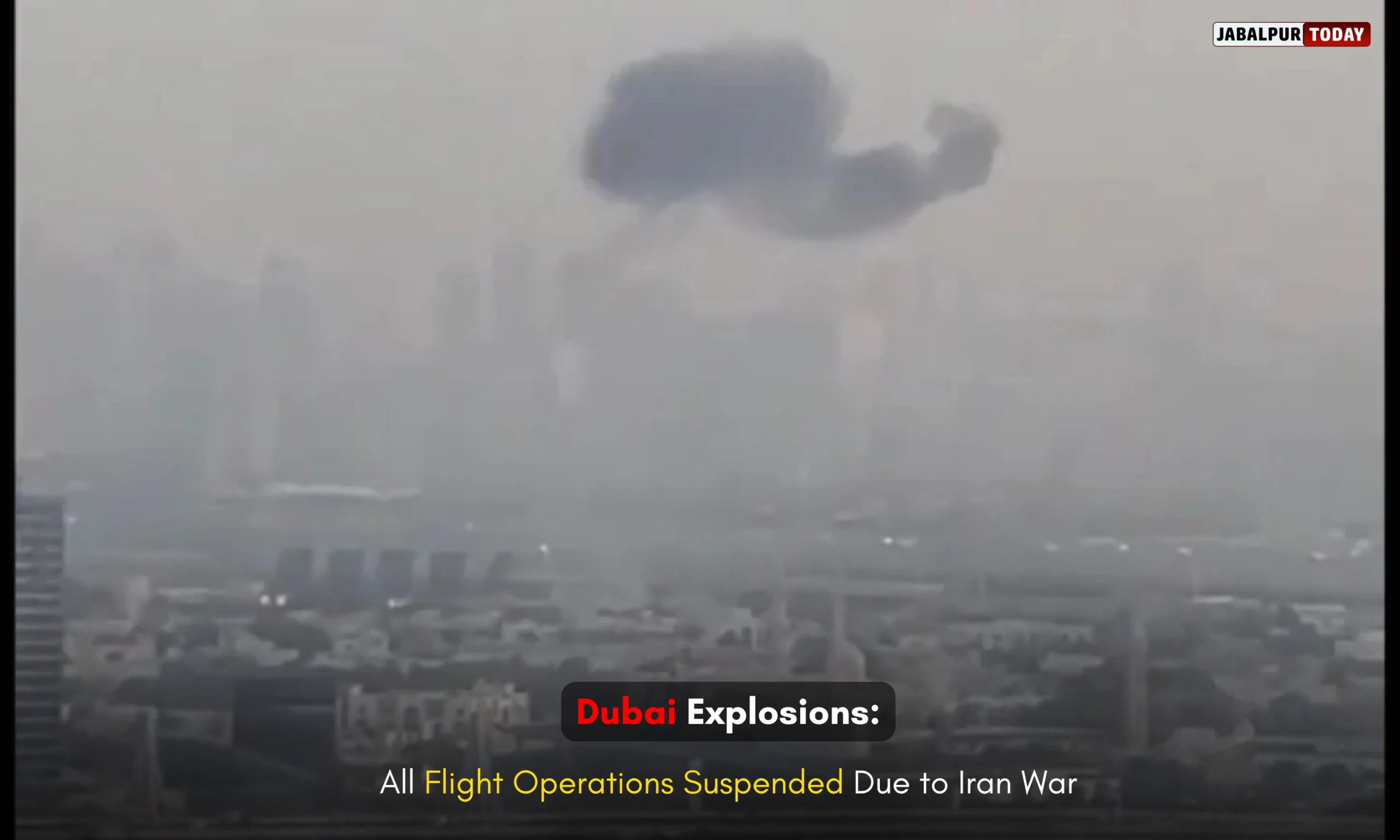
Explosions were heard in Dubai as debris from intercepted Iranian missiles fell near the city amid the ongoing Iran-Israel-US conflict. Flight operations at Dubai International Airport were temporarily suspended for safety.
Delhi/Duba: A tourist from Delhi in Dubai posted on X while holding a shaking phone: “Loud explosions near the airport – smoke everywhere, we’re evacuating!” On March 7, Dubai’s skies once again echoed with loud blasts. These explosions are being caused by debris from intercepted Iranian missiles during the escalating conflict between Iran and Israel, along with the United States. Since March 1, these “rain of fire” incidents have killed about 4–5 people, injured more than 100, and shaken the UAE’s image as a safe destination. Today, operations at Dubai International Airport were briefly stopped because of new explosions nearby.
There have been no direct strikes on famous landmarks like the Burj Khalifa. However, falling missile parts and shrapnel have started fires near places such as Palm Jumeirah, Burj Al Arab, and several port areas. For the more than 500,000 travelers from Delhi who visit the UAE every year, the situation has become stressful. Flights are delayed and many tourists are cutting their holidays short. Below is the full story, including how the war caused these explosions, what residents experienced, official responses, and why the situation could get worse.
The War Spark: How Iran-US/Israel Clashes Reached Dubai
The explosions are linked to Day 10 of the conflict between Iran and Israel/US. On February 28, airstrikes by Israel and the United States on Iran killed Supreme Leader Ali Khamenei and more than 150 members of the Islamic Revolutionary Guard Corps. The attacks targeted nuclear facilities. In response, Iran launched a major retaliation on March 1, firing more than 1,800 missiles and drones toward Gulf countries that host American bases, including the United Arab Emirates.
The UAE is officially neutral but strategically important because it hosts American military facilities such as the Al Dhafra Air Base. Although most incoming missiles were intercepted by air defenses, falling debris created panic across cities like Dubai and Abu Dhabi. The situation also worries India because around 3.5 million Indians live in the UAE. India’s Ministry of External Affairs has advised people to stay cautious.
War Triggers in Pointers
- Feb 28: US-Israel operation called “Operation Iron Resolve” strikes Tehran.
- March 1: Iran’s “Axis of Resistance” launches a massive missile and drone attack on UAE, Saudi Arabia, and Qatar.
- Ongoing: About 196 ballistic missiles and more than 1,000 drones have been fired toward the UAE.
- Why Dubai? It is a global commercial hub located near important military bases, making it a symbolic target.
Step-by-Step: Timeline of Dubai’s Explosions
The explosions began early on March 1 and continued with reports of blasts up to March 7. There has been no invasion of Dubai itself, but falling missile debris has caused fires and panic.
Daily Breakdown
- March 1 (2 AM): Air-raid sirens sound. Interceptions over the Gulf cause debris fires near Palm Jumeirah hotels, damage the facade of Burj Al Arab, and start a car fire near Dubai International Airport.
- March 2: Secondary blasts occur in industrial areas of Dubai and Sharjah. Four people die, including two Indians.
- March 3–5: Smoke rises over Jebel Ali Port. More than 100 people are injured by shrapnel.
- March 6: A quieter day, but UAE authorities report intercepting more than 1,000 drones.
- March 7 (Today): New explosions near Dubai International Airport cause evacuations and temporary suspension of flights, with about 5% cancellations.
Television footage shows bright flashes from missile interceptions and thick smoke in the sky. Residents described it as a night that suddenly “turned into day.”
Voices from the Ground: Residents and Expats Share Their Fear
Dubai has more than 3 million expatriates, including around one million Indians. Many experienced the frightening situation firsthand. A migrant worker from Delhi living in Jebel Ali said the explosion shook their dormitory building and they thought it was a bomb.
Tourists staying near Burj Al Arab ran outside when windows shattered during a nearby blast. Social media posts with the hashtag #DubaiExplosions have crossed 10,000 since March 1, showing videos of smoke and emergency evacuations. One Indian resident wrote that their family in Delhi kept calling them because they were worried.
Eyewitness Accounts
- Residents: Sirens sounded every 20 minutes, and children were crying in fear.
- Tourists: A group from Delhi ended their trip early after their flight was delayed by six hours.
- Migrant workers: Some Indian laborers were injured by debris, and two reportedly died. Indian authorities have opened helplines for families.
Flights between Delhi and the UAE, which normally operate around 50 times a day, are facing delays. Travel agencies report about a 10% increase in cancellations.
Expert Warnings: Could the War Spread?
Security analysts say the debris incidents show how even nearby countries can be affected by a larger war. Some experts believe the conflict could expand if Gulf countries respond militarily.
For India, the situation is important because millions of Indian citizens live and work in the UAE. Trade between India and the UAE, worth about $100 billion, could also be affected.
Possible Scenarios
- De-escalation (40% chance): Diplomatic talks reduce tensions.
- Wider war (50% chance): UAE or other Gulf countries strike Iranian targets.
- Direct impact on India (10%): Large-scale evacuation of Indian citizens.
Experts say stronger fact-checking systems and better public awareness can help prevent panic during such crises.

Prateeksha Kumari is a journalist and strategic communications professional specialising in digital journalism, political reporting, and public affairs. Her work focuses on grassroots issues, governance, and civic developments, with an emphasis on clarity, accuracy, and narrative-driven reporting.
She holds a Master’s degree in Journalism and Mass Communication from Himachal Pradesh University, Shimla and has qualified the UGC-NET examination, reflecting her academic grounding in media studies and communication research. Her reporting spans politics, public policy, health, education, and socio-economic issues, and she is experienced in bilingual (Hindi and English) content creation tailored to diverse audiences.
Alongside her journalistic work, she brings experience in political communication and public relations, where she has contributed to campaign messaging, media outreach, and narrative building. She has worked on integrated communication strategies across print and digital platforms, combining editorial judgment with audience insight and data-led content approaches.