
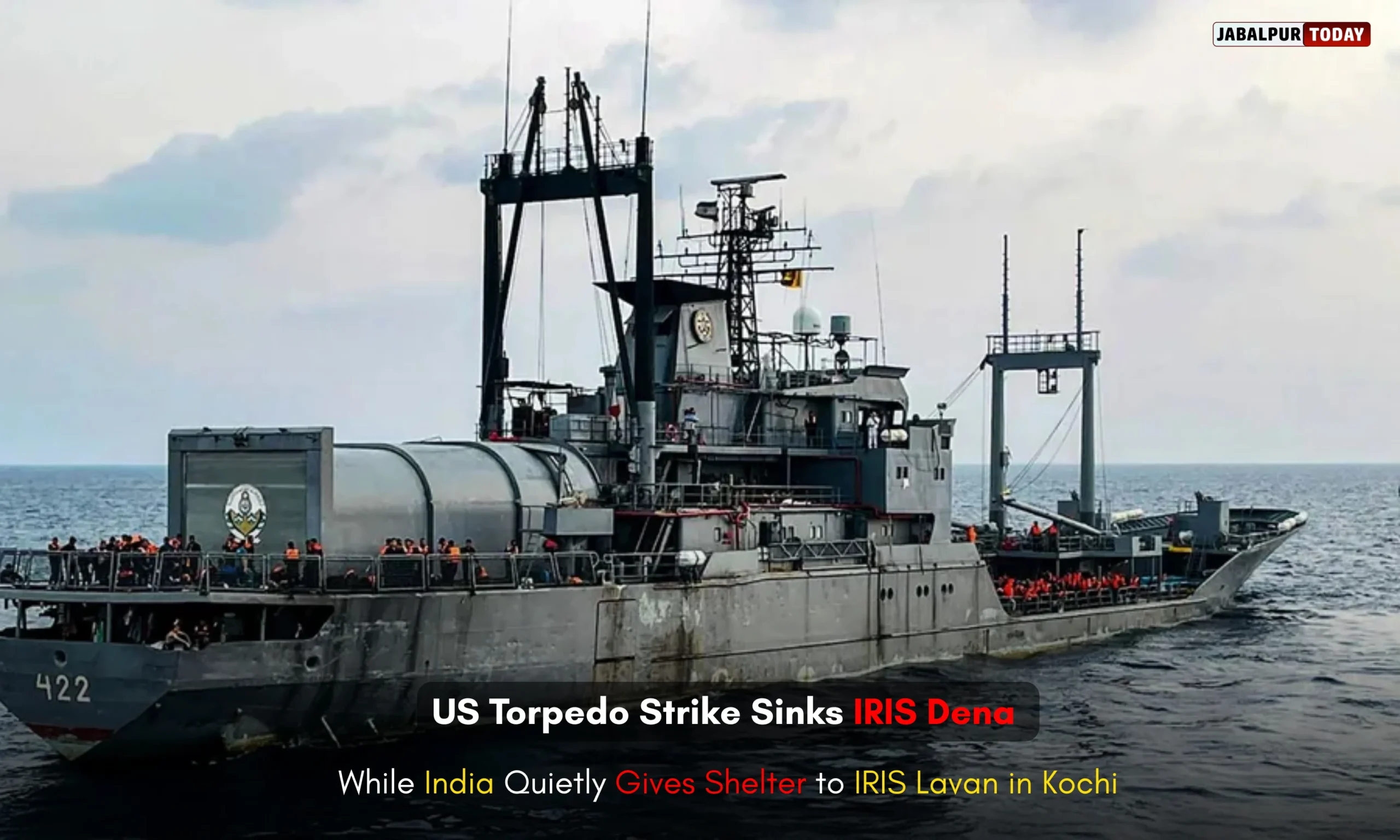
India quietly shelters an Iranian naval ship in Kochi while the US sinks another near Sri Lanka. Explore the timeline, rescue operations, geopolitical implications, and India’s delicate diplomatic balancing in the Indian Ocean crisis
New Delhi: On the same day a United States submarine torpedoed and sank the Iranian warship IRIS Dena in the Indian Ocean, killing at least 87 sailors, another Iranian naval vessel — IRIS Lavan — quietly arrived at Kochi port in India. The ship later docked there. All 183 crew members of the ship were safely accommodated by Indian authorities.
Global attention focused on the US attack. It marked the first time since World War II that a US submarine sank an enemy warship in combat. Meanwhile, India quietly offered refuge to an Iranian vessel as a humanitarian step. This move shows India’s careful diplomatic balancing during the growing US–Israel–Iran conflict.
The Coincidence of March 4, 2026
The Iranian frigate sank in international waters early on March 4. The location was about 40 nautical miles from Galle, Sri Lanka.
Sri Lanka’s Navy received a distress signal at 05:08 local time and started rescue operations. They recovered 87 bodies and rescued 32 survivors.
India, which shares the same Search and Rescue (SAR) region, quickly sent help. The Indian Navy deployed a Boeing P-8I Poseidon for the rescue effort. It also sent naval ships INS Tarangini and INS Ikshak from Kochi.
At almost the same time, IRIS Lavan arrived at Kochi port. India had granted the ship emergency permission a few days earlier.
IRIS Dena: From Indian Naval Exercise to Deadly Attack
The IRIS Dena was a modern Moudge-class frigate, commissioned in 2021 and equipped with missiles, torpedoes, and naval guns.
The ship had recently taken part in MILAN 2026 and the International Fleet Review 2026, which were hosted in Visakhapatnam from February 15 to February 25.
After the exercises ended, the ship left Indian waters on February 25–26 and began its journey back to Bandar Abbas. Iran said the ship was travelling home as an “unarmed and unloaded ceremonial guest” of the Indian Navy.
Iran’s Foreign Minister Abbas Araghchi called the attack “an atrocity at sea, 2,000 miles from Iran’s shores” and warned that the United States would “bitterly regret” the strike.
The United States confirmed that the attack was carried out by the USS Charlotte (SSN 766), which fired a Mark 48 torpedo.
US Defence Secretary Pete Hegseth bluntly described the strike, saying the Iranian ship believed it was safe in international waters, but a torpedo suddenly destroyed it.
This was the first time in about 80 years that a US submarine had sunk an enemy warship in combat.
India’s Humanitarian Move: IRIS Lavan Allowed to Dock in Kochi
While a torpedo destroyed IRIS Dena, India quietly gave refuge to another Iranian naval ship, IRIS Lavan, which had also taken part in the MILAN 2026 exercise.
Government sources say the following events took place:
• February 28, 2026: As US-Israel strikes against Iran intensified, Iran requested urgent docking permission for the ship in Kochi, saying it had technical problems.
• March 1: Indian authorities approved the request.
• March 4: The ship arrived and docked at Kochi. All 183 crew members are currently staying at Indian naval facilities.
This means three Iranian naval vessels were affected by the crisis:
• IRIS Dena – sunk by the US
• IRIS Bushehr – detained in Sri Lanka under international maritime law
• IRIS Lavan – given safe shelter in Kochi
Timeline of Events
February 15–25:
Both IRIS Dena and IRIS Lavan take part in MILAN 2026 and the International Fleet Review in Visakhapatnam.
25–26 February:
IRIS Dena leaves Indian waters to return to Iran.
February 28:
Iran asks India for emergency docking permission for IRIS Lavan due to technical problems.
March 1:
India approves the docking request.
March 4 (early morning):
IRIS Dena is torpedoed near Sri Lanka.
IRIS Lavan arrives at Kochi port.
India launches rescue operations.
March 4 onward:
The 183 crew members of IRIS Lavan remain in Kochi under Indian protection while Sri Lanka recovers bodies and survivors from IRIS Dena.
India’s Rescue Efforts and Official Position
The Indian Navy quickly supported Sri Lanka’s rescue operations by sending aircraft and ships to the area. A navy statement said that search and rescue operations were continuing in coordination with Sri Lankan authorities.
India has not officially criticised the United States for the attack. The Ministry of External Affairs has remained cautious and focused mainly on rescue operations and the welfare of sailors.
However, opposition parties such as the Indian National Congress have criticised the government. Critics said India was avoiding its responsibility as a maritime power, especially since the Iranian sailors had recently attended Indian naval exercises as honoured guests.
What This Means for India’s Indian Ocean Strategy
By rescuing sailors from IRIS Dena and giving shelter to IRIS Lavan, India has tried to show its strategic independence.
This approach helps India present itself as a responsible and humanitarian power in the Indian Ocean. Smaller countries in the region may see this as an example of balanced diplomacy.
However, the move could also create quiet tension with the United States at a time when the 2026 Iran conflict is expanding.
As Iran prepares to receive the bodies of sailors from IRIS Dena and India protects the crew of IRIS Lavan in Kochi, one thing is clear: amid the growing conflict between the United States and Iran, India has chosen a path of humanitarian diplomacy even as military tensions continue across the Indian Ocean.
