
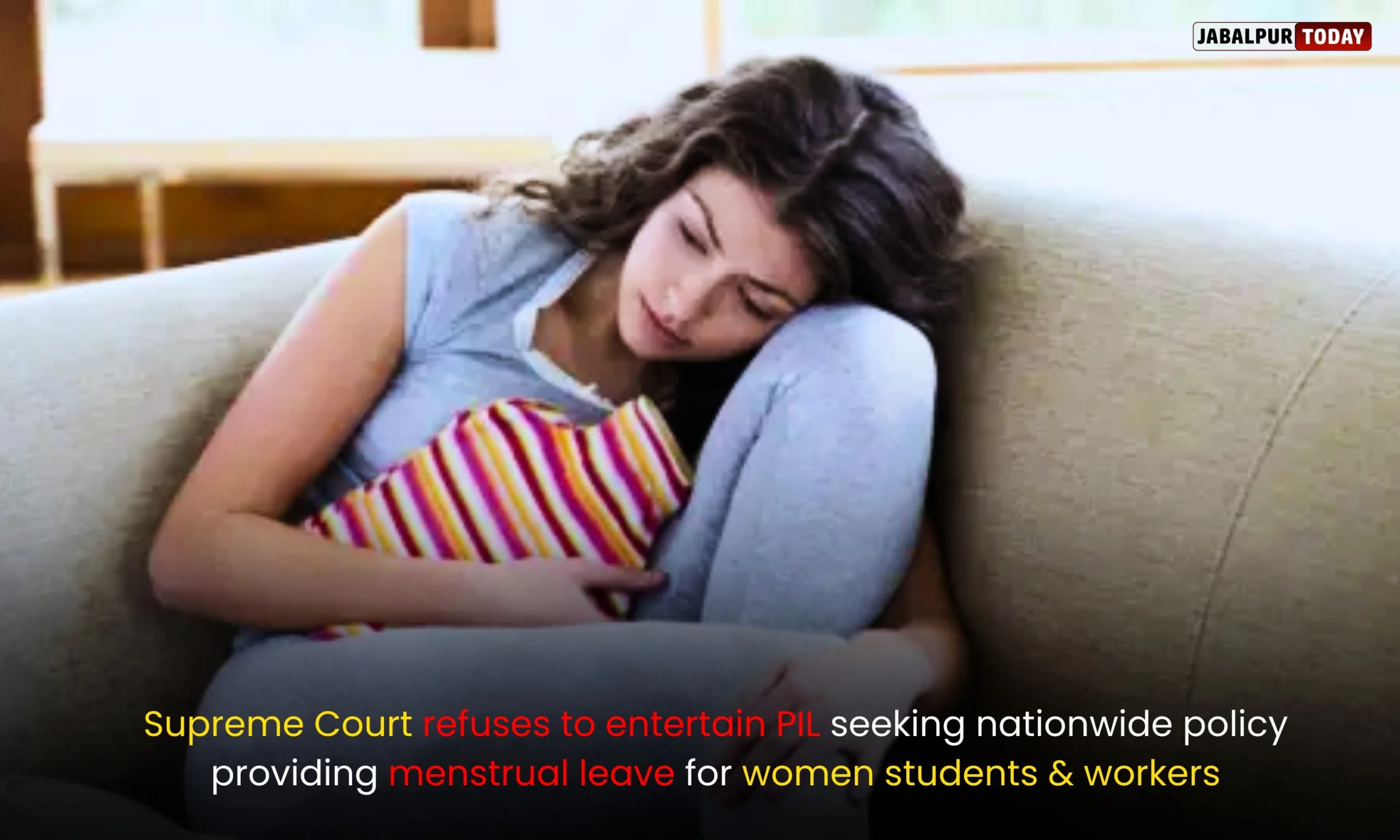
The Supreme Court has again rejected a plea for mandatory menstrual leave, urging the Centre to examine the issue through consultation with stakeholders instead of court intervention
New Delhi: The Supreme Court of India has refused to order a nationwide compulsory paid menstrual leave policy for the third time. The court said that making such leave mandatory through law could harm women’s job opportunities and reinforce gender stereotypes.
Instead of directing a compulsory rule, the court disposed of the petition and asked the Union government to consider creating a balanced policy after consulting all stakeholders.
Third Attempt by the Same Petitioner
The petition was filed by advocate Shailendra Mani Tripathi under Diary No. 73736-2025 in the case Shailendra Mani Tripathi v. Secretary, Ministry of Women and Child Development, Union of India and Others.
Tripathi requested the court to direct the central government, states and Union Territories to introduce laws or policies granting paid menstrual leave to working women and female students suffering from menstrual pain.
The plea also mentioned conditions such as dysmenorrhea, endometriosis, uterine fibroids, adenomyosis and pelvic inflammatory disease.
He argued that menstrual leave relates to the right to equality (Article 14) and the right to dignity and life (Article 21) under the Constitution, and urged the court to exercise its powers under Articles 32, 141 and 142 to address the legislative gap.
This marked the third time Tripathi approached the court on the same issue.
• In February 2023, the court disposed of the first petition and allowed him to submit a representation to the Ministry of Women and Child Development.
• In July 2024, after he returned claiming there was no response, the court again disposed of the matter and asked the Union government to take a policy decision.
• On March 13, 2026, the court disposed of the petition for the third time with a similar direction.
Bench Questions the Petition
A bench led by Surya Kant and Joymalya Bagchi heard the case.
Senior advocate M R Shamshad represented the petitioner and pointed out that some governments and institutions already provide menstrual leave voluntarily.
Examples included policies in Bihar, Karnataka and Odisha for employees, relaxations in schools in Kerala, and menstrual leave offered by some universities and private organisations.
However, the bench questioned the petitioner’s locus standi, noting that no woman had approached the court directly on the issue.
Court’s Core Concern: Impact on Women’s Careers
The bench made a clear distinction between voluntary policies and mandatory legislation.
CJI Surya Kant said that if employers choose to provide menstrual leave voluntarily, it is a positive step. But making it compulsory by law could have unintended consequences for women’s employment.
He warned that employers might hesitate to hire women or assign them important responsibilities if such leave becomes legally mandatory.
Justice Joymalya Bagchi also highlighted the practical reality of the job market, noting that employers often consider productivity and costs when making hiring decisions.
The court further cautioned that such policies, if framed incorrectly, could unintentionally reinforce stereotypes about women.
Court’s Final Order
The Supreme Court did not issue any order making menstrual leave mandatory.
Instead, it directed the government to examine the petitioner’s earlier representation and consider developing a policy after consulting all stakeholders.
The court said the petitioner had already raised the issue and done what was necessary, adding that repeatedly approaching the court was not required.
The Bigger Picture: Voices from Working Women
The debate around menstrual leave is not only legal but also deeply connected to the everyday experiences of working women.
Amulya, an executive working in PR Guru, a PR agency, says that some private workplaces have already adopted supportive policies. “In my agency, we do get menstrual leave, and it really helps during difficult days. But I don’t understand why the government still hasn’t introduced a broader policy. If some companies can recognise the need, there should at least be a discussion at the national level,” she said.
Journalist Prateeksha believes the conversation should focus on balancing health needs with workplace equality. “Menstrual pain is real, and many women silently work through it because they have no choice. The debate should not be about whether women are capable or not — it should be about whether workplaces can become more understanding without creating bias against hiring women,” she said.
Rights vs Workplace Reality
The issue of menstrual leave continues to spark debate across India.
Several state governments and private organisations have already introduced voluntary policies, but there is no nationwide law requiring menstrual leave.
The Supreme Court of India has repeatedly said that framing such a policy is the responsibility of the government and must balance women’s dignity with their equal participation in the workforce. By rejecting compulsory legislation for the third time while leaving the door open for a consultative policy, the court has signalled a clear message: any national framework must carefully consider both women’s health needs and their long-term career opportunities.
The Union government is now expected to review Tripathi’s earlier proposals and consult women employees, employers, states and experts before deciding on any national policy.

Mansi Sharma is a journalist covering Global Affairs, and wellness, known for turning complex ideas into sharp, engaging narratives. Her work is driven by curiosity, depth, and a constant urge to question and explore. When she’s not writing, you’ll often find her diving into new ideas—preferably with a cup of coffee in hand, one sip at a time.