
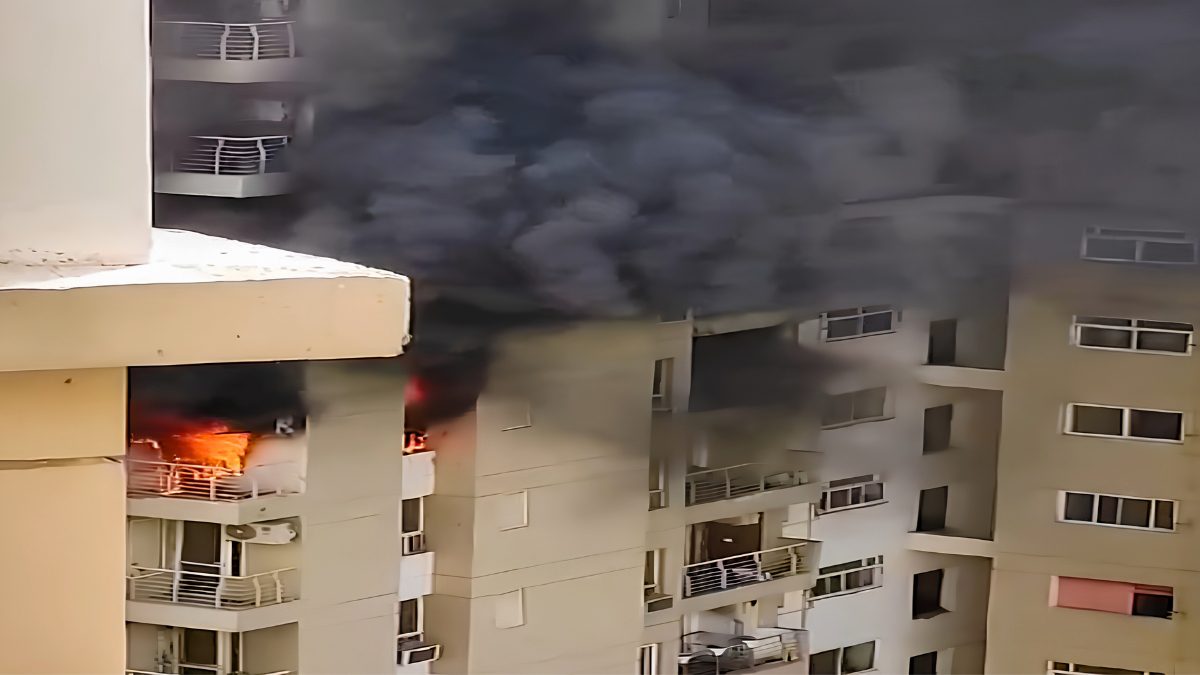
Around half a dozen fire tenders rushed to Aranya Society after a suspected AC blast triggered a fire on the 21st floor. Firefighters launched rescue and firefighting operations immediately
New Delhi: On the morning of Monday, June 29, 2026, a major fire broke out in a flat on the 21st floor of Aranya Society in Sector 119, Noida, sending residents into panic. While most reports identified the affected apartment as being on the 21st floor, one report mentioned the 22nd floor. Thick smoke and towering flames quickly engulfed the flat and became visible from nearby buildings, prompting frightened residents to evacuate as emergency teams rushed to the scene.
According to initial reports, a suspected explosion or blast in an air conditioning unit inside the flat started the fire. Firefighters reached the spot quickly with around six fire tenders. Teams, including the Chief Fire Officer of Gautam Buddh Nagar, worked continuously to control the flames. At one stage, firefighters even sprayed water from the balcony of a neighboring flat to reach the burning apartment.
Officials have not reported any deaths, injuries, or people trapped inside the building so far. Rescue and relief teams continued their work, and authorities confirmed that the fire remained limited to the affected flat and did not spread to other parts of the building. Uttar Pradesh Chief Minister Yogi Adityanath immediately reviewed the situation and instructed officials to speed up rescue operations, provide medical treatment if anyone needed it, and stay alert until the situation became completely safe.
This incident follows several similar cases in recent months. However, because this fire occurred on a very high floor, it highlighted the unique challenges of handling emergencies in high-rise buildings.
Timeline of Events
Morning Alert: Authorities received reports of the fire during the morning. Residents saw smoke and flames suddenly coming out of a flat on the upper floor.
Emergency Response: Around six fire tenders reached the society quickly. Firefighters focused on controlling the fire. Since external equipment could not reach the affected floor easily, teams entered neighboring flats to fight the fire from a better position.
Evacuation and Control: Residents from the affected tower and nearby areas safely evacuated the building through staircases. Authorities did not report any major injuries or anyone getting trapped.
Official Intervention: Chief Minister Yogi Adityanath reviewed the situation and instructed officials to respond quickly and continue monitoring the incident.
Authorities are still investigating the exact cause of the fire. However, their initial findings suggest that a blast in the AC unit most likely triggered the incident.
Recurring Threat: AC Units as Fire Hazards in Noida
This fire is not an isolated incident. Noida has witnessed several AC-related fires in recent months. Just a few weeks earlier, on June 5, 2026, another major fire broke out on the 12th floor of Ivy County Society in Sector 75. Reports linked that fire to an AC short circuit or malfunction. Thick black smoke and flames spread across parts of the 28-storey tower, forcing residents to evacuate the building. During that incident, firefighters struggled because their hoses could not reach the upper floors, exposing the limitations of available equipment.
Other similar incidents include:
• Fires in Sector 52 and several other residential societies.
• A May 2026 fire on the 27th floor of the same Ivy County Society, which also started because of an AC short circuit.
• Reports that mention dozens of AC-related fires in Noida in recent months. Most of these incidents reportedly happened because people heavily used ACs during peak summer, units were poorly maintained, or installations were faulty.
A major national incident also brought attention to this issue. A suspected AC blast in South Delhi caused the death of a retired IAS officer, raising serious concerns about the safety of air conditioning units.
These incidents reveal a common pattern. Rapid urban development, heavy dependence on air conditioners during India’s extreme summers, and poor maintenance or varying quality of electrical appliances continue to increase fire risks in high-rise buildings.
Firefighting Challenges in High-Rise Noida
Noida’s skyline now includes many residential towers that rise above 20 to 30 floors. Builders install fire safety systems such as sprinklers, fire alarms, and fire department approvals during construction. However, real emergency situations often expose important gaps.
Reach Limitations: Traditional fire tenders and water hoses often cannot effectively reach floors above the sixth to tenth level without special aerial equipment or access from inside the building. Firefighters faced this challenge during the Ivy County incident, and similar difficulties appeared during the Aranya Society fire.
Internal Systems: Residents usually rely on staircases for evacuation because authorities generally avoid using lifts during fires. Buildings also depend on smoke management systems, fire alarms, and regular emergency drills to improve safety.
Response Coordination: Authorities quickly deployed multiple fire tenders and senior officers during the Aranya Society incident, helping reduce the risk. However, handling fires on upper floors for long periods requires advanced equipment such as taller hydraulic ladders and firefighting drones.
The Aranya Society fire did not cause any major casualties, showing that the quick response and residents’ awareness helped prevent a bigger tragedy. Even so, repeated incidents show that authorities need to strengthen the overall system.
Resident Perspectives and Safety Realities
People living in high-rise societies like Sector 119 spend large amounts of money to buy premium homes and naturally expect strong safety measures. After incidents like this, residents usually raise several important questions:
Are AC units and electrical systems receiving regular maintenance?
Are the building’s fire suppression systems working properly?
Does the society conduct fire mock drills regularly?
After builders hand over the society, who remains responsible for fire safety—the builder, the Apartment Owners’ Association (AOA), or government authorities?
In the Aranya Society incident, the fact that no injuries have been reported brings relief. However, the fire also reminds families, especially those with elderly members and children, to stay prepared for emergencies.
Broader Context: Noida’s Urban Growth and Safety Imperatives
Noida continues to grow as a major residential and commercial hub, with more high-rise buildings coming up every year. During the summer months, residents use air conditioners for longer hours, increasing the chances of electrical overloads and AC-related fires.
The government already has rules such as fire NOCs and safety audits. However, authorities continue to face questions about proper enforcement and regular compliance after people move into these buildings.
Experts and resident welfare groups recommend several steps:
• Invest in modern firefighting equipment such as higher-reach hydraulic ladders and firefighting drones.
• Conduct stricter annual safety audits and independent third-party inspections.
• Make regular AC and electrical maintenance mandatory.
• Educate residents about fire safety and emergency response.
Chief Minister Yogi Adityanath has issued strong directions in this case and earlier incidents, showing that the administration is paying attention. However, preventing future fires will require close cooperation between the government, builders, housing societies, and residents.
Authorities continue to investigate the Aranya Society fire. Several important questions still remain. Was the AC unit properly maintained? Did the building’s fire safety systems work as designed? What more can authorities and housing societies do to reduce the risk of similar fires in Noida’s high-rise buildings?
Although firefighters successfully controlled this fire, the incident clearly shows that authorities cannot rely only on emergency response after a fire starts. As Noida continues to build more high-rise towers, stronger technology, stricter enforcement of safety rules, regular maintenance, and greater awareness among residents will decide whether the city’s skyline represents safe progress or growing vulnerability.
