
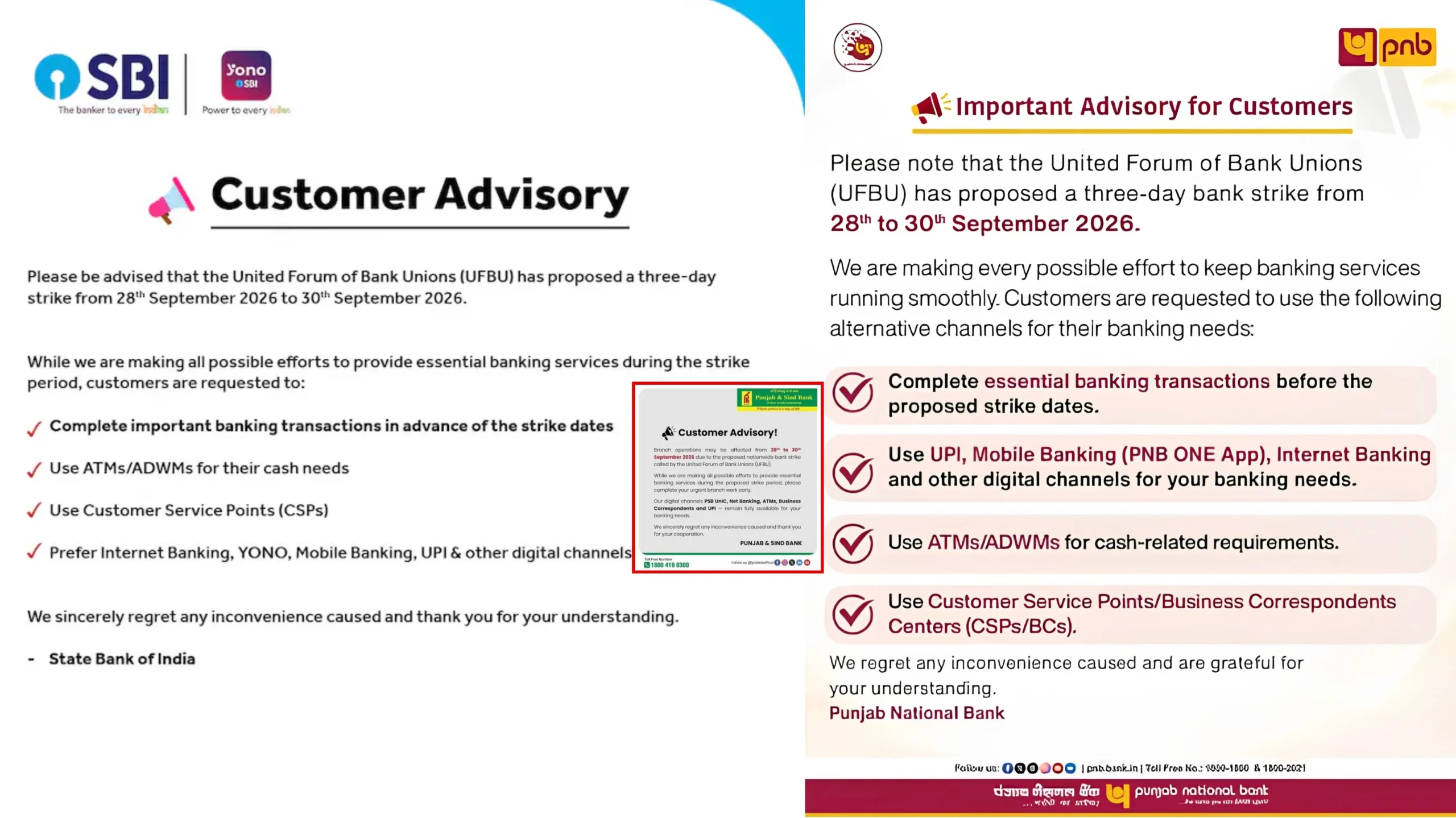
Bank Strike: SBI and other public sector banks will open on Sunday ahead of the September 28-30 strike, giving customers an extra day to complete branch work as digital services remain available
New Delhi: India’s public sector banks and regional rural banks will open their branches on Sunday, September 27, 2026, under a special arrangement approved by the Reserve Bank of India. The move will give customers one extra working day before a three-day nationwide bank strike called by the United Forum of Bank Unions (UFBU) from September 28 to 30.
The strike comes immediately after the regular fourth Saturday holiday on September 26. Without the Sunday opening, customers of public sector banks could have faced limited or no branch access for five consecutive days. The Finance Ministry directed Public Sector Banks (PSBs) and Regional Rural Banks (RRBs) to operate normally on September 27 to prevent this extended disruption.
This article explains the main reasons behind the strike, the exact calendar, the banks affected, the services that will and will not work, advisories issued by SBI and other banks, advance salary and pension payments for central government employees, the importance of the half-yearly closing on September 30, and the steps customers should take from Friday, September 25.
Why Bank Unions Are Striking: The Main Demands
The United Forum of Bank Unions, which represents around 90 percent of bank officers and staff across public sector, regional rural and some other banks, has called the three-day strike mainly over the long-pending demand for a five-day banking week.
At present, bank branches remain closed on the second and fourth Saturdays of every month. Unions want all Saturdays to become holidays under the Negotiable Instruments Act, which would make banking a full Monday-to-Friday operation.
Unions say earlier bipartite settlements agreed to the idea in principle. They also point to the March 2024 wage settlement and the Joint Note dated March 8, 2024, which followed an understanding reached with the Indian Banks’ Association in December 2023.
To compensate for the lost Saturday working hours, unions have offered to extend working hours by 40 minutes on each weekday. They also point out that the RBI, LIC, GIC, stock exchanges and most government offices already follow a five-day working week.
The revised Performance Linked Incentive (PLI) scheme has also become a major point of disagreement. Unions opposed what they described as a unilateral and discriminatory formula that gave an advantage to higher-scale officers. The government has since kept the PLI scheme in abeyance.
Other pending demands include pension updation and improvements, a common dearness allowance formula for all pensioners and an option for National Pension System subscribers to move to the Old Pension Scheme.
Conciliation meetings, including one held before the Deputy Chief Labour Commissioner around September 22, failed to produce a firm commitment on five-day banking. UFBU therefore confirmed that the strike would go ahead. The unions have also kept the possibility of an indefinite strike from October 26 if the demands remain unresolved.
Exact Calendar: What Happens Each Day
- Friday, September 25, 2026: Normal working day and the last regular opportunity for most customers to complete branch work before the weekend and strike.
- Saturday, September 26: Fourth Saturday and a regular bank holiday nationwide.
- Sunday, September 27: Special working day for Public Sector Banks and Regional Rural Banks. Branches, offices, ATM-linked branches and currency chests will operate normally under the special arrangement. SBI has specifically confirmed that all its branches will remain open and function as usual.
- Monday, September 28 to Wednesday, September 30: Strike days. Branch and office services at participating banks are expected to face major disruption or remain closed.
- Wednesday, September 30: The day also marks the half-yearly closing of banks. Banks use this date for important reconciliation, provisioning, treasury operations and market-related activities.
Private sector banks are generally expected to remain operational. However, individual branches could experience different levels of impact depending on local union participation.
Which Banks Will Be Most Affected?
The strike mainly targets public sector banks. India has 12 public sector banks:
- State Bank of India
- Bank of Baroda
- Punjab National Bank
- Canara Bank
- Union Bank of India
- Bank of India
- Indian Bank
- Central Bank of India
- Bank of Maharashtra
- Indian Overseas Bank
- UCO Bank
- Punjab & Sind Bank
Regional Rural Banks are also covered by the arrangements.
Private banks such as HDFC Bank, ICICI Bank, Axis Bank, Kotak Mahindra Bank and others are not core members of UFBU in the same way and are expected to operate largely normally. However, customers should still check with their individual bank or branch for any local impact.
Which Banking Services Will Work and Which May Face Disruption?
Services that require employees at physical branches face the highest risk of disruption. These include:
- Cash deposits and withdrawals at bank counters
- Cheque deposits, clearing and processing
- Demand draft issuance
- Locker operations
- Account opening or modification that requires physical verification
- Loan-related documentation
- Certain government scheme transactions
Digital and automated banking services are expected to continue operating. These include:
- ATMs and Automated Deposit and Withdrawal Machines (ADWMs)
- UPI
- IMPS
- NEFT
- RTGS, subject to normal system availability
- Internet banking
- Mobile banking apps
- SBI YONO and similar apps offered by other banks
- Customer Service Points (CSPs)
- Business Correspondents
- Debit and credit card payments at PoS terminals and online
SBI, Canara Bank, Bank of Baroda and other banks have issued customer advisories asking customers to complete important branch-related work in advance and use alternative digital channels during the strike.
ATM cash availability will depend on how much cash banks load into machines before the strike. Customers who need cash should therefore withdraw it early instead of waiting until the last moment.
Advance Salary and Pension Payments for Central Government Employees
The Controller General of Accounts under the Finance Ministry has ordered the advance payment of September 2026 salaries, wages and pensions for Central Government employees and pensioners, including personnel associated with Defence, Posts and Telecommunications.
The payments will be made on Friday, September 25. Authorities will treat these as advance payments and adjust them against the employees’ or pensioners’ final entitlement.
The measure aims to ensure that government employees and pensioners receive their funds before the three-day bank strike begins.
What Customers Should Do Today and on Sunday
Friday, September 25, is the last normal working day before the special Sunday opening and the strike. Customers should prioritise the following:
- Complete time-sensitive branch transactions, including large cash deposits or withdrawals, cheque deposits that require clearing before month-end, loan EMIs or documentation, KYC updates, locker access and account-related formalities that cannot be completed online.
- Check your account balance, pending cheques and upcoming auto-debit schedules.
- Keep enough cash for the next few days if you depend on branch withdrawals.
- Check that your internet banking, mobile banking app and UPI services are active. Make sure you have the required login details and access to OTPs.
- Identify nearby ATMs, ADWMs and Customer Service Points that you can use during the strike.
- Central government employees and pensioners should monitor their accounts for the advance salary or pension credit on September 25.
Use Sunday, September 27, for Remaining Branch Work
Customers should treat Sunday, September 27, as a normal banking day for Public Sector Banks and Regional Rural Banks.
Anyone who still needs to complete branch-related work should use this additional working day. SBI has publicly confirmed that all its branches will operate as usual. Other public sector banks are expected to follow the same directive.
Customers should still confirm the exact operating hours of their branch because some branches may follow limited timings.
Businesses and customers handling high-value or government-related transactions should also complete settlements and reconciliation work before September 28. The half-yearly closing on September 30 could add to the operational pressure on banks.
Broader Context and What Happens Next
Bank strikes are not new in India. However, this strike comes alongside the fourth Saturday holiday, the special Sunday opening, the half-yearly closing and the long-running demand for a five-day banking week.
Unions argue that a five-day banking week would improve work-life balance without reducing customer service hours because employees would work additional minutes on weekdays. They also point to the growing use of digital banking services.
The government and bank managements have called for dialogue and uninterrupted banking services. At the same time, authorities have taken practical steps such as opening public sector and regional rural bank branches on Sunday to reduce the impact on customers.
Customers who plan their branch work in advance can avoid most problems during the strike. Digital banking has already reduced the need to visit branches for routine transactions. However, cash-intensive transactions, complex documentation and work related to the half-yearly closing could still face pressure.
For the latest branch-specific information, customers should check official bank apps, websites and social media accounts, especially those of SBI and their own bank.
The situation could change if further talks take place before or during the strike period.
As of September 25, 2026, the key points are clear: UFBU has confirmed a three-day strike from September 28 to 30, public sector and regional rural banks will open on Sunday, September 27, to provide an additional working day, central government employees and pensioners will receive advance salary and pension payments on September 25, and customers should complete important branch work before the strike while using digital banking services for routine transactions.
