
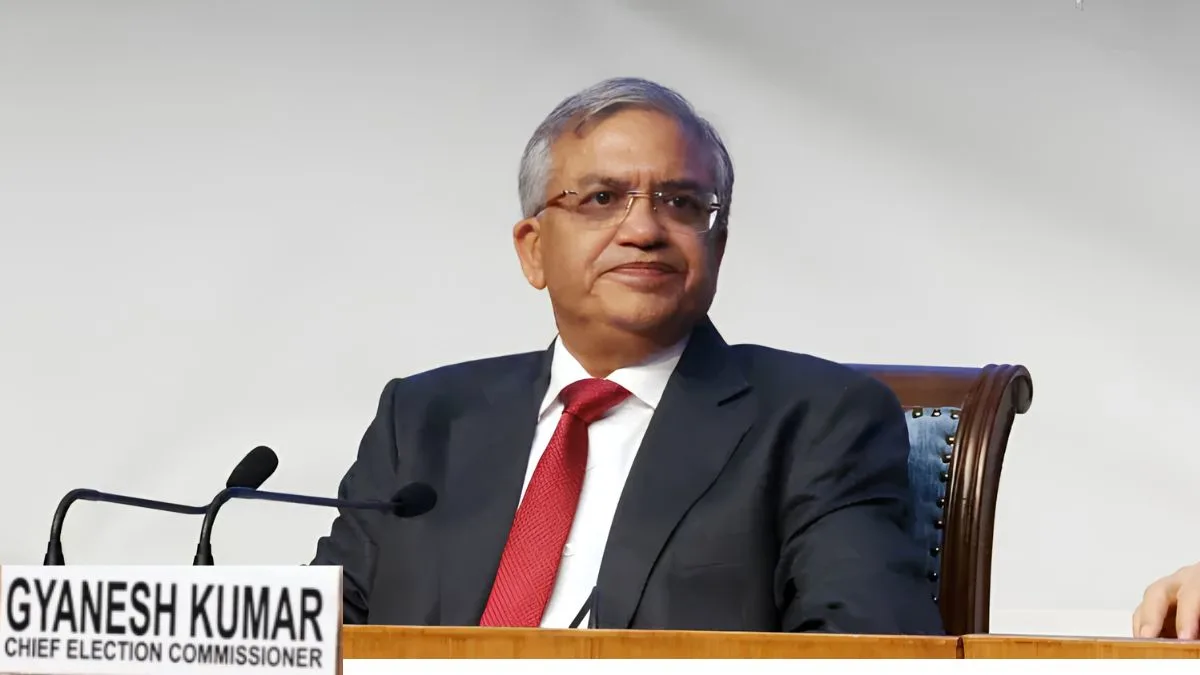
Gyanesh Kumar faces Opposition demands for resignation after a report on Election Commission objections, SIR, voter rolls and the poll panel’s response
New Delhi: Gyanesh Kumar has served as India’s Chief Election Commissioner since February 2025. A September 23, 2026 investigation reported that Election Commissioners Sukhbir Singh Sandhu and Vivek Joshi raised written objections at least 14 times over about 10 months on issues linked to voter rolls, election software and the Special Intensive Revision (SIR). Opposition leaders have cited these reported objections while demanding Kumar’s resignation. The Election Commission has rejected the description of an internal breakdown and said that its final decisions remained unanimous.
Who is Gyanesh Kumar?
Gyanesh Kumar was born on January 27, 1964, in Agra, Uttar Pradesh. He joined the Indian Administrative Service in 1988 as a Kerala-cadre officer.
Kumar studied civil engineering at IIT Kanpur. He also studied business finance at ICFAI and environmental economics at Harvard University.
During his early career, he worked in Kerala as a Sub-Collector and District Collector of Ernakulam. He also served as Municipal Commissioner of Cochin Corporation.
He later moved to the Centre, & worked in the Ministry of Defence and then in the Ministry of Home Affairs.
In the Home Ministry, Kumar worked in the Kashmir Division. His work included the Jammu and Kashmir Reorganisation Act and matters linked to the creation of the Shri Ram Janmabhoomi Teerth Kshetra Trust after the Ayodhya judgment.
Kumar later became Secretary in the Ministry of Parliamentary Affairs and then Secretary in the Ministry of Cooperation. He retired from the IAS in January 2024.
From IAS Officer to CEC
The government appointed Kumar and Sukhbir Singh Sandhu as Election Commissioners on March 15, 2024.
A selection panel headed by Prime Minister Narendra Modi made the appointments. Union Home Minister Amit Shah and then Congress leader in the Lok Sabha Adhir Ranjan Chowdhury also formed part of the panel.
Chowdhury objected to the process. He said the government did not give him enough time to examine the names before the meeting.
Kumar became Chief Election Commissioner on February 19, 2025. Vivek Joshi joined the Commission as an Election Commissioner at the same time.
Kumar is the 26th Chief Election Commissioner. His term runs until January 26, 2029.
A new law, a new appointment process
Kumar’s appointment also came under a new law.
Parliament passed the Chief Election Commissioner and Other Election Commissioners (Appointment, Conditions of Service and Term of Office) Act, 2023.
The law changed the composition of the panel that selects the CEC and other Election Commissioners. It includes the Prime Minister, the Leader of the Opposition in the Lok Sabha and a Union Cabinet minister nominated by the Prime Minister.
The law removed the Chief Justice of India from this panel.
Rahul Gandhi, who served on the selection panel when Kumar became CEC, objected to the process. He argued that the new system could affect the independence of the Election Commission.
The appointment process has also faced legal challenges in the Supreme Court. The court had earlier created an interim selection arrangement that included the Chief Justice of India until Parliament passed a law. Parliament later enacted the 2023 law.
What the September 2026 investigation found
The September 23 investigation reported that Sandhu and Joshi made written objections at least 14 times during a period of about 10 months.
According to the report, the two commissioners questioned decisions and instructions that they said reached them without their knowledge or approval.
The reported concerns covered voter registration, deletion and restoration of names, voter appeals, access to electoral-roll databases and the security of election data.
The report also referred to concerns about the use of election software in some cases. It said the two commissioners took some concerns to the Cabinet Secretary.
The report did not establish that Kumar personally committed any wrongdoing. It documented objections raised by two commissioners and their concerns about how certain decisions and systems operated.
What exactly were the internal objections about?
One issue involved Form 6, which people use to apply for voter registration.
According to the investigation, the Election Commission changed the form during the SIR process. The revised form asked applicants whether their name, or the name of a parent or grandparent, appeared in an earlier electoral roll.
Joshi reportedly objected to this change. Sandhu later supported the objection and described the change as “unauthorised and illegal”.
Another issue involved access to the electoral-roll database.
The two commissioners reportedly questioned whether officials at the state and constituency levels had enough access to the system used to maintain voter lists. They also raised questions about who could make changes to the database.
The investigation also reported concerns about voter appeals in West Bengal and a software-related problem in Goa.
In Goa, election officials reportedly found 97 voters eligible after checking their documents. The report said the software did not allow officials to restore those names before the final roll was published.
Why SIR Has Become the Main Point of Dispute ?
The Special Intensive Revision, or SIR, aims to check and update electoral rolls.
The Election Commission started the latest SIR exercise in Bihar in 2025 and later expanded it to other states and Union Territories.
The process involves checking voter details and identifying entries that officials believe need further verification. The exercise has generated political and legal debate over how officials should handle names that face questions.
Opposition parties have cited figures of more than 13 crore names removed from draft electoral rolls across different areas. They have used the figure to question the scale and effect of the exercise.
However, the 13-crore figure forms part of the political debate and should not be treated as a verified figure of wrongful deletions.
The Supreme Court has also examined different aspects of the SIR process. In West Bengal, for example, thousands of voters have filed appeals after names were removed during the revision process. The Election Commission has provided figures on those appeals to the court.
Why Rahul Gandhi and Other Opposition Leaders Want Kumar to Resign
Rahul Gandhi has demanded Kumar’s resignation after the reported objections became public. Gandhi described the electoral process as “fundamentally broken”.
Congress leaders have also repeated allegations that the BJP, RSS and Election Commission worked together against Opposition interests. These remain allegations made by Congress and Opposition leaders.
Other Opposition leaders have also demanded Kumar’s resignation.
Samajwadi Party chief Akhilesh Yadav, MNS chief Raj Thackeray and CPI leader P. Sandosh Kumar have called for action against the CEC. DMK president M K Stalin has also demanded Kumar’s resignation and called for an inquiry into the SIR process.
The Opposition has linked its demands to the reported objections by Sandhu and Joshi. Its leaders argue that the objections raise questions about how the Commission handled voter-list changes and the SIR process.
CJP Gives 48-Hour Resignation Deadline to Gyanesh Kumar
The Cockroach Janta Party (CJP) has separately demanded Kumar’s resignation.
CJP national convenor Abhijeet Dipke gave Kumar 48 hours to resign at a September 24 press conference in New Delhi. Dipke said the group would begin a nationwide protest if Kumar did not step down.
CJP co-conveners Saurav Das and Ashutosh Ranka also joined the press conference.
The group launched a campaign called “Election Commission Thik Karo.” It linked its demands to the SIR process and the reported objections raised by the two Election Commissioners.
The CJP has also demanded a pause in the SIR process and wants the electoral rolls from January 2025 restored while the changes are reviewed. The group has called for an independent inquiry into decisions taken during the SIR exercise.
The CJP has also demanded changes to the 2023 law governing the appointment of the CEC and other Election Commissioners.
These demands and allegations represent the CJP’s position. They do not amount to findings by a court or an independent inquiry.
The group has warned that it will organise a nationwide agitation and another large protest in Delhi if Kumar does not resign within its 48-hour deadline.
How the Election Commission has responded
The Election Commission issued a statement signed by all three commissioners.
The Commission said different views and written objections form a normal part of discussions in a three-member constitutional body. It said commissioners can raise questions and record their views before the Commission takes a final decision.
The ECI also said the final decisions, including decisions connected with SIR, received the approval of all three commissioners.
The Commission said focusing only on selected internal notes showed “one part of the picture”. It argued that those notes did not represent the full range of its work or decisions.
The Commission also defended its election technology and said statutory officials continue to handle voter-roll work at the appropriate levels.
A pattern of earlier friction
The latest dispute follows earlier disagreements between Kumar and Opposition parties.
Opposition MPs had earlier sought Kumar’s removal through parliamentary notices. Presiding officers rejected those notices in April 2026.
The Opposition had also discussed possible removal proceedings over disagreements involving SIR and voter lists.
Kumar and Rahul Gandhi have also publicly disagreed over Gandhi’s earlier “vote chori” allegations. Kumar asked Gandhi to substantiate those allegations under oath or apologise.
These earlier exchanges have added to the political tension around the Election Commission and Kumar’s tenure.
What could happen next
The Opposition can continue to raise the issue in Parliament and demand action against Kumar. Political parties can also seek further clarification about the objections raised by the two Election Commissioners and the way the ECI handled them.
Any formal removal process would have to follow the constitutional and legal rules that apply to the Chief Election Commissioner.
Article 324 of the Constitution provides special protection for the CEC’s removal. The process broadly follows the procedure used for removing a Supreme Court judge.
For now, the Opposition is seeking Kumar’s resignation and further scrutiny, while the Election Commission maintains that its final decisions received the approval of all three commissioners.
The current dispute involves competing claims about how the Election Commission handled internal objections, voter rolls and the SIR process. The Opposition sees the reported objections as grounds for further action, while the ECI says internal differences are part of normal discussions and that final decisions remained unanimous. The matter remains politically contested and unresolved.
