
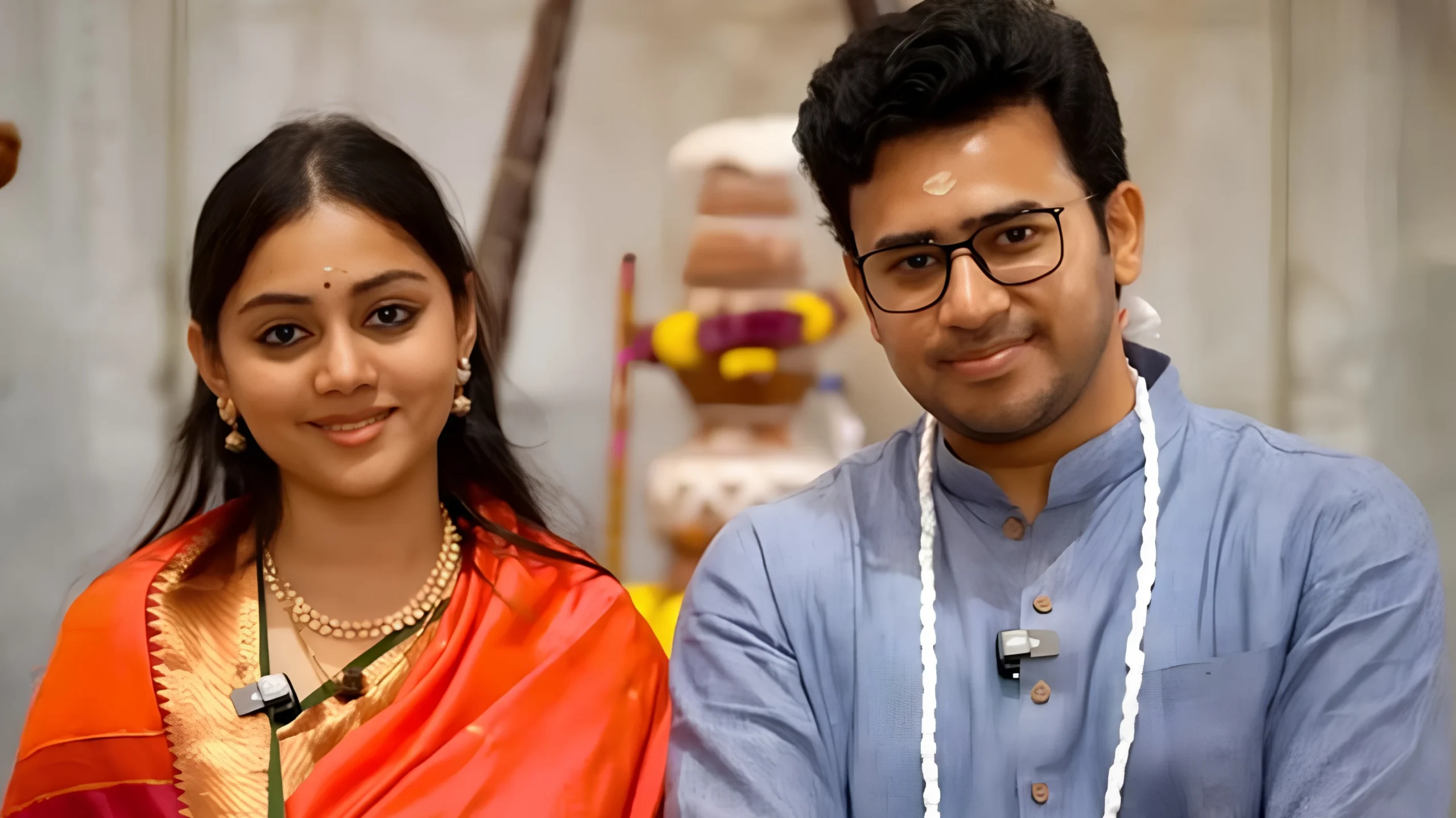
Tejasvi Surya and Sivasri Skandaprasad’s train episode sparks a wider debate over noise, public behaviour and civic sense in shared spaces
New Delhi: Tejasvi Surya’s wife, Carnatic singer and performing artist Sivasri Skandaprasad, has sparked a debate over civic sense after describing a five-hour train journey as “traumatic” because of a group of around 40 passengers who allegedly talked, shouted and laughed loudly throughout the trip.
Sivasri Skandaprasad Describes Five-Hour Train Ride
Skandaprasad said around 40 middle-aged adults occupied most of a 56-seat coach. According to her, the group talked, shouted and laughed continuously for nearly five hours.
“I had a traumatic train ride today,” she wrote.
She said people often fail to respect public spaces. She also argued that passengers should avoid shouting or talking loudly because such behaviour affects everyone around them.
Why Silence Matters to the Carnatic Singer
Skandaprasad also explained why silence matters to her as an artist.
“Artists have a 100 thoughts running. And we thrive in silence,” she wrote.
She acknowledged that groups can naturally feel excited while travelling together. However, she asked people to imagine sitting in a coach where around 40 adults talked loudly for five hours without stopping.
Around 16 passengers who did not belong to the group had to deal with the noise throughout the journey.
Skandaprasad Approaches the TTE
Skandaprasad said she approached the Travelling Ticket Examiner (TTE) and asked if she could move to another coach.
Since the train was full, the TTE could only offer her another seat in the same coach.
Later, a smaller group of around eight passengers started playing UNO. They continued talking and laughing loudly.
Skandaprasad approached the TTE again. He asked the group to stop, and they followed his instruction.
What Happened When the TTE Returned
However, when the TTE returned, he reportedly joked in Kannada, “Yaake sir galaatte maadtaideera?” This means, “Why are you creating a nuisance?”
The group laughed and invited him to join them.
Some reports also said that the larger group later started singing Bollywood songs.
Skandaprasad Raises the Civic Sense Question
Skandaprasad ended her post by turning the incident into a wider question about public behaviour.
“So the concern here is not about who won. Myself, along with them, as Indians, lost the Civic sense game,” she wrote.
She then asked when people as a nation would improve their behaviour in public spaces. She ended the post with the words, “God save this country.”
The post attracted widespread attention partly because Skandaprasad is married to a sitting Member of Parliament. It also revived a familiar discussion about behaviour in shared public spaces.
Who Is Sivasri Skandaprasad?
Calling Sivasri Skandaprasad only “Tejasvi Surya’s wife” overlooks her own professional identity.
Born on August 1, 1996, in Chennai, Skandaprasad works across several artistic fields. She trained as a Carnatic vocalist under Guru A.S. Murali.
She also began learning Bharatanatyam when she was three years old.
Her Work in Classical Arts
Skandaprasad also works as a painter and accepts commissioned projects.
She founded and directs Ahuti, a platform that aims to promote India’s 64 classical art forms through training and outreach.
Her academic background also covers different fields. She holds a B.Tech in bio-engineering from SASTRA University in Thanjavur.
She also holds an MA in Bharatanatyam from the University of Madras. In addition, she studied Sanskrit at the Madras Sanskrit College and holds a diploma in Ayurvedic cosmetology.
Her International and Film Work
Skandaprasad has represented India through Indian Council for Cultural Relations (ICCR) tours to South Korea and Denmark.
Her film-related work includes providing vocals for Mani Ratnam’s Ponniyin Selvan, including work associated with composer A.R. Rahman.
She also has a substantial online following across Instagram and YouTube.
Her father, Seerkazhi Sri J. Skandaprasad, is a well-known mridangam artist.
Sivasri Skandaprasad and Tejasvi Surya
Skandaprasad married Tejasvi Surya, the Bharatiya Janata Party MP from Bengaluru South, on March 6, 2025.
Surya was born on November 16, 1990. He has represented Bengaluru South in the Lok Sabha since 2019.
He previously served as president of the Bharatiya Janata Yuva Morcha.
Her marriage to a high-profile politician has brought additional attention to her public posts. However, her comments about the train journey focus on a broader issue: how passengers behave in shared public spaces.
The Viral Reaction Online
Skandaprasad’s post started a familiar conversation online.
Many users shared their own experiences of dealing with noisy groups on trains, buses and even inside residential complexes.
People mentioned several common problems. These included passengers playing videos and music loudly without headphones.
Others discussed groups having conversations without considering fellow passengers. Some also pointed to the difficulty of asking strangers to reduce their volume without starting an argument.
What People Said About the Incident
Some users supported Skandaprasad for raising an issue that many passengers experience but often choose to ignore.
Others pointed to the TTE’s response. They said the incident showed how railway staff may handle such situations differently depending on the circumstances.
Another discussion focused on the way several reports introduced Skandaprasad primarily as “Tejasvi Surya’s wife”.
Some commenters pointed out that she had already established her own career and identity as a classical artist before her marriage.
At the same time, her connection to a well-known elected representative gave the post a wider reach than a similar complaint might normally receive.
Railway Response and Passenger Behaviour
At the time of the initial reports, South Western Railway had not issued a public response.
Railway staff and TTEs can address passenger behaviour that disturbs other travellers. They can ask passengers to reduce their volume and, in more serious cases, take further action under applicable railway rules.
However, crowded trains and the social dynamics between groups can make enforcement difficult in practice.
Why the Incident Started a Civic Sense Debate
India’s public transport system carries millions of passengers every day.
Long-distance trains create temporary communities where people from different backgrounds share a limited space for several hours.
When a large group treats a train coach like a private gathering space, other passengers can lose the basic expectation of a reasonably peaceful journey.
Skandaprasad’s statement that “we… as Indians, lost the Civic sense game” reflected a concern that many people have raised about public behaviour.
Noise in Public Spaces Is a Common Complaint
Passengers regularly complain about music played through speakers and loud video calls.
Group celebrations can also spill into common areas. At the same time, some people hesitate to speak up when another passenger disturbs others.
The issue does not belong to one particular region, class or age group.
However, people often mention group travel and middle-aged passengers when discussing such incidents.
Why Quiet Spaces Matter to Many Passengers
Parents and educators also frequently point out that schools and families often give academic performance more attention than civic behaviour.
Government and public-service campaigns promote responsible behaviour in public places. However, enforcement and social pressure do not always work consistently.
For artists and people who work in creative fields, silence can have particular importance. Skandaprasad’s comment that artists have “100 thoughts running” reflects her own experience.
However, the need for personal space and reasonable quiet does not apply only to artists.
Passengers recovering from illness, professionals trying to work during a journey, students preparing for examinations and elderly travellers can all share the same need for a peaceful environment.
What Could Improve Passenger Behaviour?
People have suggested several practical ways to reduce such problems, although authorities rarely implement them on a large scale.
Railways could make clearer announcements about passenger behaviour. Staff could also respond consistently when noise disturbs other travellers.
Authorities could consider designated quiet coaches on more trains. They could also run simple campaigns about responsible behaviour.
Applying existing rules consistently could also help when passengers create a nuisance.
Civic Sense Also Depends on Passengers
Long-term change also depends on social behaviour.
Parents can teach children that public spaces belong to everyone. Adults can set an example by keeping their voices down.
Passengers can also learn to request lower volume politely without turning such conversations into confrontations.
These small actions can help people share public spaces more comfortably.
Skandaprasad Did Not Seek Punishment
Skandaprasad did not identify the train or the people involved.
She also did not demand punishment for the individuals.
Instead, she presented the incident as a form of collective self-reflection.
In her view, the issue went beyond the discomfort faced by one passenger. It concerned the larger standard of behaviour people follow in public spaces.
Why the Post Connected With People
The post may have connected with a wider audience because it focused on more than the group inside one train coach.
Rather than discussing only the 40 passengers, Skandaprasad used the experience to raise a question about society’s broader attitude towards civic behaviour.
Her comments also encouraged people to share their own experiences of dealing with noise in public places.
What Happens Next?
As of late September 2026, the incident remains a topic of online discussion.
No formal complaint details or railway investigation related to the incident have been publicly reported.
It remains unclear whether the discussion will lead to any measurable change in passenger behaviour or railway staff protocols.
A Wider Conversation About Public Behaviour
The incident has once again brought attention to everyday behaviour on India’s trains.
Anyone who has spent hours travelling in a crowded coach may recognise the situation Skandaprasad described.
For others, her post provides a first-person account of how continuous noise can affect passengers during a long journey.
Her final question — “When will we as a nation improve our public behaviour?” — goes beyond this particular train ride.
For millions of passengers, civic sense remains part of everyday travel. It is often experienced quietly during journeys that can last much longer than five hours.
