
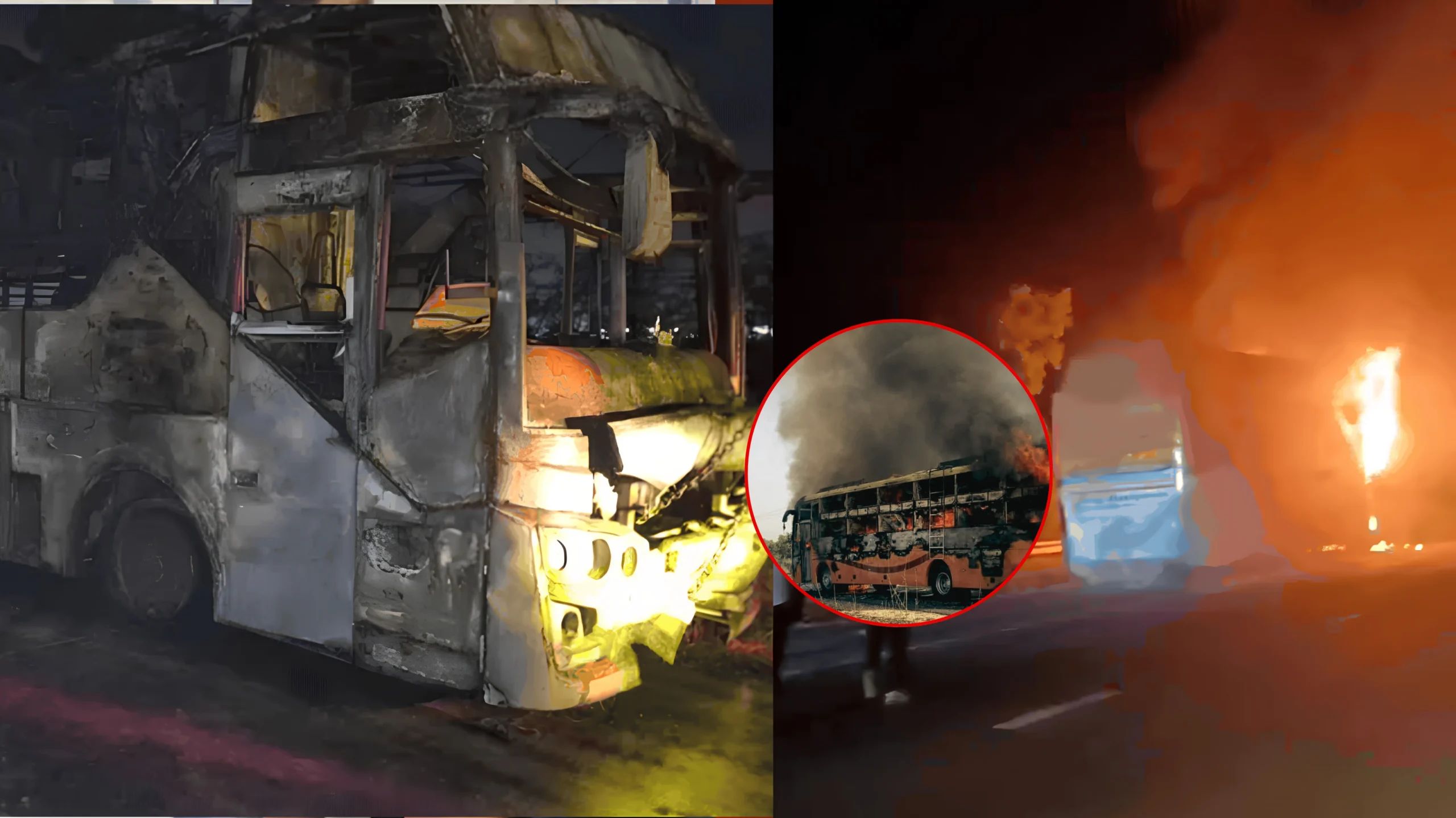
Passengers reportedly warned the driver and conductor about a burning smell before the blaze erupted
Jewar, Greater Noida: Nine passengers died and several others suffered injuries after a private sleeper bus caught fire on the Yamuna Expressway near Jewar in Greater Noida late on September 23, 2026. The fire broke out around 11:00–11:30 pm near the 33-kilometre milestone in the Jewar police station area of Gautam Buddh Nagar district. The spot lies close to the upcoming Noida International Airport and Dayanatpur village.
The BharatBenz business-class air-conditioned sleeper bus belonged to Raj Kalpana Travels and carried registration number BR32PA8647. The bus had started its journey from Kashmere Gate in New Delhi and was heading towards Mahoba in Uttar Pradesh. Around 30–35 passengers travelled on the bus, although some reports put the number at around 35–40. Most passengers had fallen asleep or were preparing to sleep when they noticed the first signs of trouble.
How the Fire Started: Passengers Reported a Burning Smell
According to the First Information Report (FIR) filed on the complaint of passenger Sunil Kumar, a resident of Hamirpur, the passengers noticed a strong burning smell near the driver’s cabin when the bus reached the 33-km mark.
Several passengers immediately warned the driver and conductor, also called the helper, and asked them to stop the bus and check the source of the smell.
According to the complaint, the driver did not take the warning seriously. He allegedly told the passengers that such smells were common on the bus and continued driving.
The FIR also states that the driver and conductor continued to smoke bidis or cigarettes inside the cabin. Some survivors gave a more detailed account and claimed that the crew also consumed gutkha or paan. They said the crew laughed at their concerns and even threatened passengers when they objected.
A short time later, flames suddenly appeared near the driver’s seat. The fire quickly spread through the sleeper coach.
Thick smoke filled the bus within minutes. Passengers who were awake shouted and tried to wake those who were sleeping. People rushed towards the exits. Some passengers jumped through windows to escape. Others became trapped because of the thick smoke and the design of the sleeper berths.
Survivor Rinki Rajput described the situation and said there was chaos inside the bus. She said people pushed each other as they struggled to breathe through the smoke. She also said the fire started near the driver’s seat and several passengers remained trapped.
Another survivor recalled that one passenger could not even put on her shoes before escaping and ran out with only her phone.
The driver eventually moved the bus to the side of the expressway. However, the flames had already grown rapidly. Some reports said the driver and conductor initially fled the spot before police detained them later.
Rescue Operation and Nine Deaths
Fire and rescue teams reached the spot soon after the fire started. Reports put the number of fire tenders between four and ten, including a fire tender stationed at the Jewar toll plaza. Police and local personnel also joined the rescue operation.
Chief Fire Officer Pradeep Kumar said rescue teams put out the fire and safely evacuated around 20–25 passengers.
When rescue personnel entered the smoke-filled bus, they found nine people dead inside. The victims appeared to have died from burns and suffocation.
The victims included eight men and one woman. Some early reports said elderly passengers and a child with disabilities were among those who died. Authorities continued the process of identifying all nine victims in the latest updates.
Authorities took the bodies to Kailash Hospital in Jewar, where doctors declared the victims dead. Doctors also conducted post-mortem examinations.
Several other passengers suffered burn injuries and received treatment at the same hospital. The fire also destroyed passengers’ bags, mobile phones and other belongings.
Driver and Conductor Arrested, FIR Registered
Jewar police arrested the driver, identified as Pawan, and the conductor, identified as Yogesh.
Police registered an FIR under relevant sections of the Bharatiya Nyaya Sanhita (BNS). These include provisions related to culpable homicide not amounting to murder, rash and negligent acts and other applicable sections, including Sections 281, 125(b), 105 and 351(3).
Inspector Ajay Kumar Singh is handling the investigation.
Police are examining the bus, statements from survivors and technical evidence. The investigation will establish how the fire started and whether negligence contributed to the deaths.
What Caused the Fire?
Preliminary police findings suggest that a short circuit or spark/blast in the air-conditioning system may have started the fire. Investigators believe the spark may have ignited lubricating oil in the engine, which allowed the flames to spread quickly.
Authorities believe the fire started in or near the driver’s cabin and engine area.
However, officials have not reached a final conclusion. A detailed technical investigation remains underway.
Safety Violations Under the Scanner
The tragedy has also raised questions about safety standards in private sleeper buses.
On-ground observations and reports highlighted several possible safety violations. These included emergency exits that appeared sealed or replaced with additional sleeping berths, windows covered with plastic instead of proper breakable glass, highly flammable interior materials and unauthorised modifications inside the bus.
Some modifications may have reduced the number of escape routes and increased the passenger capacity beyond safe limits.
Indian safety standards, including AIS-052, which covers bus body construction, and AIS-119, which covers sleeper buses, require buses to have multiple emergency exits of specified sizes, roof hatches, fire-resistant materials and proper access.
However, some custom-built and modified sleeper buses may compromise these requirements to increase the number of berths.
Narrow aisles, stacked berths and limited headroom can make escape extremely difficult when smoke fills a sleeper bus at night.
Official data presented in Parliament has also recorded dozens of bus fire incidents in recent years that caused significant casualties. These figures point to a recurring safety problem.
Smoking inside a moving passenger vehicle also creates a serious safety risk. In this case, several factors may have combined to make the situation worse. These included the reported burning smell, continued smoking near possible electrical or oil sources, delayed stopping and limited emergency exits.
Government Announces Compensation
Uttar Pradesh Chief Minister Yogi Adityanath took immediate cognisance of the tragedy.
He expressed condolences to the families of the victims and directed officials to provide proper medical treatment to the injured passengers.
The Uttar Pradesh government announced financial assistance of ₹2 lakh for the family of each deceased passenger and ₹50,000 for each injured passenger.
The Chief Minister also spoke with affected families and directed the administration to provide them with all possible assistance.
Prime Minister Narendra Modi expressed distress over the deaths and announced the same amount of compensation from the Prime Minister’s National Relief Fund.
The families of each deceased passenger will receive ₹2 lakh, while each injured passenger will receive ₹50,000.
President Droupadi Murmu also expressed sorrow over the tragedy and prayed for the recovery of the injured passengers.
The Bigger Question: How Can Such Fires Be Prevented?
Thousands of passengers use overnight buses to travel long distances on India’s highways. Private sleeper buses meet an important demand, especially on routes connecting Delhi with different parts of Uttar Pradesh and other states.
However, repeated bus fires have raised concerns about the enforcement of vehicle fitness rules, bus body-building standards, emergency exit requirements and crew training.
Investigators and regulators now face several important questions.
Was the bus properly certified and free from unauthorised modifications? Were the fire extinguishers working and easy to access? Had the driver and conductor received proper safety training? How quickly could the crew have stopped the bus after passengers reported the burning smell?
Authorities also need to examine what changes can prevent similar accidents in the future.
For the families of the nine passengers who could not escape and for the survivors who jumped through windows into the night, these questions carry enormous importance.
The answers could determine whether future passengers travel safely or face the same danger.
As of September 24, 2026, the driver and conductor remain in custody. Authorities continue to identify the victims, while investigators work to determine the exact cause of the fire.
The Yamuna Expressway bus fire has once again raised serious questions about passenger safety on overnight sleeper buses. A warning such as a burning smell can signal a major danger, and transport operators must respond to such warnings immediately.
