
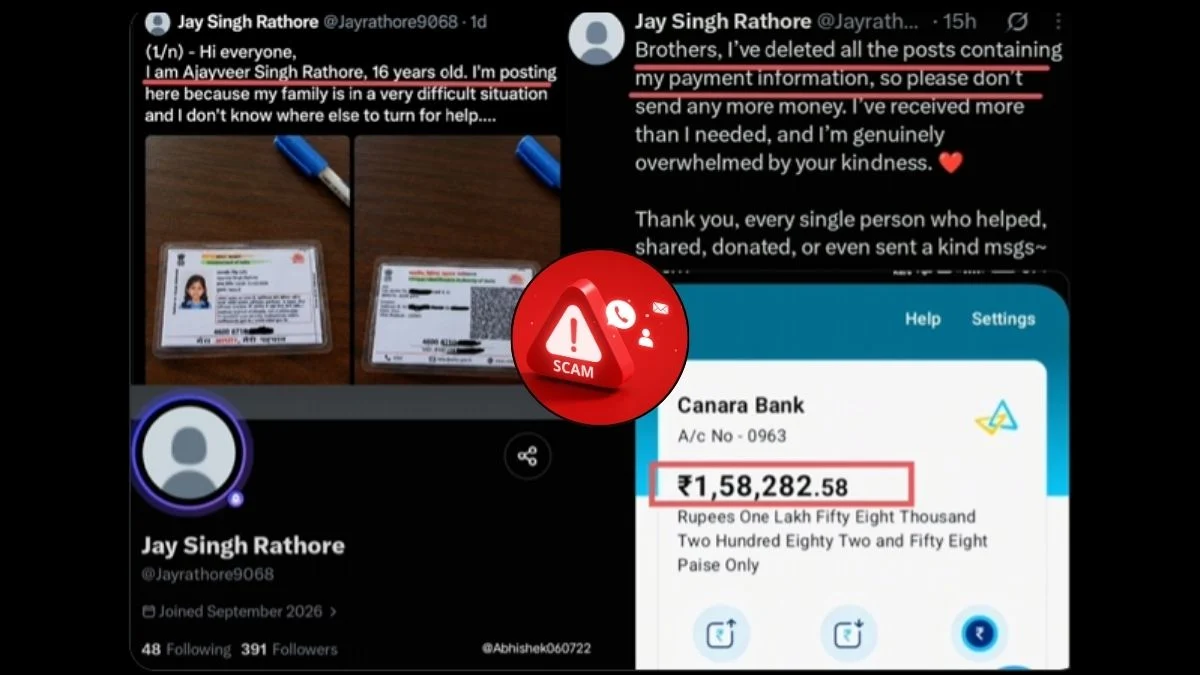
Scam Alert: Jay Singh Rathore raised ₹1.5 lakh through a donation appeal for his sister’s eye surgery. Shroff Eye Centre later said the documents did not match
New Delhi: An X user named Jay Singh Rathore asked people for money, saying his 12-year-old sister urgently needed eye surgery. He said the family needed around ₹73,000 more for her treatment and soon received more than ₹1.5 lakh in donations. The appeal later came under scrutiny after Delhi’s Shroff Eye Centre said the medical documents being shared did not match its records. Rathore then changed parts of his story and later admitted that some claims were false or misleading.
The appeal that went viral
Rathore’s original post described a serious medical emergency involving his 12-year-old sister. He said doctors had diagnosed her with glaucoma and vitreous haemorrhage, an internal eye bleed that can affect vision.
And claimed the family had already spent more than ₹2.5 lakh on treatment at Delhi’s Shroff Eye Centre and needed around ₹1.2 lakh more for surgery. He said the family had arranged ₹50,000 through savings and relatives but still faced a shortfall of about ₹73,000.
The appeal included what appeared to be medical reports, hospital bills, an estimate, appointment documents and an Aadhaar card. Rathore asked people to contribute even ₹10 or ₹20 and said sharing the post could also help. Reports identified the account holder as Jay Singh Rathore, while the original appeal also used the name Ajayveer Singh Rathore.
Donations pour in within 24 hours
The appeal quickly reached a large audience. Within roughly a day, Rathore said he had received more than ₹1.5 lakh from donors. One figure cited in reports was ₹1,58,282.
He then removed the payment details and said the family had received more money than it needed. At that stage, the fundraiser appeared to have reached its stated goal. The situation changed after questions emerged about the medical paperwork attached to the appeal.
Shroff Eye Centre raises the alarm
Shroff Eye Centre later issued a public warning through an Instagram Story. The hospital said someone had created a fake patient record, prescription and estimate sheet using its letterhead and had approached individuals and NGOs for financial assistance.
The hospital did not name Rathore in the warning. However, the warning came after the documents connected to his appeal faced questions, and the similarity in the circumstances led to widespread scrutiny of the fundraiser.
A purported audio recording also circulated in which someone contacting the hospital was allegedly told that the details connected to the fundraiser did not match its records. That recording has not been independently established as proof of every claim surrounding the appeal. The hospital’s own public warning remains the key confirmed development regarding the documents.
The story changes: from sister to father
Rathore deleted his original posts as the scrutiny intensified. He later returned to X and participated in several live audio discussions.
During those discussions, his explanation changed. He said his father was actually the family member who needed financial help and acknowledged that he had used his sister’s name in the original appeal because it would attract more sympathy and attention.
That account differed significantly from the original fundraiser, which had specifically presented the money as being needed for the treatment of his 12-year-old sister. Reports also said Rathore acknowledged that parts of his story were false or misleading.
Hours of questions on X
The controversy then moved from the fundraising post to lengthy X Spaces, where participants questioned Rathore about the medical documents, the money raised and his changing explanations.
Some of the sessions lasted several hours. A Supreme Court lawyer who participated in one discussion reportedly explained that fabricated medical documents could potentially lead to legal consequences, including provisions relating to cheating and forgery under the Bharatiya Nyaya Sanhita (BNS), depending on the facts established by an investigation.
Rathore became emotional during parts of the discussions and eventually accepted that some of his earlier claims had been misleading. However, online questioning does not itself establish criminal liability, and no formal charges had been widely reported as of September 23–24.
A moment that drew backlash: “I keep cash, I am not poor”
Another moment from the Spaces drew attention when participants questioned Rathore about buying tea after he had earlier referred to problems with his bank account.
When questioned about how he could make the purchase, he reportedly responded, “I keep cash, I am not poor.” The remark drew criticism during the online discussions and became another part of the wider controversy.
Refunds promised, but only partly confirmed
Rathore later agreed to refund people who had donated. He shared transaction screenshots that he said showed repayments had begun.
One circulating bank screenshot reportedly showed the balance falling from around ₹1,58,282 to approximately ₹1,37,893. However, that screenshot has not been independently verified as evidence that donors received complete refunds.
Rathore cited daily transaction limits as a reason for making refunds in stages and said he would return the remaining money later. As a result, the available evidence supports a promise and some reported repayment activity, but it does not independently establish that every donor has received a full refund.
Where things stand now
As of September 23–24, 2026, no widely reported FIR or formal police complaint against Rathore had emerged in the available reporting. There was also no independent confirmation that all donors had received their money back or that authorities had filed charges.
Rathore has continued to remain active on X and has referred to further Spaces. The Shroff Eye Centre warning confirms that documents using the hospital’s identity were not genuine, but the full circumstances behind their creation and use would require an independent investigation to establish.
Medical Fundraising Scams Are Not New
The Rathore case is not the first time medical fundraisers in India have faced questions. Over the past decade, hospitals, doctors, donors and crowdfunding platforms have flagged campaigns involving fake documents, inflated treatment costs and misleading patient details.
A 2022 investigation found several suspicious medical fundraisers on platforms such as Ketto and Milaap. In one case, a family ran multiple campaigns that raised nearly ₹9 lakh. Hospitals later disputed some of the documents used in the campaigns. In another case, a hospital confirmed that medical papers submitted by a fundraiser were forged.
The investigation also examined a fundraiser for a child that collected money on two platforms. Milaap identified the campaign as fraudulent and stopped it, although some money had already been transferred. Another campaign showed a treatment estimate that appeared significantly higher than the amount later listed on the hospital invoice.
These cases highlight some common warning signs. Fraudulent fundraisers may use emotional stories, fake or altered medical documents, inflated bills, old photographs or personal payment accounts to collect money. Some campaigns may also appear on multiple platforms, making it harder for donors to verify the appeal.
Digital Fraud Raises the Need for Donor Verification
The issue exists within a broader rise in digital fraud. RBI data shows that banks reported 36,075 fraud cases involving ₹13,930 crore in 2023-24 for frauds of ₹1 lakh and above. In 2024-25, banks reported 23,953 such cases involving ₹36,014 crore. The RBI said card and internet frauds accounted for the largest number of reported cases in 2024-25, while loan-related frauds accounted for the largest share by value.
These RBI figures cover banking fraud and do not specifically measure medical crowdfunding scams. However, they show the wider fraud environment in which online fundraising appeals operate.
For donors, the safest approach is to verify a campaign before making a payment. Contact the hospital directly and check whether the platform has verified the fundraiser. Donors should also seek clarification when an appeal uses a personal UPI account or documents that cannot be independently verified.
