
Cervical cancer kills a woman every two minutes somewhere in the world. The HPV vaccine can prevent most of these cases. So why do millions of parents still refuse to give it to their children?
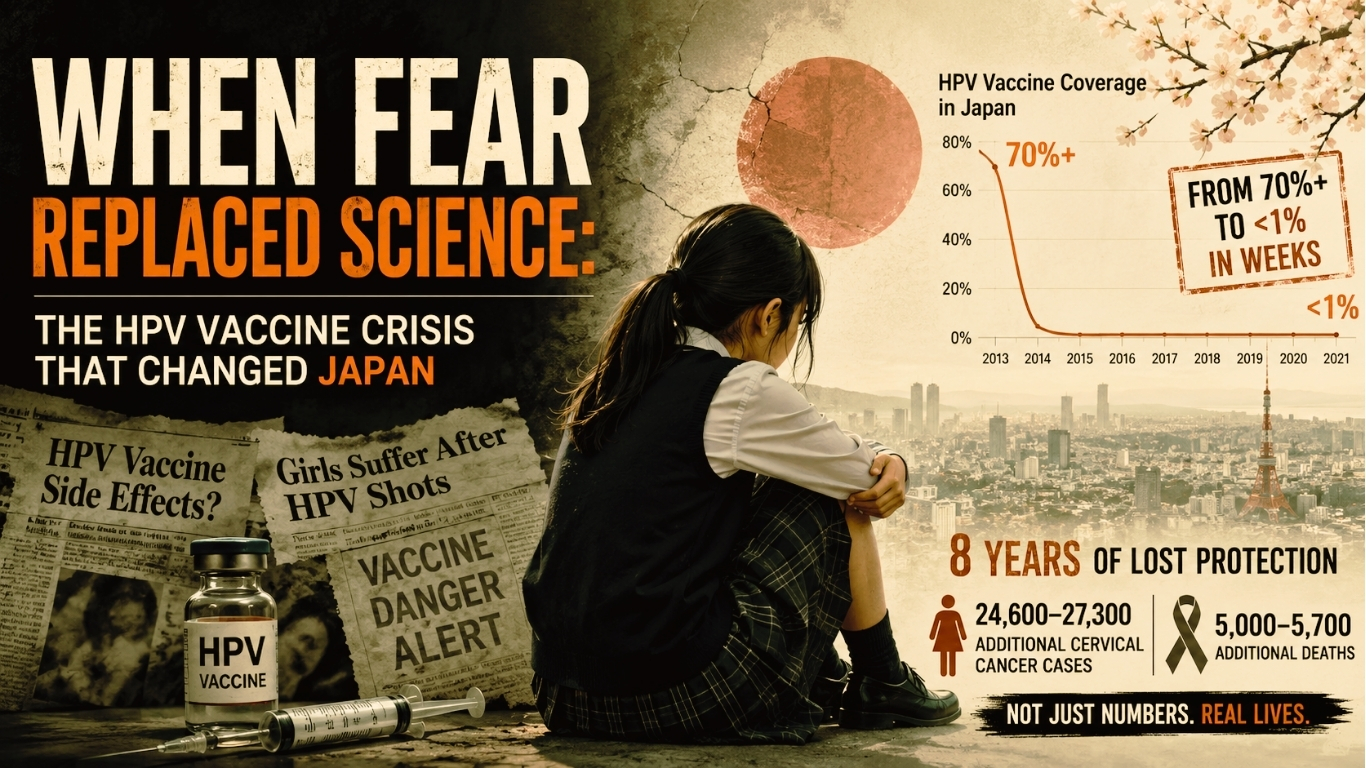
New Delhi: In June 2013, Japan stood among the best-performing countries in the world for HPV vaccination. More than 70% of eligible girls received the vaccine. Then, within weeks, that number collapsed to under 1%, and it stayed there for almost eight years.
Nothing changed about the vaccine. The story around it changed.
A group of girls reported chronic pain and movement problems after vaccination. Japanese television channels and newspapers heavily covered these stories. Many reports failed to mention that scientific reviews found no causal link between the vaccine and these symptoms. A paper in The Lancet Public Health reported that in May 2013, Japanese media highlighted a cluster of suspected adverse events linked to HPV vaccination.
This coverage pushed the government to suspend its proactive recommendation for the vaccine the following month. Local investigations found no evidence of a link, and WHO and the global scientific community urged Japan to resume recommendations. However, the suspension continued for years. The Ministry of Health panicked and stopped actively recommending the vaccine. It did not ban it, but that hesitation—amplified by media coverage—proved enough to destroy confidence.
Japan kept its HPV vaccination policy effectively inactive for more than eight years. Authorities finally resumed proactive recommendations on 1 April 2022. Paul Bloem, WHO’s HPV vaccine strategy lead, called this decision “an important signal of confidence in the vaccine and its safety.” By that time, the damage had already occurred.
Researchers Kate T. Simms, Sharon J. B. Hanley, Megan A. Smith, Adam Keane, and Karen Canfell published findings in The Lancet Public Health in 2020. They modeled the real cost of the eight-year crisis. They found that, compared to maintaining 70% coverage, the drop in vaccination between 2013 and 2019 would result in 24,600 to 27,300 additional cervical cancer cases and 5,000 to 5,700 deaths among women born between 1994 and 2007.
Another Japanese research team published its findings in Scientific Reports. The team reached a similarly alarming conclusion. They estimated that the policy suspension would increase lifetime cancer risk significantly. In one birth cohort alone, about 12 additional women per day would face higher risk of cervical cancer, and about three additional women per day would face higher risk of death. The authors clearly stated that no one should accept this situation.
This problem does not exist only in Japan. It happens every day across the world. It spreads on Instagram, TikTok, WhatsApp groups, and comment sections under doctors’ videos. Anywhere a confident voice without medical training speaks loudly, it can overpower scientific advice.
Before we examine the myths, we must understand one fact: this is not a harmless debate. It causes real deaths, and we have clear evidence.
Myth 1: “The vaccine causes infertility”
This myth spreads widely and causes serious damage. Scientists have studied it more thoroughly than almost any other vaccine safety concern.
The World Health Organization’s vaccine safety group, the Global Advisory Committee on Vaccine Safety (GACVS), specifically investigated this claim. This independent group of 15 international experts formed in 1999 to address global vaccine safety concerns. PAHO/WHO clearly states the conclusion: after reviewing all available scientific evidence, the committee found no relationship between HPV vaccination and infertility.
What the answer actually rests on
This conclusion relies on strong population data. The Society of Behavioral Medicine highlighted one of the largest studies on this issue. Researchers reviewed over 200,000 women and found no link between the HPV vaccine and premature ovarian failure, which forms the basis of the infertility myth.
Researchers also analyzed the United States Vaccine Adverse Event Reporting System (VAERS), which many anti-vaccine claims rely on. In Drugs – Real World Outcomes, they examined 228,341 reports related to premature ovarian failure. Only 281 cases, or 0.1%, even mentioned HPV vaccines, and these reports did not prove causation. VAERS accepts any report without confirming medical accuracy.
Turning the myth on its head
The disease itself threatens fertility, not the vaccine. The Society of Behavioral Medicine clearly explains that cervical cancer and its treatments—such as surgery, radiation, and chemotherapy—can damage fertility or cause pregnancy complications. The vaccine reduces this risk. It does not create it.
Myth 2: “It encourages teenagers to become sexually active”
This myth worries parents because it connects to beliefs about morality rather than science. Researchers have tested it directly in real populations.
The studies, by name
Robert Bednarczyk and his team conducted a major study at Kaiser Permanente and Emory University. They published their findings in Pediatrics in October 2012. Also They used actual medical records instead of surveys. They tracked 493 vaccinated girls and 905 unvaccinated girls, observing pregnancy rates, STI testing, and contraceptive counseling. They found no differences between the groups. The researchers concluded that the HPV vaccine did not increase sexual activity-related outcomes.
Robert Bednarczyk described the findings as “comforting and reassuring.” Dr. Elizabeth Alderman, an adolescent medicine specialist at The Children’s Hospital at Montefiore, acknowledged that some parents worry the vaccine acts as permission for sexual activity. She stated that this research clearly disproves that concern.
Later research confirmed the same result. The Society of Behavioral Medicine cited a review of over 500,000 individuals that found no increase in sexual activity after vaccination. In fact, vaccinated individuals often reported safer sexual behavior.
A 2019 study in PMC, using data from the Michigan HPV and Oropharyngeal Cancer Study, extended this research to men. It reached the same conclusion: the vaccine does not influence sexual behavior in either men or women.
Susan Werner, MD, a former UVA Health pediatrician, pointed to a long-term European study. Researchers followed adolescents aged 12 to 18 over 30 years and found no connection between vaccination and increased sexual activity.
Why doctors recommend ages 9–12
Gynecologic oncologist Ariel M. Kredentser from Dartmouth Cancer Center addresses this concern often. She clearly states that data repeatedly disproves the myth.
Doctors recommend vaccination at ages 9–12 for biological reasons. The immune system responds more strongly at that age, and the vaccine must work before exposure to the virus.
The European Society of Gynaecological Oncology explains this clearly: you can vaccinate too late, but not too early. Real-world data shows that vaccination before age 15 provides stronger protection.
Dr. Jo Morrison from Somerset NHS Foundation Trust explained that vaccinating before age 16 can reduce cervical cancer cases by 80%.
Myth 3: “It is only for girls and women”
This myth creates a major gap in vaccination coverage. It is scientifically incorrect.
The 3.5-million-person study
At the 2024 ASCO Annual Meeting, researchers presented data from nearly 3.5 million people. They compared 1.7 million vaccinated individuals with a similar number of unvaccinated individuals.
Dr. Leana Wen explained that HPV causes multiple cancers in men, including penile, anal, and throat cancers. HPV causes over 90% of anal cancers, about 70% of throat cancers, and more than 60% of penile cancers.
The study showed that vaccinated men reduced their risk of HPV-related cancers by 46%.
Dr. Glenn J. Hanna from Dana-Farber Cancer Institute explained that the vaccine reduces oral HPV infections and prevents head and neck cancers. He emphasized that HPV vaccination prevents cancer.
Dr. Cristina Rodriguez from Fred Hutchinson Cancer Center stated that she now actively recommends vaccination for all eligible individuals based on this data.
Why men face major risk
Dr. Katharine Price from Mayo Clinic pointed out that men represent the largest group affected by HPV-related cancers, especially head and neck cancers.
The CDC reports that HPV causes 60–70% of throat cancers in the United States.
Medical organizations like the American Academy of Otolaryngology–Head and Neck Surgery strongly recommend vaccination for both boys and girls.
HPV spreads through skin-to-skin contact. If many men remain unvaccinated, the virus continues to spread and puts women at risk.
Myth 4: “Screening is enough”
This idea sounds logical but confuses prevention and detection.
What doctors say
Dr. Jayanthi S. Lea explained that vaccinated women still need screening. Screening detects disease after it begins. The vaccine prevents infection before it starts.
WHO’s elimination strategy
The World Health Organization’s elimination plan depends on three goals:
• 90% vaccination coverage
• 70% screening coverage
• 90% treatment of detected cases
Removing any one of these steps makes elimination impossible.
Real-world example
In Denmark, falling cancer rates led some to question the need for screening. However, experts Jesper Bonde and Anne Hammer warned that stopping screening would be risky. Experts agree that vaccination changes screening frequency, not the need for it.
Vaccination and screening work together. Skipping one creates risk.
Myth 5: “The vaccine is dangerous”
This fear caused Japan’s crisis.
Safety data
Global health organizations monitor vaccine safety across millions of doses. FIGO reported that more than 270 million doses have been studied.
Severe allergic reactions occur at a rate of about 1.7 cases per million doses. There is no increased risk of serious conditions like Guillain-Barré syndrome or neurological disorders.
WHO confirms that the vaccine has shown no serious safety concerns since 2006.
Japan’s own findings
Japan’s Ministry of Health conducted its own investigation. It found that reported symptoms occurred at the same rate in vaccinated and unvaccinated girls. This result matched findings from the European Medicines Agency.
Fainting can occur, but it happens with many vaccines due to anxiety. It is not caused by the vaccine itself.
Doctors consistently report only mild side effects like soreness, headache, fatigue, and nausea.
The numbers the myths ignore
Cervical cancer ranks as the fourth most common cancer among women worldwide. In 2022, experts recorded about 660,000 cases and 350,000 deaths.
Most deaths occur in low-income countries. Limited access to vaccines, screening, and treatment drives this inequality.
HPV vaccination programs have already prevented over 1 million deaths. Around 86 million girls now have protection.
A 2026 Lancet study from England showed that high vaccination rates reduced cervical cancer deaths among young women.
However, global vaccination coverage remains low. Only 21% of girls received the first dose by age 15 in 2024. WHO aims for 90% coverage.
Experts estimate that achieving this goal could prevent 74 million cases and save 62 million lives over the next century.
Why myths spread faster
Misinformation spreads because it appears credible. Influencers use expert-like language and gain visibility through algorithms.
Financial incentives also drive misinformation. Content that generates strong reactions earns more money.
Emotional stories spread faster than factual explanations, even when they are false.
Misinformation also weakens trust in healthcare systems. Japan’s case shows how government hesitation can amplify damage.
What science clearly shows
• The vaccine does not cause infertility.
• It does not increase sexual activity.
• It protects both men and women.
• It works with screening, not instead of it.
• It has a strong safety record.
• Skipping it increases risk.
Japan’s experience shows that vaccine misinformation is not simply a communication problem—it is a public health crisis. A few unverified reports, amplified by television, social media, and government hesitation, erased years of progress in just a few weeks. It took almost a decade to rebuild confidence, but by then, thousands of preventable cancer cases and deaths had already been set in motion.
Today, the same pattern continues across the world. A viral video, a misleading social media post, or a celebrity repeating an unverified claim can reach millions of people long before doctors and scientists have a chance to respond. The consequences are not measured in likes or shares. They are measured in cancers that could have been prevented, families that lose mothers, daughters, wives, sisters, and fathers, and lives cut short by a virus we already know how to stop.
Read More: Planning to get the HPV Vaccine? Here’s your complete guide

Mansi Sharma is a journalist covering Global Affairs, and wellness, known for turning complex ideas into sharp, engaging narratives. Her work is driven by curiosity, depth, and a constant urge to question and explore. When she’s not writing, you’ll often find her diving into new ideas—preferably with a cup of coffee in hand, one sip at a time.