
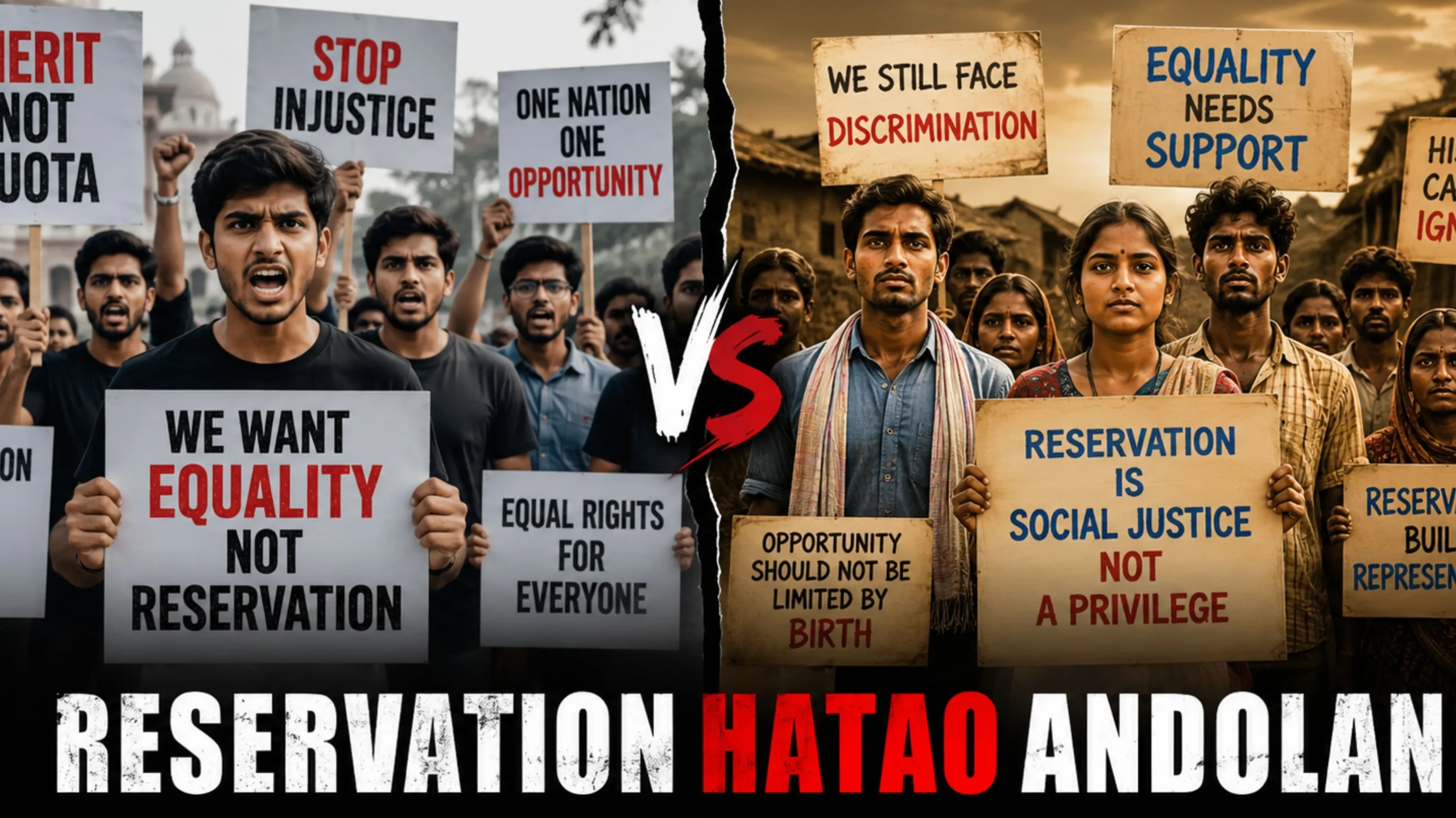
3.8 Million Followers and Counting: Reservation Hatao Andolan brings Reservation Debate Back to the National Stage
New Delhi: The Cockroach Janta Party (CJP) ended its weeks-long protest at Jantar Mantar after the government accepted several key demands, including the resignation of the Union Education Minister over repeated NEET paper leaks. Soon after, Reservation Hatao Andolan (Remove Reservation Movement) went viral on social media. Its Instagram page reportedly gained over one million followers within hours, with later claims of crossing three million. Students flooded Instagram and X with slogans such as “Equality. Merit. Justice.” and “One Nation, One Identity – Indian,” while calling for peaceful protests.
The movement gained momentum because many students who had protested against exam paper leaks began questioning why caste still plays a major role in education and government jobs. They argued that fairness should apply not only to examinations but also to the admission and recruitment process. Reservation Hatao Andolan became the first major Gen-Z, social media-driven campaign to primarily demand the removal of caste-based reservation, triggering a nationwide debate.
For lakhs of aspirants preparing for NEET, JEE, UPSC, and other competitive exams, reservation directly affects educational and career opportunities. Many believe it determines who gets a government college seat or a secure public-sector job. The campaign spread rapidly because it remained independent of major political parties and highlighted widely discussed data on cut-offs, reservation policies, and discrimination. It soon evolved from a viral online movement into a national conversation on merit, equality, and reservation.
How the Movement Started and Grew So Quickly
The Cockroach Janta Party (CJP) first emerged as a satirical response to a controversial judicial remark about unemployed youth. Soon, the group shifted its focus to serious issues such as examination paper leaks, marking errors, and irregularities in competitive exams.
After protesting for more than a month, the group achieved several major victories.
The government accepted important demands, including the resignation of the Union Education Minister. It also agreed to withdraw cases filed against protesters and started discussions about providing compensation to the families of students who died by suicide during the NEET controversy.
Within a day of the protest ending, several Reservation Hatao Andolan social media accounts appeared online. The campaign expanded at an extraordinary pace.
Unlike earlier reservation movements, this campaign does not have one well-known public leader. For example, Hardik Patel led the Patidar reservation movement, while Manoj Jarange became the face of the Maratha reservation campaign.
Reservation Hatao Andolan has not introduced any similar leader. Instead, its organisers describe it as a citizen-led movement that works independently and stays away from political parties.
The campaign carefully uses peaceful and constitutional language. Its social media posts repeatedly describe the movement as respectful towards every Indian citizen.
The movement also repeats a clear set of demands. It wants the government to end caste-based reservation in educational institutions and government jobs. It argues that authorities should select candidates through transparent and common standards based on merit, ability, and hard work.
The movement also asks the government to provide scholarships, coaching support, and financial assistance according to measurable economic and educational hardship instead of caste.
Another important demand asks authorities to stop making students and job applicants mention their caste on routine admission and employment forms.
The campaign also promotes the slogan “One Nation, One Identity.” Some supporters have suggested additional reforms that policy experts have discussed for years.
These ideas include enforcing stricter creamy layer rules, eventually extending those rules to SC and ST categories, limiting reservation benefits to one generation or one member of a family, and introducing a sunset clause so that reservation does not continue indefinitely. The movement mainly attracts young people, especially students from the general category.
Every counselling season, many of these students see large differences in qualifying marks and closing ranks between categories. Those visible score gaps have become the biggest source of frustration and have driven much of the movement’s support.
The Numbers Behind the Anger
The Reservation Hatao Andolan has gained support because many students believe the current reservation system creates unequal competition. Every year, admission results and counselling data bring this debate back into public discussion.
At the central level, the reservation system covers about 59.5% of all seats after the government introduced the Economically Weaker Sections (EWS) quota.
The current reservation structure includes:
- 15% for Scheduled Castes (SC)
- 7.5% for Scheduled Tribes (ST)
- 27% for Other Backward Classes (OBC)
- 10% for Economically Weaker Sections (EWS)
Many states provide even higher reservation percentages.
Candidates from reserved categories can also compete under the open or unreserved category if they score high enough. However, qualifying marks and admission cut-offs often differ significantly across categories.
These differences have become one of the biggest reasons behind the growing frustration among many students.
For example, JEE Main 2026 reported major differences in the qualifying percentile for different categories.
The reported qualifying percentile stood at around 93.4 for the General (UR) category. It dropped to around 80.9 for OBC candidates, around 63.9 for SC candidates, and around 52 for ST candidates.
A similar pattern appears every year in NEET. The qualifying marks for General and EWS candidates usually remain much higher than those for OBC, SC, and ST candidates.
Government medical college counselling also shows large differences in closing ranks. In many cases, general-category students need scores that are hundreds of marks higher than students admitted under reserved categories for similar seats.
These numbers do not represent a new trend. Authorities publish them every year during the admission process. For many students, these statistics are not just numbers. They shape personal experiences. Students who narrowly miss admission despite scoring high often compare their results with lower cut-offs in reserved categories. As a result, many of them believe the system rewards caste instead of merit.
This feeling has become one of the strongest driving forces behind the Reservation Hatao Andolan.
Why Supporters Want Change
Supporters of the movement argue that India introduced reservation as a temporary measure to reduce historical inequality. They believe that after more than seven decades, the system has strengthened caste identity instead of reducing it.
They point out that almost every admission form and government job application still asks candidates to mention their caste. According to them, this practice keeps caste alive in everyday public life instead of moving India toward a casteless society.
Many supporters also question whether reservation benefits reach the people who need them the most. They argue that a large share of these benefits goes to the creamy layer—families that have already improved their economic and social conditions but continue to receive reservation advantages generation after generation.
Meanwhile, they say, many poor families from general-category communities struggle without receiving similar support. Supporters believe the government should replace caste-based benefits with a system that measures actual financial hardship and educational disadvantage.
Under such a model, scholarships, coaching support, fee assistance, and other welfare schemes would go to students based on economic need instead of caste identity. The creamy layer debate has existed for several years.
An official government panel that studied OBC sub-categorisation found that a very small number of OBC communities received a disproportionately large share of reservation benefits, while many other communities received little or no benefit.
Supporters of Reservation Hatao Andolan often cite this finding to argue that the current system does not distribute opportunities equally, even within reserved categories.
They also highlight another issue. Several reports have shown that many reserved faculty positions in central educational institutions remain vacant for years. UNESCO-linked reporting has estimated that nearly 30% of reserved faculty posts remain unfilled in some central institutions.
Supporters believe these vacancies reveal weaknesses in how the reservation system works.
They argue that the government should focus on improving school education, coaching opportunities, and financial support so that students from disadvantaged backgrounds can compete successfully on equal terms instead of relying on permanent reservation.
Many people associated with the movement have also suggested broader reforms. These proposals include applying stricter creamy layer rules, eventually extending those rules to SC and ST categories, limiting reservation benefits to one generation or one member of a family, and introducing a sunset clause so that reservation gradually ends after achieving its original purpose.
Supporters believe these reforms would create a system that rewards merit while still helping students who genuinely need financial and educational support.
The Other Side of the Debate: Why Many Believe Reservation Is Still Necessary
While the Reservation Hatao Andolan has gained strong support among many students, many researchers, policymakers, and social justice groups argue that India cannot remove caste-based reservation yet. They point to data that shows caste discrimination and social inequality still exist across the country.
According to the National Crime Records Bureau (NCRB), authorities continue to register tens of thousands of cases of crimes and atrocities against Scheduled Castes (SCs) and Scheduled Tribes (STs) every year.
Recent data recorded more than 55,000 cases of crimes against Scheduled Castes, along with several thousand cases involving Scheduled Tribes.
Experts also point out that conviction rates in these cases remain relatively low, while courts take years to dispose of many of them. As a result, victims often wait a long time for justice.
Supporters of reservation say these numbers show that caste discrimination has not disappeared from Indian society.
Discrimination on College Campuses
Higher education institutions also continue to report complaints related to caste discrimination.
Data submitted by the University Grants Commission (UGC) to parliamentary committees and courts shows that complaints of caste discrimination on university campuses increased from 173 cases in 2019–20 to 378 cases in 2023–24.
This represents an increase of more than 100 percent in just a few years.
Although universities eventually marked most of these complaints as resolved, critics of removing reservation argue that the rising number of complaints reflects continuing social challenges in educational institutions.
Cases registered under the Protection of Civil Rights Act, which deals with offences related to untouchability, also continue to show a very high pendency rate.
Many experts believe these figures indicate that caste-based discrimination remains a reality despite decades of legal protection.
Surveys Show Social and Economic Gaps
State-level studies also highlight continuing differences among communities. For example, Telangana’s recent socio-economic and caste survey found that Scheduled Castes and Scheduled Tribes scored much higher on backwardness indicators than general-category communities.
The survey reported that SC and ST families were more likely to depend on daily-wage labour and faced greater economic and social disadvantages than many other groups.
Supporters of reservation argue that these findings prove that historical inequality continues to affect opportunities for education, employment, and income.
They also acknowledge that reservation has improved representation in higher education and government jobs over the years.
However, they say complete equality has not yet been achieved, especially in prestigious educational institutions and senior government positions.
Another issue remains the large number of reserved posts that stay vacant for years.
Experts believe these vacancies result from several factors, including unequal access to quality school education, limited educational opportunities, and delays in recruitment.
What Pew Research Found
The debate becomes even more complex when survey data enters the discussion.
The Pew Research Center, through its large national studies on religion and social attitudes in India, found that around 82 percent of Indians said they had not personally experienced caste discrimination during the previous year.
Even among respondents from Scheduled Castes and Scheduled Tribes, a large majority reported that they had not personally faced caste discrimination during that period.
Only about 14 percent of SC and ST respondents said they had personally experienced caste discrimination in the previous year. The survey also asked people whether they believed there was “a lot” of discrimination against SCs, STs, or OBCs.
Most respondents answered no.
Even among members of these communities, fewer than one in four believed that widespread discrimination existed.
However, the same survey revealed another important reality. A large majority of Indians still considered inter-caste marriage unacceptable or undesirable. This finding suggests that although many people may not experience everyday discrimination directly, caste continues to influence social relationships and family decisions.
Both Sets of Data Matter These different data sets do not contradict each other. Crime records and university complaints clearly show that caste-based violence and discrimination still occur and remain serious issues.
At the same time, perception surveys suggest that many Indians do not experience caste discrimination in their daily lives. Both realities can exist together.
Some people continue to face severe discrimination, while many others may rarely encounter it personally. Any honest discussion on reservation must consider both sets of evidence instead of focusing on only one.
History Shows Why Reform Is Difficult
India’s reservation system existed even before Independence. Several princely states and British-era provinces experimented with different forms of communal representation before the country became independent.
A major turning point came in 1932 with the Poona Pact between Mahatma Gandhi and Dr. B.R. Ambedkar. The agreement replaced separate electorates for the Depressed Classes with reserved seats in legislatures.
After Independence, the Constitution introduced special provisions for socially and educationally backward classes.
The reservation system expanded significantly in 1990, when the government implemented the Mandal Commission’s recommendation to provide 27 percent reservation for OBCs in central government jobs.
The decision triggered one of the largest anti-reservation movements in India’s history. Thousands of students protested across the country, and several young people died by self-immolation during the agitation.
Another major protest took place in 2006, when the government extended OBC reservation to central educational institutions. Students under the Youth for Equality banner organised nationwide demonstrations against the decision. Despite these large protests, India did not abolish the reservation system.
Instead, policymakers introduced reforms such as the creamy layer principle for OBCs and, years later, the Economically Weaker Sections (EWS) quota. At the same time, several communities outside the reservation system—including Jats, Patidars, Marathas, and Gujjars—have repeatedly organised protests demanding inclusion in reserved categories.
Whether the movement eventually changes government policy remains uncertain. Meaningful reform would require political consensus, legislative action, constitutional safeguards, and careful consideration of the interests of millions of people.
At present, that remains a difficult task.
However, the movement has already succeeded in raising questions that many young Indians believe deserve serious discussion.
The future of this debate will depend on whether citizens, policymakers, and political leaders choose evidence over emotion.
