
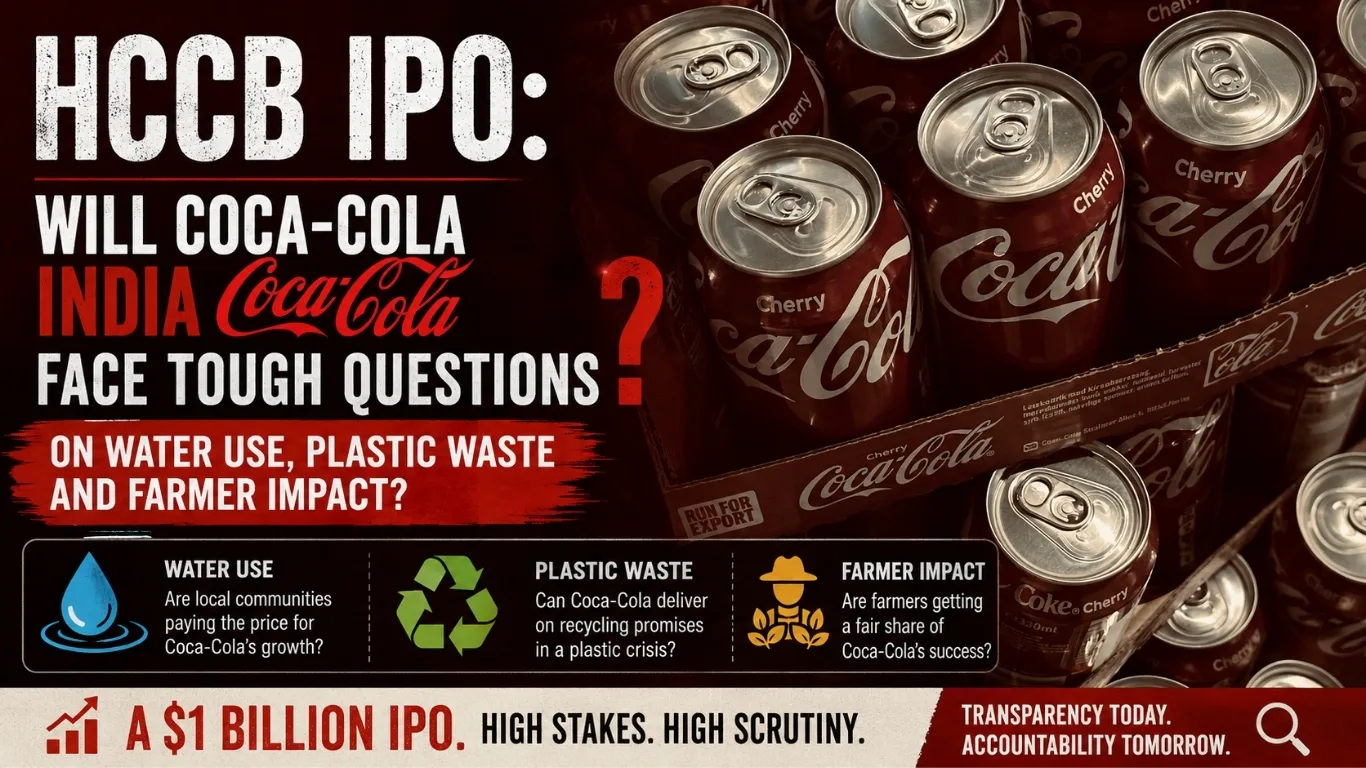
As Hindustan Coca-Cola Beverages (HCCB) prepares for its IPO, questions grow over its water footprint, plastic waste management, farmer partnerships and sustainability commitments
New Delhi: The discussion around Hindustan Coca-Cola Beverages’ (HCCB) proposed IPO has largely focused on numbers. Reports suggest the company could be valued at nearly $10 billion and may raise around $1 billion through the public issue. Kotak and Citibank are reportedly advising the deal, while the Bhartia family of the Jubilant Group has already acquired a 40% stake in the company for ₹12,500 crore.
However, the bigger question goes beyond valuation and fundraising. Once HCCB becomes a listed company, investors, regulators and consumers will likely ask a more important question: what responsibility does the company have towards the water, land and farmers that support its business?
That is the real story behind HCCB’s planned IPO. It is a question that market regulators, ESG-focused investors and environmentally conscious consumers are increasingly demanding companies answer.
A Business Built on India’s Natural Resources
HCCB is one of India’s largest beverage companies. It operates 16 factories across 22 states and three Union Territories. Through a network of 3,500 distributors, it supplies products to around 2.5 million retailers and employs nearly 6,000 people.
The company reported revenue of ₹14,021 crore in FY24, up 9.2% from the previous year. Its net profit increased by 247% during the same period. HCCB manufactures more than 60 products across seven categories, including Coca-Cola, Thums Up, Sprite, Maaza, Minute Maid, Kinley and Limca.
Every one of these products depends on two resources that India increasingly struggles to manage—water and agricultural produce.
Water is the most important raw material in beverage manufacturing. HCCB says it uses only 0.023% of India’s total industrial water consumption and argues that its overall footprint is small. However, critics point out that the real issue is not the national total but where the company extracts that water.
The Groundwater Question That Refuses to Go Away
HCCB’s use of groundwater has been one of the most debated issues in Indian corporate history. A public listing is likely to bring this history back into focus through mandatory risk disclosures.
The most well-known example is Plachimada in Kerala. HCCB opened a bottling plant there in 2000, but authorities shut it down in 2004 after local residents claimed that the plant had caused severe groundwater depletion and contamination. A state-appointed High Power Committee later found evidence supporting those concerns. Kerala eventually passed legislation that allowed legal action against the company for damages estimated at up to $47 million. The dispute remained tied up in legal proceedings for years.
A similar controversy emerged at Mehdiganj near Varanasi in Uttar Pradesh. When Coca-Cola started operations there in 1999, the Central Ground Water Board classified the area as “safe.” By 2009, the area had moved into the “critical” category. By 2014, authorities classified it as “over-exploited,” meaning water extraction exceeded natural recharge levels.
Local communities reported that groundwater levels had fallen by nearly 7.9 metres after the plant began operations. In August 2014, the government rejected HCCB’s proposal to expand the facility. As a result, a newly built PET bottling line worth $25 million never received permission to begin operations.
The company faced another challenge in Kala Dera near Jaipur. Groundwater levels declined to such an extent that HCCB eventually closed the facility. While the company relocated 115 permanent employees, around 170 contract workers lost their jobs, leading to unrest in the area.
The India Resource Center has documented protests against HCCB facilities in at least six locations, including Plachimada, Mehdiganj, Kala Dera, Wada in Maharashtra and Sivaganga in Tamil Nadu.
HCCB disputes claims that its operations have harmed local water resources. The company says it reduced its water-use ratio from 2.89 litres of water per litre of product in 2009 to 2.35 litres in 2012 and has continued improving since then. It also claims that its water conservation projects now create a replenishment potential exceeding 130% of the water it uses in India.
The company highlights watershed development programmes and community water projects as examples of its efforts. In 2024, its Bidadi plant in Karnataka became the first Coca-Cola facility in India and Southwest Asia to receive carbon-neutral certification under the PAS 2060 standard.
However, public markets may judge these claims differently. A national water replenishment figure does not necessarily address concerns in communities where local groundwater resources have been affected. Under SEBI’s Business Responsibility and Sustainability Reporting (BRSR) framework, listed companies must provide detailed information about water consumption and sourcing at the plant level. That requirement creates a much higher level of accountability than broad company-wide sustainability claims.

Mansi Sharma is a journalist covering Global Affairs, and wellness, known for turning complex ideas into sharp, engaging narratives. Her work is driven by curiosity, depth, and a constant urge to question and explore. When she’s not writing, you’ll often find her diving into new ideas—preferably with a cup of coffee in hand, one sip at a time.