
Experts Highlight Green Energy, Energy Security and Sustainability as Key Drivers of India’s Journey Towards Viksit Bharat 2047
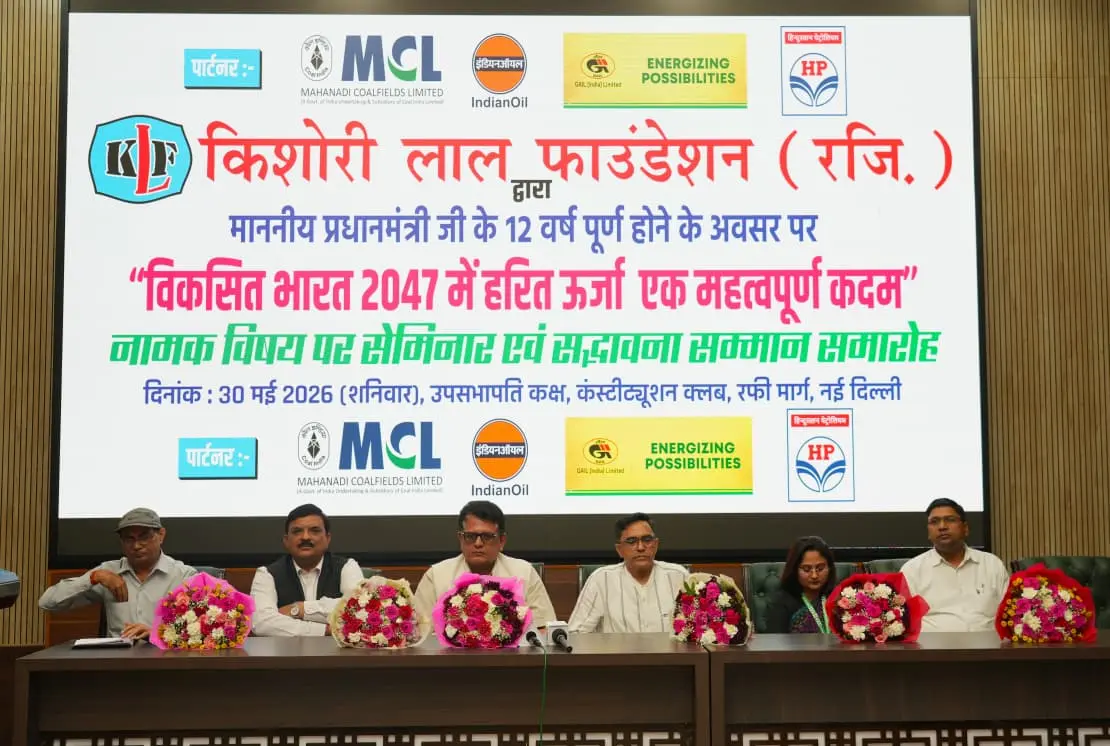
New Delhi: To commemorate 12 years of Prime Minister Narendra Modi’s leadership, the Kishori Lal Foundation organised a special seminar titled “Green Energy: A Crucial Step Towards Viksit Bharat 2047” at the Constitution Club of India, New Delhi. The occasion also witnessed the presentation of the Sadbhavana Samman to social workers and journalists from diverse fields in recognition of their outstanding contributions.
The seminar brought together eminent personalities from government, industry, media, and public service, including Kuldeep Singh, Chairman of Hill India Limited; Ram Kumar, Deputy Secretary, Ministry of Coal; Manoj Verma, Senior Journalist at Sansad TV; PCS Officer Madira Sharma; Sanjay Kumar, Under Secretary, Government of India; and Jagdamba Singh, General Secretary of BJP Purvanchal Morcha, Delhi Pradesh.
The programme commenced with a welcome address by Kuldeep Sharma, President of the Kishori Lal Foundation, who greeted the guests and highlighted the significance of sustainable development in India’s growth journey.
Speaking on the occasion, Kuldeep Singh, Chairman of Hill India Limited, said India has witnessed unprecedented growth in the green energy sector over the past decade. He noted that the country’s renewable energy capacity crossed 200 GW by 2023, driven by major contributions from solar, wind, hydro, and nuclear energy. He emphasized that India currently ranks fourth globally in solar energy capacity and fifth in wind energy generation.
Highlighting India’s future roadmap, Singh said the nation has set an ambitious target of achieving 500 GW of renewable energy capacity by 2030, which is expected to account for nearly half of the country’s energy mix. According to him, this milestone will not only strengthen India’s energy security but also position the country as a global leader in climate action.
Referring to the National Green Hydrogen Mission, Singh described it as a transformative initiative in India’s energy transition. Launched in 2023, the mission aims to produce 5 million tonnes of green hydrogen annually by 2030 and is expected to drive major changes across industry, transportation, and power sectors. He added that the initiative would also contribute to the development of 125 GW of renewable energy capacity, further advancing India’s energy self-reliance while supporting global efforts to combat climate change.
Singh also underlined the importance of international cooperation in strengthening India’s green energy ambitions. He pointed to the International Solar Alliance (ISA), launched by India in 2015, as a landmark initiative. Through projects such as “One Sun, One World, One Grid,” the alliance seeks to create a global solar energy network and currently includes more than 110 participating countries.
He further noted that Prime Minister Modi’s Panchamrit commitments, announced at the COP26 Climate Summit in 2021, significantly reinforced India’s climate goals. These include achieving 500 GW of renewable energy capacity by 2030 and reaching net-zero emissions by 2070, along with attracting $100 billion in investments for green energy projects.
Addressing the gathering, Manoj Verma, Senior Journalist at Sansad TV, said that Prime Minister Modi’s vision of Atmanirbhar Bharat has become a strong foundation for reducing dependence on imported fuels and steering India toward sustainable development. He observed that India has established itself as a global force in clean energy, solar power, and green hydrogen while steadily progressing toward the goal of a developed nation.
Verma emphasized that energy self-sufficiency is essential for securing the future of India’s youth and farmers. He remarked that while India had originally targeted achieving 50 percent clean energy by 2030, the commitment and collective efforts of its citizens enabled the country to accomplish the goal by 2025. He described the advancements in solar, nuclear, hydro, and hydrogen energy as a major step toward energy independence.
Ram Kumar, Deputy Secretary, Ministry of Coal, said that Prime Minister Modi’s vision for transforming India into a developed nation by 2047 is both comprehensive and far-reaching. He stressed that green energy would play a central role in achieving that objective and urged citizens to actively support energy conservation efforts.
“Energy is the foundation of development. We must focus on reducing wastage at every level and adopt sustainable practices. India is likely to achieve its carbon emission reduction targets well before the 2070 deadline, provided all stakeholders contribute collectively to this mission,” he said.
Jagdamba Singh, General Secretary of BJP Purvanchal Morcha, Delhi Pradesh, stated that achieving developed nation status by 2047 would require collective action in the field of green energy. He noted that conventional energy sources have inherent limitations, making it necessary to rapidly expand alternative and sustainable energy options.
“Green energy will not only make India self-reliant in the energy sector but will also reduce adverse impacts on humanity, biodiversity, and the environment. Our development model must be one that balances economic growth with ecological responsibility,” he said.
Speaking on the broader significance of the green transition, Sanjay Kumar, Under Secretary, Government of India, said that investments and initiatives in green energy would prove decisive in achieving the vision of Viksit Bharat 2047.
He described green energy as more than a pathway to energy security, calling it a catalyst for environmental sustainability, social inclusion, and economic empowerment. According to him, green energy will enable India to tackle environmental challenges while strengthening its position as a self-reliant, prosperous, and globally influential nation.
Kumar said that the vision outlined by Prime Minister Modi reflects the aspirations of every Indian and requires active participation from all sections of society. Looking ahead to 2047, when India will celebrate 100 years of independence, he said the country’s green energy-driven development journey would usher in a new era, positioning India not only as a developed nation but also as a global leader.
