
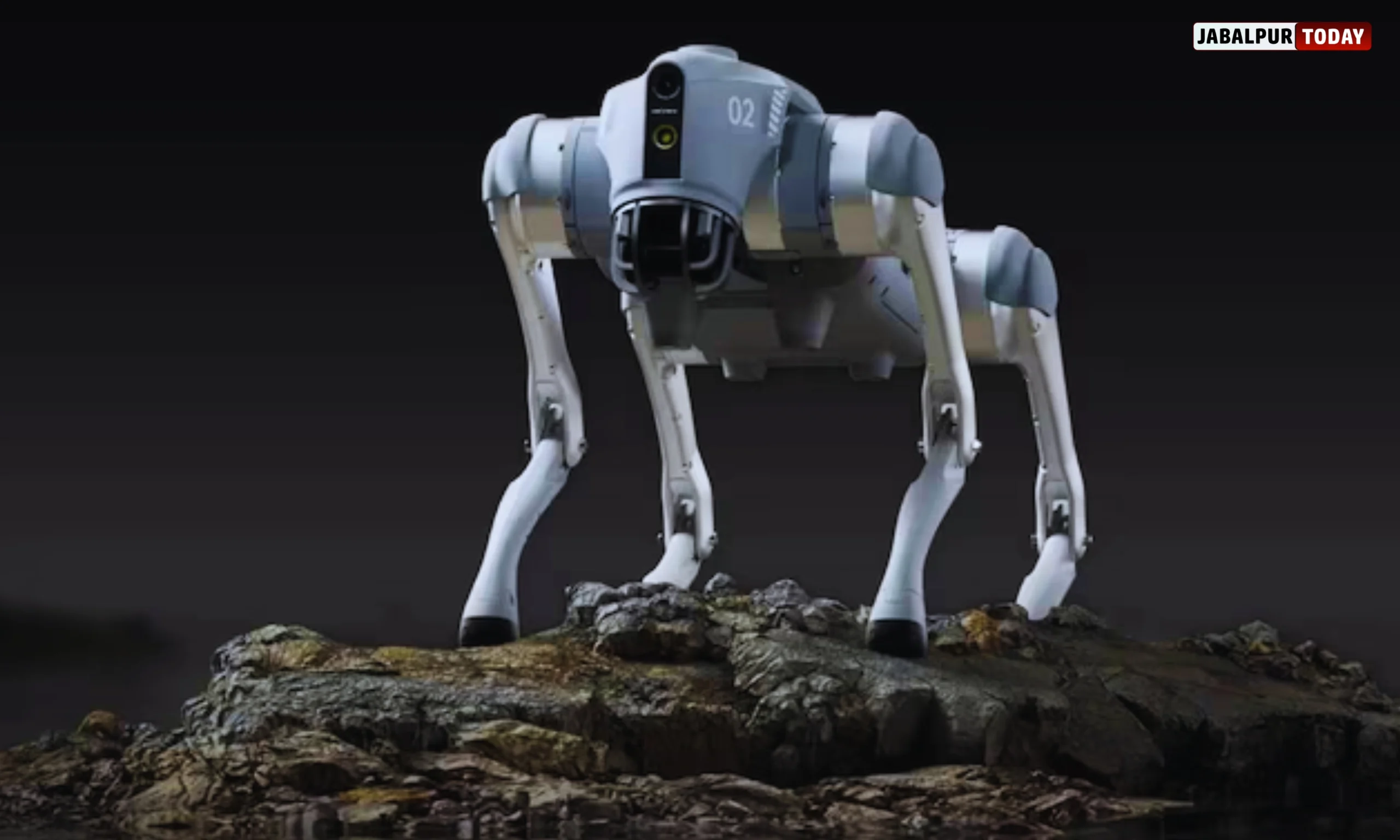
At the India AI Impact Summit 2026, Galgotias University displayed a robot dog called “Orion,” later identified as the commercially sold Unitree Go2, sparking debate over its presentation and origin.
New Delhi: At the India AI Impact Summit 2026 in New Delhi, a robotic dog called “Orion” attracted a lot of attention. It was displayed by Galgotias University as an example of their innovation in artificial intelligence. However, the excitement soon turned into controversy. People online recognized that “Orion” was actually the Unitree Go2, a robot made by the Chinese company Unitree Robotics.
The Go2 was launched in 2023 and is sold worldwide as an affordable robot for education and research. While the incident raised questions about how the robot was presented, it also showed how international technology like the Go2 is helping students and researchers experiment with advanced robotics.
How the Controversy Started at the Summit
The India AI Impact Summit 2026 began on February 17 at Bharat Mandapam in New Delhi. It was meant to showcase new developments in artificial intelligence across India.
At the Galgotias University stall, the robot dog “Orion” performed actions like walking, jumping, and avoiding obstacles. It attracted large crowds.
Here is how events unfolded:
• February 17 (Day 1): The university demonstrated the robot. Professor Neha Singh described it as developed by their Centre of Excellence in collaboration with industry partners.
• Late February 17: A video of the robot went viral online. Many viewers identified it as the Unitree Go2, a commercially available robot, not one built by the university.
• Early February 18 (Day 2): Criticism increased online. Reports said that organizers cut power to the stall and asked the team to leave to protect the event’s credibility.
• Mid-February 18: The university released a clarification, and its staff left the summit.
As of February 19, 2026, authorities have not reported any further official action. However, the situation has sparked discussions about honesty and transparency in academic technology exhibitions.
What Was Shown and Claimed
In the viral video, the robot was labeled “Orion” and carried the university’s logo. It performed advanced movements such as walking smoothly, jumping, and navigating around objects.
Professor Singh described it as a product of the university’s innovation hub and said the university was using it for student AI projects. This statement led many people to believe that the university had fully developed the hardware in-house. This issue became sensitive because the summit strongly promoted India’s locally developed technologies.
Galgotias University’s Response
The university quickly clarified that they never claimed to have manufactured the robot. They called the issue a “communication error” during a live demonstration.
In their statement, they explained that they had purchased the Unitree Go2 as part of their AI ecosystem. They said their work focused on software development, AI integration, and student learning projects using the robot—not on building the hardware itself.
They also highlighted their ₹350 crore investment in AI labs and emphasized that they intended the robot to provide students with hands-on experience.
The Real Creator: Unitree Robotics
Unitree Robotics, a company based in Hangzhou, China, created the Go2 robot dog. Wang Xingxing founded the company in 2016.
Wang was inspired by the robot “BigDog” from Boston Dynamics. During his postgraduate studies (2013–2016), he built early prototypes such as “XDog.” His goal was to make quadruped (four-legged) robots cheaper and more accessible.
Important Milestones in Unitree’s Development:
• 2017: First prototype (35 kg, $30,000)
• 2018: A1 model (12 kg, $10,000)
• 2019: Aliengo (capable of jumping 1.2 meters)
• 2020: Go1 ($2,700)
• 2023: Launch of Go2
The Go2’s Launch in 2023
Unitree officially introduced the Go2 on July 12, 2023. It was an upgraded version of the earlier Go1 model from 2021.
The company described it as a second-generation robot with improved artificial intelligence, better navigation, and voice interaction features. It designed the robot as an “embodied AI” system for everyday and educational use.
Key Features of the Go2
The Go2 weighs about 15–16 kg. Manufacturers make it from aluminum alloy and strong plastic, which keeps it durable yet lightweight.
Main Specifications:
• Size: 70 × 31 × 40 cm (standing)
• Top Speed: 3.7 meters per second (about 13 km/h)
• Battery Life: 1–2 hours (8000 mAh battery)
• Load Capacity: Up to 7 kg
• Mobility: Can climb 30° slopes and cross 5.9-inch obstacles
• Movement: 12 joint motors allow jumping, flipping, and dancing
• AI Features: 4D LiDAR for 360° sensing, voice commands with GPT integration, improved wireless positioning
• Price: Starts at around $1,600 (approximately ₹1.3 lakh). In India, it sells for about ₹2–3 lakh on platforms like Amazon.
How People Use the Go2 Around the World
The Go2 is not just a robot toy. It is used in many practical ways:
• Search-and-rescue simulations
• Fire inspection and patrol tasks
• Entertainment (such as dance performances)
• AI research and student projects
• Custom programming through mobile apps
Comparison with Other Robot Dogs
• Compared to Spot by Boston Dynamics (costing about $74,500), the Go2 is much cheaper and lighter but less suited for heavy industrial work.
• Compared to Sony Aibo, the Go2 is more functional and research-focused rather than designed mainly as a robotic pet.
The company has sold the Go2 globally since 2023, including in India. It supports Wi-Fi 6, Bluetooth, and 4G connectivity, which makes it well suited for remote learning and research projects.
What This Means for India’s AI Development
This incident highlights India’s strong push to build its own technology while still depending on international hardware, especially from China.
Universities like Galgotias must learn a clear lesson: they must prioritize transparency. They can use imported hardware as a base for local software innovation, but they must communicate this clearly.
It also suggests that technology events may need stricter disclosure rules to maintain trust. This supports national goals such as promoting domestic innovation under programs like “Make in India.”
Conclusion: A Lesson Beyond the Controversy
What began as a controversy at a summit also shows something positive. The Unitree Go2 makes advanced robotics affordable and accessible to students and researchers worldwide.
The real opportunity lies not in claiming ownership of global technology, but in building meaningful innovations on top of it. As artificial intelligence continues to grow, stories like this remind us that progress comes from honest collaboration and clear communication.
Also Read on jabalpur today: Decoding the Epstein Files: What the Unsealed Documents Reveal and Why Questions Still Remain

Mansi Sharma is a journalist covering Global Affairs, and wellness, known for turning complex ideas into sharp, engaging narratives. Her work is driven by curiosity, depth, and a constant urge to question and explore. When she’s not writing, you’ll often find her diving into new ideas—preferably with a cup of coffee in hand, one sip at a time.