
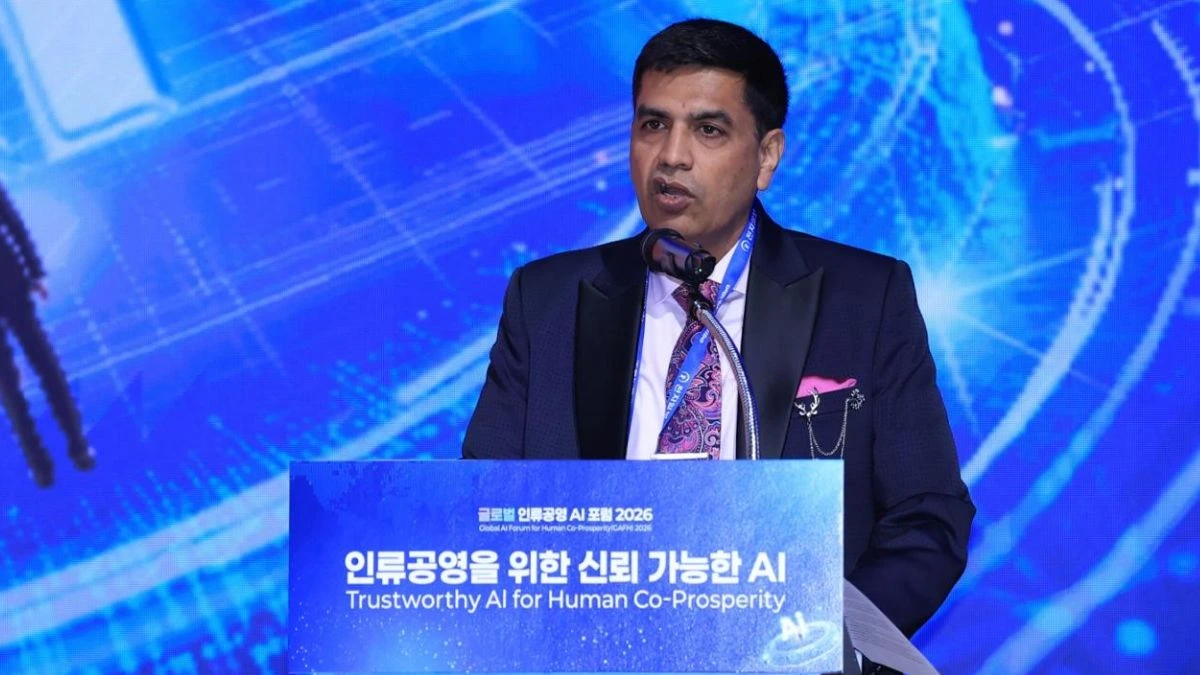
New Delhi/Seoul: Experts and decision-makers worldwide have urged that artificial intelligence be developed with strong ethical foundations and human supervision, warning that unchecked innovation could amplify global risks.
The call was made at the Global AI Forum for Human Co-Prosperity 2026 (GAFH 2026), held on June 12 at the Korea Chamber of Commerce and Industry in Seoul, South Korea. Organized by media house Cheonji Ilbo, the summit brought together more than 300 delegates, including policymakers, human rights advocates, academics, and industry leaders, culminating in the signing of the Global AI Declaration.
Opening the forum, Lee Sang-myeon, CEO of Cheonji Ilbo and Chairman of the GAFH Organizing Committee, said the future of AI should be guided by universal human values rather than competition for technological dominance. He cautioned that unchecked AI development could accelerate risks such as autonomous weapons, mass surveillance, and misinformation.
Representing India, Professor (Dr.) Lalit Aggarwal, Vice President of the MERI Group of Institutions, highlighted what he described as an emerging “Empathy Divide.” He said that while digital connectivity has increased, societies have become more fragmented due to algorithm-driven echo chambers and polarization.
Professor Aggarwal advocated for AI-powered peace education and urged developers to build intelligent learning platforms that promote conflict resolution, cross-cultural understanding, and peace literacy. He also presented MERI’s Total Assessment of Risk and Peace (TARP) framework, designed to assess whether high-stakes systems contribute to conflict or stability.
Other speakers echoed the need for a human-centric approach to AI governance. Andy Vermaut, Chairman of the World Council for Public Diplomacy and Community Dialogue, stressed that AI regulation must extend beyond national borders, while cultural anthropologist Dr. Park Jung-jin argued that ethical principles should be built into AI systems from the beginning rather than added later.
Joo Young-seop, Distinguished Professor at Seoul National University, said a country’s progress in the AI era should be measured by its ability to use technology for human coexistence and the United Nations Sustainable Development Goals rather than commercial success alone.
The Global AI Declaration adopted at the summit emphasizes that as AI systems increasingly influence human decision-making, governments, technology companies, and institutions must ensure that ethics, accountability, and human oversight remain at the core of innovation.
