
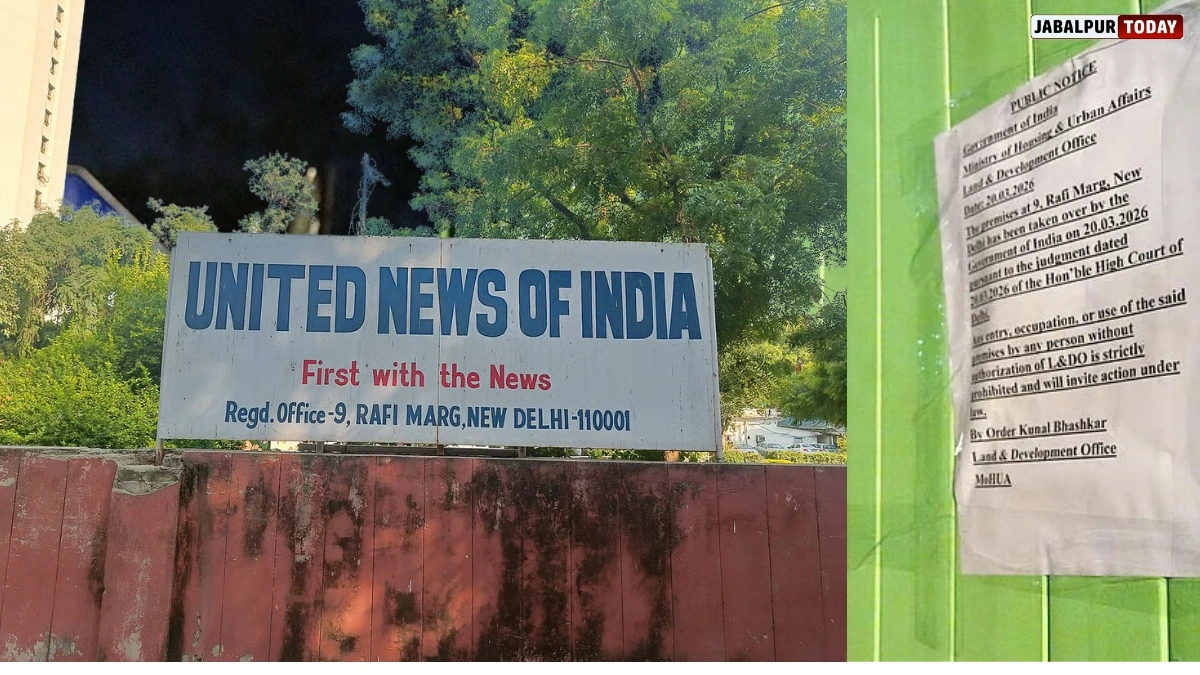
UNI Office sealed in Delhi: After the Delhi High Court denied United News of India (UNI)’s appeal contesting the cancellation of a land allocation dating back to 1979, its Delhi headquarters was sealed on March 20, 2026. Here is the whole Story.
New Delhi: On the evening of March 20, 2026, when Delhi Police and Land and Development Office (L&DO) teams arrived at 9, Rafi Marg, New Delhi, and sealed the United News of India (UNI) headquarters, one of India’s oldest news agencies found itself at the centre of a major dispute.
Hours after the Delhi High Court ruled against UNI’s plea and confirmed the government’s decision to withdraw its land allocation came the action. Though UNI has deemed it an affront on press freedom, the government contends it is only a property law case devoid of relevance to media or journalistic freedom.
Land allocation from back 1979
The roots of this disagreement go nearly five decades back. The L&DO, operating under the Ministry of Housing and Urban Affairs, granted UNI 2,024 square metres of land at Rafi Marg in 1979. The aim was to create a composite office building meant for media companies to share.
The conditions of the allocation were unambiguous: two years were set for construction; UNI was to work with CPWD and NBCC; expenditures were to be divided with co-allottees such the Press Council of India.
None of this ever materialized. In correspondence sent in 1986, 1999, and 2000, deadlines were reiterated; however UNI never provided a building design or began any building. UNI itself acknowledged in an email from 2022 that it had suffered from a severe financial crisis that had kept it from engaging in the project.
Show Cause Notice, No satisfactory Answer, Cancellation
L&DO sent UNI a show cause notice in January 2023 inquiring why its allocation should not be revoked. In February 2023, UNI answered; however the response was deemed inadequate. On March 29, 2023, L&DO formally called off the land distribution.
Challenging this decision in the Delhi High Court, UNI filed W.P.(C) 5363/2023. The organization contended that its allocation constituted an irrevocable license under Section 60 of the Indian Easements Act, therefore construction was not possible due to financial issues together with government approval delays.
Decision of Delhi High Court: Rejection of 98 pages
On March 20, 2026, a bench headed by Justice Sachin Datta rejected completely UNI’s request. In its conclusions, the roughly 98-page decision was clear. The court determined UNI had effectively squatted on government property by occupying highly valuable public land for 47 years without meeting any of the criteria for the allowance.
The court defined UNI as a mere licensee rather than a leaseholder, therefore it lacked permanent rights over the land and the license was always cancellable. UNI’s arguments financial difficulties, approval delays, and the immutable character of the license were all turned down. The court observed that over almost five decades no significant move had been made and the initial goal of the allotment had remained completely unfulfilled.
L&DO was instructed to take immediate possession of the property, make sure the Press Council of India got its fair share of 3,265.52 square meters, and demolish all unauthorised structures erected by UNI.
Hours After the Verdict: the sealing
Hours following the decision being declared, an L&DO team arrived at Rafi Marg escorted by Delhi Police and CRPF soldiers. Workers were instructed to leave the area; a notice placed on the gate stated that the property had been commandeered by the Government of India on March 20, 2026, pursuant to the order of the High Court, and that access without permission was strictly forbidden.
UNI and its employees claim they were ejected without prior notice, that women staff members were treated unfairly, and that they were not permitted to remove their possessions. Police said the court’s instructions were followed during the whole operation.
Two incredibly distinct iterations of the same incident
UNI and its crew have said the action was a direct attack on press freedom and purportedly political motives behind it. According to their reasoning, closing an autonomous news agency in this way creates a hazardous precedent for media organizations all across the country.
The government and L&DO, however, maintain that this case has nothing to do with journalism or editorial independence. It is, they say, a straightforward case of a public body occupying government land for decades without meeting the conditions of its allotment. The Delhi High Court, too, treated it entirely as a civil and land law matter.
