
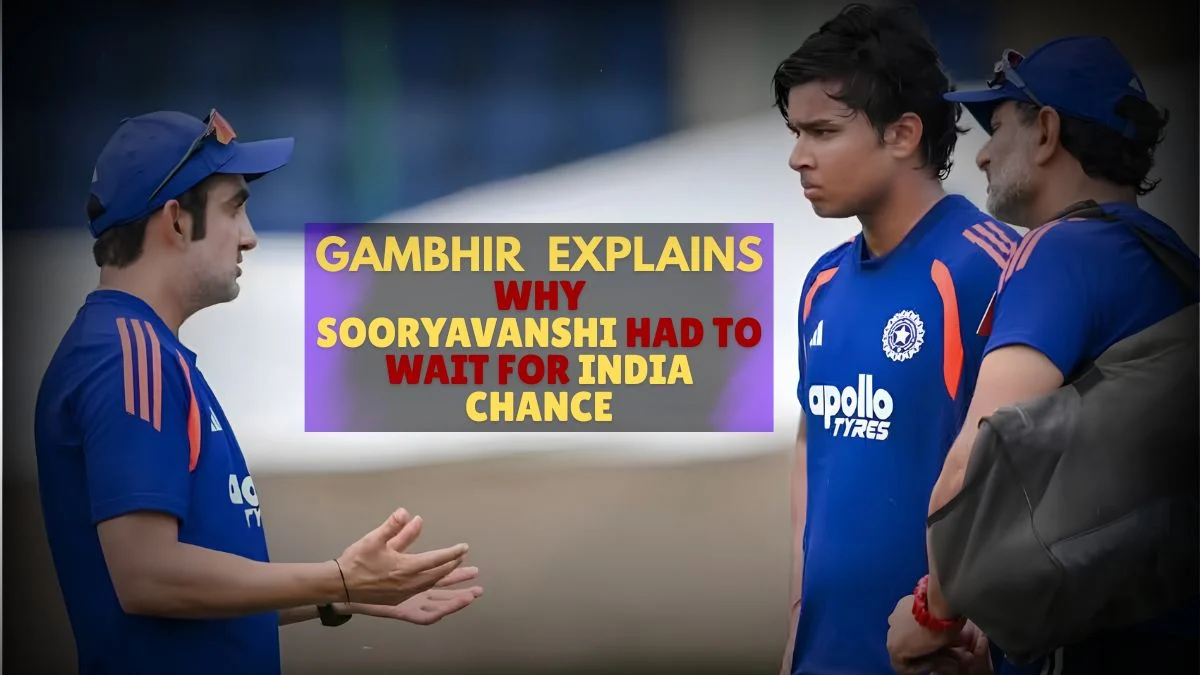
Gautam Gambhir explains why Vaibhav Sooryavanshi had to wait despite his form before helping India win Asian Games gold at just 15
New Delhi: Gautam Gambhir has explained why Vaibhav Sooryavanshi had to wait for his chance despite showing strong form at the start of his international career. The India head coach said the teenager needed to understand the value of established players and settled combinations before breaking into the XI regularly. Sooryavanshi eventually returned to the team at the Asian Games, where he helped India retain the men’s cricket gold and became the country’s youngest-ever Asian Games gold medallist.
Gambhir opens up on a tough conversation
Gambhir admitted that handling Sooryavanshi’s selection was a new experience for him too. The 15-year-old had already made an impression, but the coach knew that giving him a place meant leaving out another player who had contributed consistently.
Gambhir recalled the difficult conversation he had with the youngster. He told Sooryavanshi that good form alone could not guarantee immediate selection because several players had earned their places through sustained performances.
He also gave the teenager a simple example of the selection dilemma: “If Vaibhav plays today, then it’s going to be a tough conversation between me and whoever we leave out, whether it’s Abhishek or Sanju.”
Why being “in form” wasn’t enough
Sooryavanshi’s form gave Gambhir a strong reason to consider him, but the coach also had to balance youth with experience.
Gambhir explained that players who have performed for India over a long period deserve backing, particularly when the team has built a combination that works. For a young player, that can mean waiting even when the numbers suggest he deserves an opportunity.
That patience became part of Sooryavanshi’s early international education. Instead of treating his omission as a setback, he had to remain ready for the next opening.
The record-breaking start that raised expectations
Sooryavanshi had already created history before the Asian Games. Earlier in 2026, he became the youngest Indian to play international cricket when he made his T20I debut against England at 15 years and 99 days.
That appearance broke a long-standing record associated with Sachin Tendulkar.
Sooryavanshi then added another milestone against Zimbabwe. He reached a half-century at 15 years and 118 days, becoming the youngest player to score a men’s international half-century.
Those performances naturally raised expectations around the teenager. However, India did not immediately turn that promise into a permanent place in the XI.
A quiet stretch: left out through two series
After his early international milestones, Sooryavanshi watched from the sidelines during India’s entire Afghanistan series.
He also missed the one-off T20I against Japan, which formed part of India’s build-up to the Asian Games.
The spell could have tested a young player’s confidence. Instead, it became another lesson in international cricket: selection depends not only on individual form but also on team balance, roles and the performances of established players.
Gambhir’s explanation offered a glimpse into that larger picture.
Back in the XI: the Asian Games semi-final
Sooryavanshi finally returned to India’s XI in the Asian Games semi-final against Sri Lanka.
He made his opportunity count with a brisk 38 off 21 balls. The innings showed why the team had kept him in the picture despite his absence from the previous series.
His return also gave India another attacking option at the top, while Sooryavanshi gained valuable experience on a major multi-sport stage.
“Social media doesn’t decide the playing eleven”
Gambhir also addressed the noise surrounding selection. With Sooryavanshi already attracting attention because of his age and record-breaking performances, outside expectations could easily have influenced the conversation.
But Gambhir made India’s selection process clear: “Social media or outside noise doesn’t decide the playing eleven.”
He said the coach and captain have to decide which combination gives India the best chance of winning a match. That approach meant the team could resist the pressure to select a young player simply because public interest had grown around him.
Protecting a settled combination
For Gambhir, selection also involved protecting the confidence of players who had built a successful combination over the previous one-and-a-half to two years.
He argued that India could not discard that combination after a few failures simply to accommodate a talented youngster. At the same time, he recognised Sooryavanshi’s ability and form.
The balance, therefore, was not about choosing experience over youth forever. It was about finding the right moment.
Gambhir said the team wanted to “create that security in that dressing room”, making it clear that patience applied to both the established players and the youngster waiting behind them.
The final: a golden finish anyway
Sooryavanshi received another opportunity in the Asian Games final against Pakistan.
He scored a quick 15 off nine balls as India posted 211/6. Pakistan fought back to 192/6, but India held on for a 19-run victory and retained the men’s cricket title.
Sooryavanshi’s dismissal also produced a brief moment of tension when a Pakistani all-rounder gave him a send-off. The moment drew attention, but the teenager’s larger contribution came from the two innings he completed during the tournament.
He finished with 53 runs at a strike rate of 176.66 across those two innings.
Youngest Indian to win Asian Games gold
The victory gave Sooryavanshi a record that extended beyond cricket.
At 15 years, six months and six days, he became the youngest Indian ever to win an Asian Games gold medal. His achievement surpassed the previous age record held by shooter Saurabh Chaudhary.
Sooryavanshi’s record carries an important distinction because his medal came through a team event. India won the men’s cricket gold, while Chaudhary had achieved his record in an individual discipline.
How his record compares with Saurabh Chaudhary’s
Chaudhary was 16 years, three months and nine days old when he won the men’s 10m air pistol gold at the 2018 Asian Games in Jakarta.
That means Sooryavanshi became the youngest Indian gold medallist overall, but Chaudhary remains the youngest Indian to win an individual Asian Games gold medal.
Sooryavanshi’s medal also helped India retain the men’s cricket title they first won at the 2023 Asian Games in Hangzhou, the Games originally scheduled for 2022.
For a teenager who spent part of his first international season waiting for his next opportunity, the Asian Games provided a fitting answer. Gambhir asked him to be patient, and when the opportunity came, Sooryavanshi was ready.
