
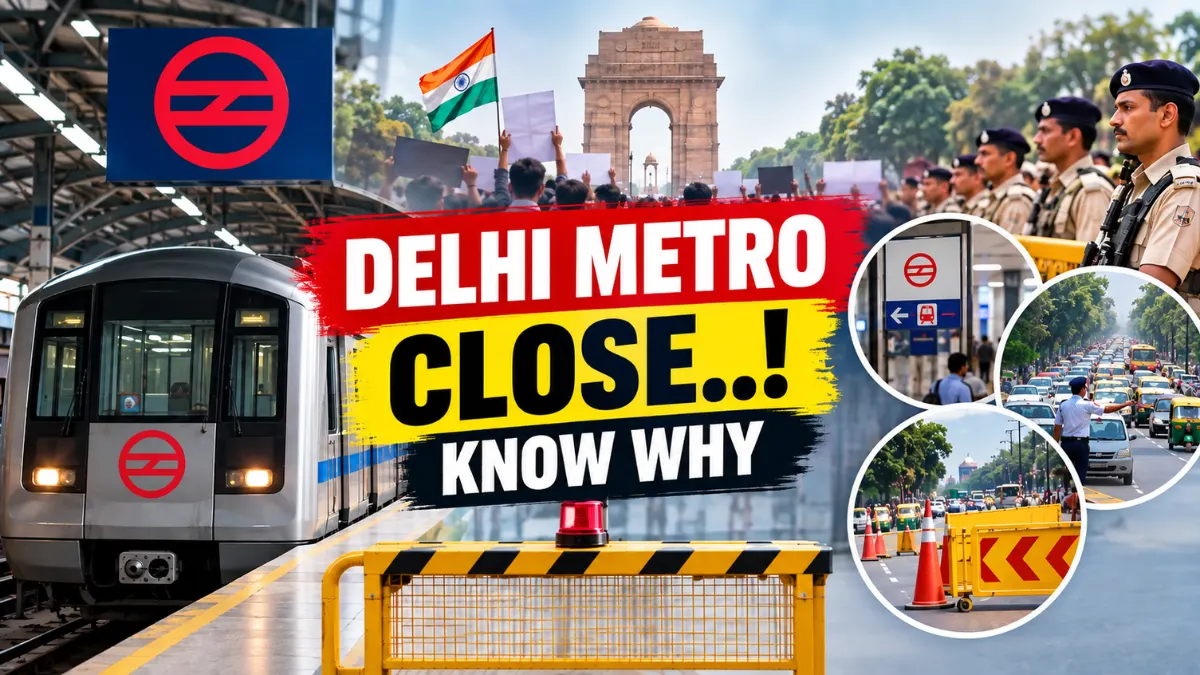
Delhi Metro has closed entry and exit at 11 central Delhi stations on October 2 amid security measures, protests and Gandhi Jayanti traffic curbs
New Delhi: Entry and exit at 11 Delhi Metro stations in central Delhi remain closed until further notice on Friday, October 2, as Delhi Police tightens security around a planned protest at Jantar Mantar and Gandhi Jayanti events. Trains continue to run through the affected stations, but passengers cannot enter or leave them. Four stations — Rajiv Chowk, Mandi House, New Delhi and Central Secretariat — continue to allow interchanges.
Delhi Traffic Police has also imposed diversions and regulated movement on several central Delhi roads. Commuters travelling through Connaught Place, Jantar Mantar, Parliament Street and nearby areas should allow extra time and check live traffic and Metro updates before starting their journey.
Why Delhi is seeing extra security today
Central Delhi is witnessing additional security arrangements because two separate sets of events coincide on October 2.
A planned political demonstration at Jantar Mantar has prompted Delhi Police to restrict gatherings and increase deployment around New Delhi. At the same time, Gandhi Jayanti programmes at Rajghat and Vijay Ghat are bringing their own security and traffic arrangements.
The combination has affected both road movement and access to several Metro stations. Police have placed additional personnel, barricades and crowd-control equipment at sensitive locations, including around Jantar Mantar.
The planned protest at Jantar Mantar
Several student and youth organisations, including the All India Students’ Association (AISA), Aam Aadmi Party (AAP), National Students’ Union of India (NSUI) and Indian Youth Congress (IYC), have backed a planned protest at Jantar Mantar.
The organisers are demanding the resignation of Chief Election Commissioner Gyanesh Kumar. They have raised concerns about the functioning of the Election Commission and alleged deletion of voters during the Special Intensive Revision (SIR) of electoral rolls.
Some reports have referred to the planned demonstration as “Jantar Mantar Protest 2.0”, linking it to earlier demonstrations over the same broad issue. Delhi Police has denied permission for the proposed gathering.
Section 163: what the prohibitory order means
Delhi Police has imposed prohibitory orders under Section 163 of the Bharatiya Nagarik Suraksha Sanhita (BNSS) across the New Delhi district.
BNSS replaced the old Code of Criminal Procedure, under which authorities commonly used Section 144 for similar preventive restrictions.
In practical terms, Section 163 allows authorities to restrict gatherings, processions, demonstrations and certain activities when they consider such restrictions necessary to prevent public-order problems. The current order restricts assemblies and related activities without prior permission.
DCP Sachin Sharma told reporters, “Section 163 is in force in New Delhi.”
For commuters, the important point is that police restrictions remain in place while security teams manage movement around the protest area.
Gandhi Jayanti adds a second layer of security
October 2 also marks Gandhi Jayanti, with special programmes taking place at Rajghat and Vijay Ghat.
Delhi Traffic Police has made separate arrangements around these locations, particularly during the morning period of approximately 5 am to 11 am. These arrangements operate alongside the restrictions linked to the proposed Jantar Mantar protest.
As a result, commuters may face diversions even on roads that are not immediately adjacent to Jantar Mantar. Traffic personnel are regulating movement at several points in central Delhi.
The 11 Delhi Metro stations with entry and exit closed
The Delhi Metro Rail Corporation (DMRC) has suspended entry and exit at these 11 stations until further notice:
- Janpath
- Patel Chowk
- Central Secretariat
- Rajiv Chowk
- Seva Teerth
- Mandi House
- Lok Kalyan Marg
- INA
- Chawri Bazar
- Ramakrishna Ashram Marg
- New Delhi
The closure applies to entry and exit, not to train movement. Metro trains continue to pass through these stations, but commuters cannot use them to start or end their journeys while the restriction remains in force.
Good news: interchange is still allowed at four stations
Passengers who need to change Metro lines can still use interchange facilities at Rajiv Chowk, Mandi House, New Delhi and Central Secretariat.
This means a passenger may be able to change from one Metro corridor to another at these stations without leaving the station premises. However, commuters should not assume that they can enter or exit these stations normally. The entry-exit restriction remains separate from the interchange facility.
Roads to avoid in central Delhi
Delhi Traffic Police has issued arrangements for central Delhi, with special restrictions around the Gandhi Jayanti programmes during the 5 am to 11 am period and additional diversions linked to the protest.
Commuters should particularly avoid unnecessary travel through or around:
- Connaught Place
- Patel Chowk
- GPO
- Tolstoy Marg
- Jantar Mantar Road
- Parliament Street
- Ashoka Road and nearby stretches
Traffic may be regulated or diverted depending on the situation on the ground. Motorists should follow directions from traffic personnel and use alternate routes wherever possible.
What police are saying on the ground
Delhi Police has said that it has not granted permission for the proposed Jantar Mantar protest and has taken preventive measures.
Security has been increased around sensitive points in New Delhi, with barricades and additional personnel deployed. Reports also indicate the deployment of water cannons and riot-control equipment around Jantar Mantar.
Police have also warned commuters to expect regulated traffic movement around the protest zone. The restrictions are intended to manage movement and maintain public order while the planned gathering and Gandhi Jayanti programmes coincide.
A separate “Jail Bharo” call adds to the day’s protests
A separate development is taking place in Mumbai, where Cockroach Janta Party founder Abhijeet Dipke has announced a “Jail Bharo Andolan” at Shivaji Park on October 2.
The announcement followed the denial of permission for the group’s proposed protest at the venue. The Mumbai action is separate from the Delhi Jantar Mantar gathering, although both relate to demands concerning Chief Election Commissioner Gyanesh Kumar and the Election Commission.
What commuters should do
If you need to travel through central Delhi today:
- Check your Metro station before leaving home. Do not rely on Janpath, Patel Chowk, Central Secretariat, Rajiv Chowk, Seva Teerth, Mandi House, Lok Kalyan Marg, INA, Chawri Bazar, Ramakrishna Ashram Marg or New Delhi for normal entry or exit.
- Use the Metro interchange option where suitable. Rajiv Chowk, Mandi House, New Delhi and Central Secretariat continue to provide interchange facilities.
- Avoid Jantar Mantar and nearby roads unless your journey requires you to pass through the area.
- Allow extra travel time, particularly if you are travelling by road through central Delhi.
- Follow police and traffic personnel on the ground, as diversions can change according to crowd and traffic conditions.
- If you have an appointment or train to catch from New Delhi Railway Station, start earlier and check your route because the New Delhi Metro station’s entry and exit facilities are also restricted.
The 11 Metro station entry-exit closures and central Delhi traffic restrictions remain in force until further notice. The situation can change during the day depending on security requirements.
Commuters should check the latest DMRC and Delhi Traffic Police updates before travelling and keep alternate routes ready.
