
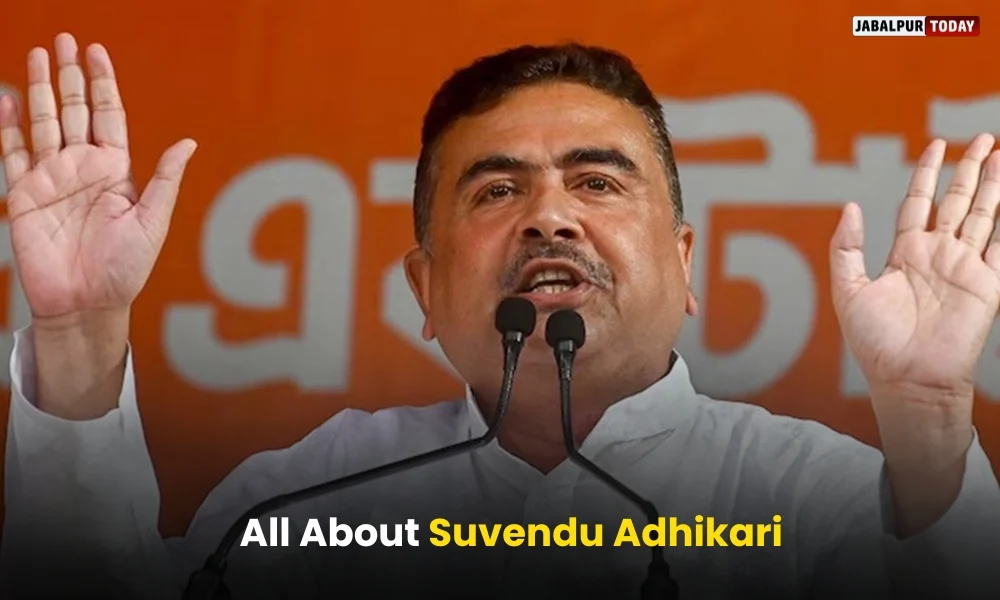
Know how Suvendu Adhikari, once Mamata Banerjee’s trusted lieutenant and hero of the Nandigram movement, became her fiercest political rival
West Bengal: Suvendu Adhikari, currently the Leader of Opposition in the West Bengal Legislative Assembly and a senior BJP leader, has emerged as one of the most influential and combative figures in Bengal politics. Once a key architect of Mamata Banerjee’s rise and a close aide during the historic Nandigram land movement, he is now her direct challenger in the high-stakes 2026 Assembly elections, contesting against her from Bhabanipur while also fighting from his traditional seat of Nandigram.
Early Life and Family Background
Suvendu Adhikari was born on December 15, 1970, in Karkuli village in Purba Medinipur district of West Bengal. He grew up in a political family. His father, Sisir Kumar Adhikari, built a long political career and served as a Member of Parliament and Union Minister of State for Rural Development in the UPA government. His mother is Gayatri Adhikari.
His brothers also entered politics. His brother Dibyendu Adhikari worked with TMC before joining BJP in 2024, while Soumendu Adhikari remained active in politics too.
Suvendu completed his early education in his hometown. After that, he earned a Bachelor of Arts (Honours) degree from P.K. College, Contai, which is affiliated with Vidyasagar University. Later, he earned a Master’s degree from Netaji Subhas Open University. Some records also mention Rabindra Bharati University. Before politics became his full-time career, he managed business activities.
Entry Into Politics and Rise in Congress and TMC
Suvendu started his political journey with the Indian National Congress. In 1995, voters elected him as a councillor from Kanthi Municipality.
Then, in 1998, when Mamata Banerjee launched the All India Trinamool Congress (TMC), Suvendu and his father joined the party in its early days. Soon after, he strengthened his position in the party through strong organisational work and his growing support base in Purba Medinipur.
In 2006, voters elected him to the West Bengal Legislative Assembly from Kanthi Dakshin, a seat his father held earlier. After that, voters re-elected him in 2011. Then in 2009, he won the Lok Sabha seat from Tamluk and served as MP until 2016.
Key Role in Singur-Nandigram Movements (2006–2008)
Suvendu gained major recognition across the state and country during the anti-land acquisition protests in Singur and especially in Nandigram in 2007.
During that period, he led the Bhumi Uchhed Pratirodh Committee and organised local people against the Left Front government’s plan to take farmland for a chemical hub.
As a result, the Nandigram movement changed Bengal politics. The movement weakened the long-ruling Communist Party of India (Marxist) and helped TMC rise to power in 2011.
At the same time, Suvendu built TMC’s rural strength in East Midnapore and challenged CPI(M)’s grassroots control.
Ministerial Roles in TMC Government
After TMC won the 2011 Assembly elections, Suvendu took charge of several important departments.
Later, in 2016, he left his Lok Sabha seat and contested the Assembly election from Nandigram. He won that seat and took on major responsibilities such as:
- Minister of Transport
- Minister of Irrigation and Waterways
- Chairman of Hooghly River Bridge Commissioners (HRBC)
Because of these important roles, he became one of the most powerful ministers in Mamata Banerjee’s cabinet. Moreover, he handled key infrastructure and administrative work.
Problems Inside TMC and Move to BJP (2020)
Over time, differences started growing inside TMC. In particular, Suvendu disagreed with the increasing influence of Abhishek Banerjee, Mamata Banerjee’s nephew. At the same time, many senior leaders felt ignored.
As these tensions increased, Suvendu resigned from his Transport Minister post and HRBC chairmanship in November 2020.
Then, on December 16, 2020, he resigned as MLA from Nandigram. After that, on December 17, he officially left TMC.
Just two days later, on December 19, 2020, he joined the Bharatiya Janata Party (BJP) at a public rally where Amit Shah was present. At the same time, several other TMC leaders and MLAs also switched to BJP.
2021 Assembly Elections: Mamata’s Defeat in Nandigram
In the 2021 Assembly elections, Suvendu fought from Nandigram as a BJP candidate.
At the same time, in a major political move, Mamata Banerjee also contested from Nandigram. As the results came on May 2, 2021, Suvendu defeated Mamata by 1,956 votes. He secured 1,10,764 votes, while Mamata received 1,08,808 votes.
This victory gave BJP a huge symbolic win. However, TMC still formed the government with a strong majority.
Soon after, on May 10, 2021, BJP appointed him as the Leader of the Opposition in the West Bengal Assembly.
BJP’s Main Face in Bengal (2021–2026)
Since 2021, Suvendu has led BJP’s opposition in West Bengal and built his image as the party’s strongest voice against TMC.
He has continuously attacked the TMC government on major issues such as:
- School recruitment scam (SSC scam)
- Alleged syndicate raj and corruption
- Law and order issues
- Cut money allegations and governance failures
Besides this, he has held rallies, addressed press conferences, and submitted complaints to the Election Commission of India over voter list problems.
Now, ahead of the 2026 Assembly elections, he is contesting from both Nandigram and Bhabanipur, where he directly faces Mamata Banerjee.
Controversies
During his TMC years, investigators linked Suvendu’s name to the Saradha chit fund scam investigation and the Narada sting operation case, where several TMC leaders allegedly accepted bribes.
Later, after he joined BJP, police filed several cases against him, including criminal intimidation and rioting charges.
However, in October 2025, the Calcutta High Court cancelled 15 of those cases.
The Big Political Shift: Insider to Strongest Opponent
What makes Suvendu Adhikari’s political journey so important is the complete change in his role.
Earlier, he stood beside Mamata Banerjee during the fight against Left rule in Nandigram. However, today he stands as her biggest political rival.
Now, as Phase 2 voting takes place on April 29, 2026, and the Bhabanipur battle grabs attention, Suvendu Adhikari’s career continues to show how loyalty, ambition, and ideology can completely change political alliances in India.
