
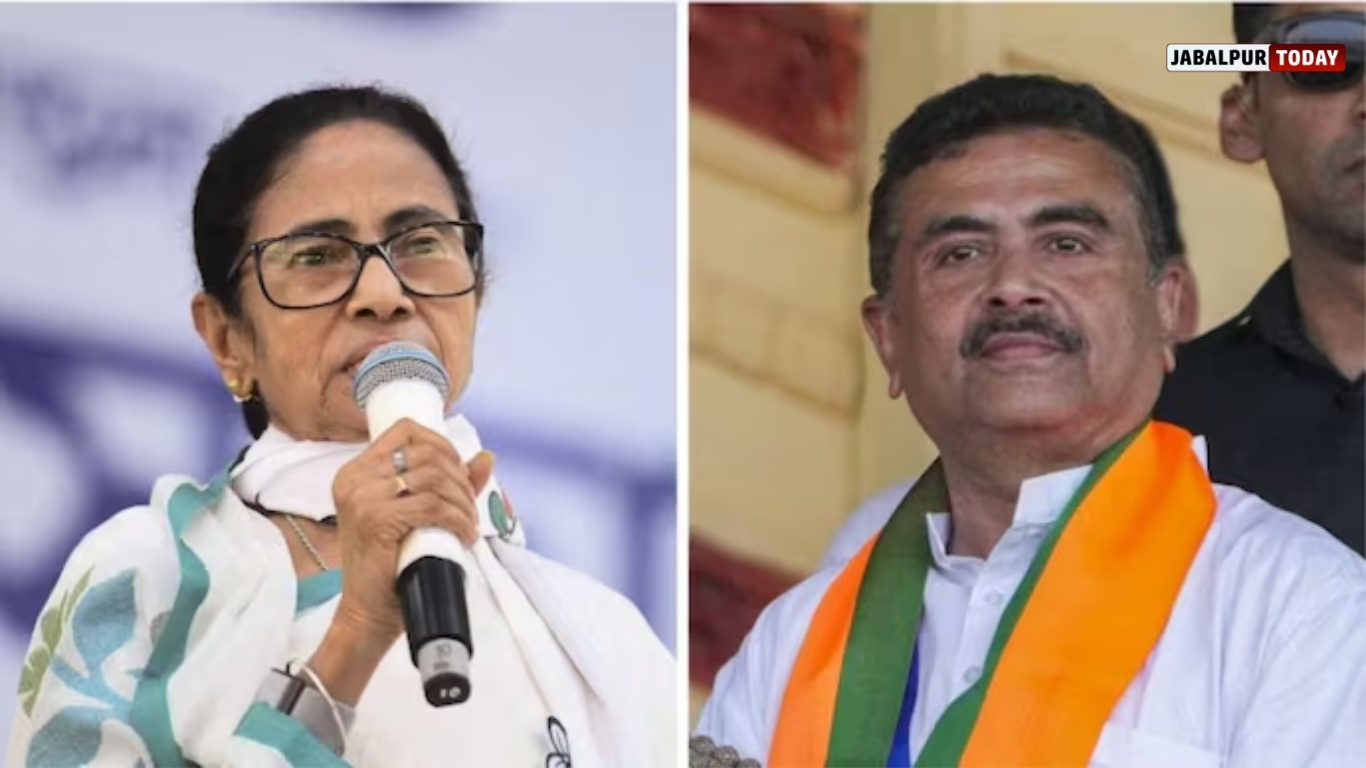
Early voter turnout has crossed 18% as the All India Trinamool Congress (TMC) and Bharatiya Janata Party (BJP) face a tough fight in Mamata Banerjee’s stronghold in south Bengal. The Bhabanipur seat has become the main focus of this crucial election battle
West Bengal: The 2026 Assembly elections in West Bengal reached their final stage on April 29, as voting for 142 constituencies was started in the second and last phase. Key urban and semi-urban areas in seven districts were covered in this phase. These included Kolkata (11 seats), North 24 Parganas (33), South 24 Parganas (31), Nadia (17), Howrah (16), Hooghly (18), and Purba Bardhaman (16). These regions have long been considered strongholds of the All India Trinamool Congress (TMC).
Authorities have registered more than 3.21 to 3.22 crore eligible voters, and they have placed around 1,448 candidates in the contest across 41,001 polling stations. This phase will largely decide whether Chief Minister Mamata Banerjee secures a fourth term or whether the Bharatiya Janata Party makes major gains in south Bengal.
Officials started polling at 7 AM and continued it till 6 PM. They also deployed more than 2,400 companies of central armed police forces to maintain law and order.
Background: Two-Phase Polls and Record Phase 1 Turnout
The Election Commission of India (ECI) scheduled the 294-seat West Bengal Assembly elections in two phases. Voters cast their votes for 152 seats on April 23 across northern and some central districts, while they will vote for the remaining 142 seats on April 29. The ECI has fixed May 4 for counting votes for all seats.
Officials recorded a turnout of 93.19% in Phase 1, marking it as the highest ever in the state. Women also participated strongly, with around 1.65 crore women casting their votes out of a total of 3.36 crore voters in that phase. Districts like Cooch Behar (96.2%), Dakshin Dinajpur (95.44%), and Malda (94.79%) recorded the highest turnout. Because of this massive participation, both the All India Trinamool Congress (TMC) and the Bharatiya Janata Party (BJP) claimed strong momentum.
Now, focus has been shifted to south Bengal and the Kolkata metropolitan region, where issues like anti-incumbency, governance concerns, and identity politics are being strongly felt.
Key Contest: The Bhabanipur Battle
The biggest contest is unfolding in Bhabanipur, which people consider the home turf of Mamata Banerjee. From this seat, BJP leader Suvendu Adhikari is contesting against her. Adhikari was once a TMC leader, and in 2021, he defeated Mamata Banerjee in Nandigram before he changed political sides.
Observers see this rematch as highly important because it tests Mamata Banerjee’s personal popularity in her stronghold against a stronger challenge from the Bharatiya Janata Party.
At the same time, candidates are also contesting against Suvendu Adhikari from Nandigram, his current seat. Phase 2 also includes many other important constituencies where TMC ministers and urban candidates are contesting.
These seats in Kolkata, Howrah, and Hooghly may show changes in middle-class and industrial belt voting patterns.
Voter Turnout and Early Trends on April 29
By 9 AM on polling day, a voter turnout of 18.39% was recorded in Phase 2. Among districts, Purba Bardhaman recorded the highest at 20.86%, followed by Hooghly (20.16%), Nadia (18.50%), North 24 Parganas (17.81%), Howrah (17.76%), Kolkata North (17.28%), Kolkata South (16.81%), and South 24 Parganas (17.25%).
At the beginning, observers described the turnout as slightly lower compared to Phase 1, partly because rain affected some areas. However, voters formed long queues at many polling booths.
Officials reported some isolated clashes, noticed EVM malfunctions at a few stations, and recorded allegations of irregularities. Mamata Banerjee visited booths in Bhabanipur and expressed strong dissatisfaction. She accused the Election Commission of India of working on the instructions of the Bharatiya Janata Party.
On the other hand, BJP leaders highlighted the security arrangements and urged voters to participate in large numbers.
Electoral Roll Controversy and SIR Impact
Before polling, the Special Intensive Revision (SIR) of electoral rolls created a major issue. Tribunals disposed of appeals, and officials added and removed names from the voter list.
Before Phase 2, the Election Commission of India (ECI) allowed 1,468 people to vote through a supplementary roll after authorities cleared their appeals by April 27. Overall, officials removed a large number of names—around 27 lakh, according to some reports—from the voter rolls.
Because of this, the issue triggered debates over voter exclusion, fairness, and possible targeting on caste or religious grounds. TMC and opposition leaders raised concerns about disenfranchisement, while the Election Commission of India (ECI) maintained that it was following a regular process to keep voter rolls clean. After completing all additions, officials kept the total voter base for Phase 2 at around 3.22 crore.
Core Issues Shaping the Phase 2 Narrative
- Anti-incumbency and Governance: After nearly 15 years of TMC rule, issues like the school recruitment scam, “syndicate raj,” and “goonda raj” allegations dominated BJP’s campaign. BJP leaders, including PM Narendra Modi and Amit Shah, promised an end to these and highlighted CAA implementation.
Women’s Safety and Welfare: TMC leaned on its schemes for women, while opposition pointed to rising concerns.- Identity and Community Votes: Matua community influence (especially in North 24 Parganas and Nadia) remained crucial. Muslim voters and other demographic factors also played roles in this polarized contest.
- Left-Congress Role: Though weakened, their residual vote share could influence outcomes in close seats, as seen in past margins.
Campaigning ended on April 27 evening. Star campaigners from both sides, including Yogi Adityanath and Tejashwi Yadav (supporting TMC), hit the ground in the final days.
Security and Administrative Steps
Large-scale security arrangements were made by the ECI and state administration to prevent violence, which has often been seen during Bengal elections. More than 41,000 polling stations were set up, and strict monitoring was arranged.
Some booth-level clashes and attacks on journalists were reported in certain places, but overall control was claimed by authorities. The Model Code of Conduct was kept in force, and silence period rules were applied.
Why Phase 2 is so important?
Phase 1 covered more rural and northern seats, where the Bharatiya Janata Party has shown strength in earlier elections. In Phase 2, voters are testing the core urban and southern support base of the All India Trinamool Congress (TMC).
If the BJP secures strong results in this phase, it can create a serious challenge to TMC’s majority. A party needs at least 148 seats to form the government. On the other hand, if TMC retains its strongholds with high turnout, it will increase the chances of Chief Minister Mamata Banerjee securing a fourth term.
As polling continued on April 29, both sides showed a close and intense fight, with leaders carrying out aggressive campaigning and voter mobilization.
The final results on May 4 will show whether anti-incumbency and national political trends weaken TMC’s hold, or whether voters once again reward Mamata Banerjee’s grassroots support and welfare politics.
This phase reflects Bengal’s deep political divide—between continuity under TMC and the change promised by the BJP. After record participation in Phase 1 and strong voting in Phase 2, voters in West Bengal are shaping another major chapter in the state’s political history.

Mansi Sharma is a journalist covering Global Affairs, and wellness, known for turning complex ideas into sharp, engaging narratives. Her work is driven by curiosity, depth, and a constant urge to question and explore. When she’s not writing, you’ll often find her diving into new ideas—preferably with a cup of coffee in hand, one sip at a time.