
New Delhi: Cricket in India has always been more than a sport—in fact, it is a passion that unites millions. Meanwhile, Test cricket had long been considered the gold standard; however, the introduction of One Day Internationals (ODIs) in the 1970s marked a revolutionary shift in the game.
As a result, the sport began to evolve into a faster, more dynamic spectacle For the Indian team, the journey into this new format began with a tough learning curve, but it quickly delivered a moment of pure glory.
What happened in Debut Match
India’s maiden ODI came on 13 July 1974 against England at Headingley, Leeds, during the Prudential Trophy series. The team posted a competitive 265 all out but fell short, losing by 4 wickets. It was a learning experience against a formidable opponent, highlighting the challenges of adapting to the shorter format.
Just 11 months later, India returned to the same iconic venue—Headingley—for a date with destiny in the inaugural Prudential World Cup 1975.
India’s Full 1975 Cricket World Cup Squad
Sunil Gavaskar, Farokh Engineer (wk), Anshuman Gaekwad, Gundappa Viswanath, Brijesh Patel, Eknath Solkar, Syed Abid Ali, Madan Lal, Mohinder Amarnath, Srinivas Venkataraghavan (c), Bishan Bedi (vc)
Back to Leeds for the First win
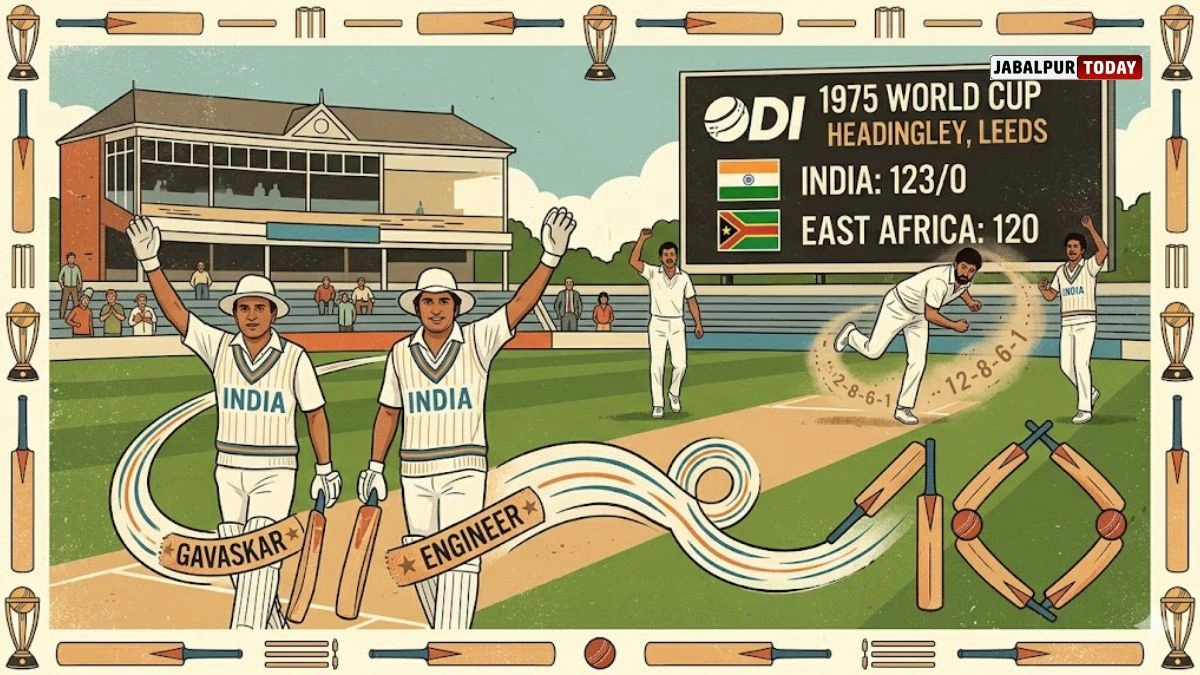
On 11 June 1975, in Group A of the Prudential World Cup (the 6th match of the tournament), India faced East Africa (an associate team comprising players from Kenya, Uganda, Tanzania, and Zambia). What unfolded was nothing short of a masterclass and a record-breaking performance.
East Africa batted first and were bundled out for a modest 120 all out in 55.3 overs. India’s spin-heavy attack shone brightly:
- Madan Lal claimed 3/15, dismantling the middle order.
- Legendary spinner Bishan Singh Bedi delivered a miserly spell of 12-8-6-1, choking the opposition’s scoring rate.
Chasing a target of 123, India made light work of it. Openers Sunil Gavaskar and Farokh Engineer remained unbeaten, racing to 123/0 in just 29.5 overs—a staggering 181 balls remaining. The victory margin? A crushing 10 wickets.
Gavaskar finished on 65 not out, while Engineer smashed 54 not out. The duo’s unbroken opening stand not only sealed the win but etched their names into ODI folklore. Farokh Engineer was named Player of the Match for his explosive contribution with the bat (and his reliable glovework behind the stumps).
Landmark Moment in Cricket History
This wasn’t just any win—it was:
- India’s second ODI ever and their first-ever victory.
- The first 10-wicket win in the history of One Day Internationals.
- A confidence booster for a young Indian side in their maiden World Cup appearance.
The match at Headingley showcased India’s potential in the limited-overs format, laying the foundation for future successes. While East Africa was an associate nation, the clinical manner of the victory—dominating with both bat and ball—signaled India’s arrival on the global ODI stage.
Legacy That Endures
Over five decades later, this victory remains a cherished milestone in Indian cricket history. It proved that the shorter format suited India’s talented players. As a result, it paved the way for the 1983 World Cup triumph and the ODI revolution that followed.
From that sunny June afternoon in Leeds to today’s T20 dominance, India’s ODI journey began with a statement. It was a flawless 10-wicket win. Ultimately, it announced their intent to the world.

Amulya Shrivastav is a journalist who loves cricket and enjoys telling stories around it. Her interest in the sport is what led her to choose journalism as a career. She holds a Master’s degree in Journalism and writes mainly on sports, while also exploring topics like politics, health, tech, and lifestyle. Her work focuses on simple, engaging storytelling that connects with readers.