
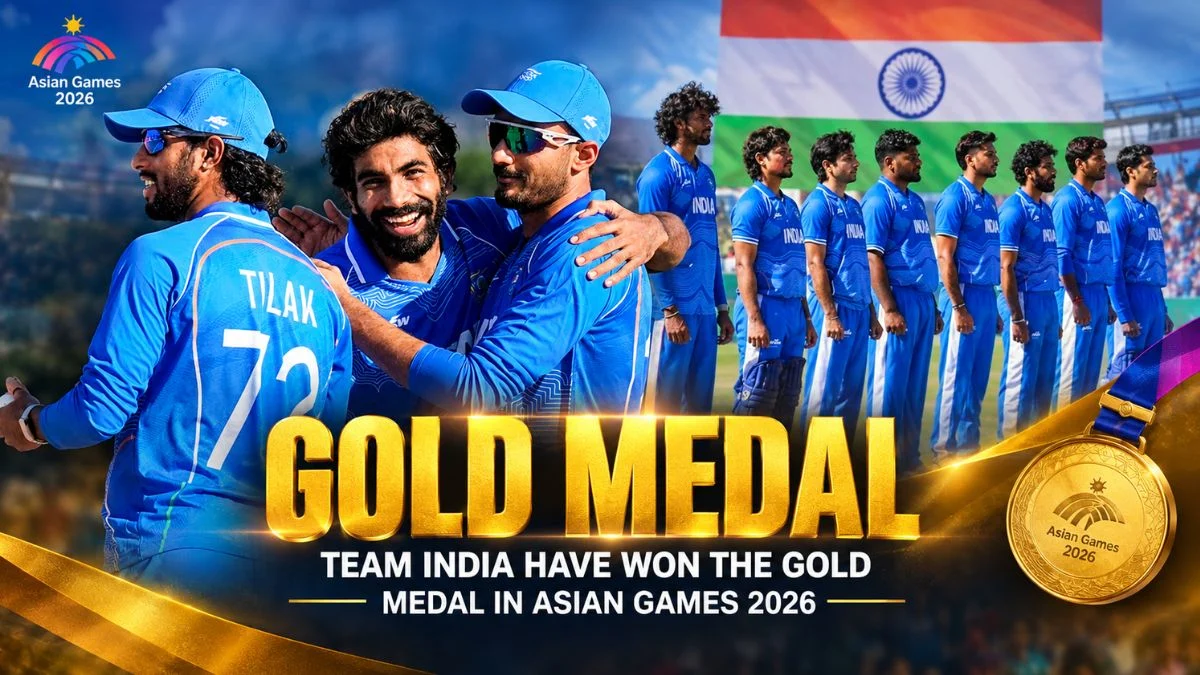
India beat Pakistan by 19 runs in the Asian Games final as Abhishek Sharma and Tilak Varma hit fifties to win India the Asian Games gold medal in Japan
New Delhi: India beat Pakistan by 19 runs in the men’s cricket final at the 2026 Asian Games on Saturday to win the gold medal in Nisshin, Japan. Abhishek Sharma set up India’s imposing total with a blistering 61 off 28 balls, while Tilak Varma finished the innings with an unbeaten 51 off 22.
India claim gold with a 19-run win over Pakistan
India held their nerve in a high-scoring Asian Games final to beat Pakistan by 19 runs and secure the men’s cricket gold medal at Korogi Sports Park.
The victory came after India posted 211/6 in their 20 overs, their batting effort built around contrasting half-centuries from Abhishek Sharma and Tilak Varma.
Abhishek attacked from the start and reached his fifty in only 20 balls, while Tilak absorbed pressure in the middle overs before exploding at the finish.
Pakistan fought back strongly during the chase, with Hasan Nawaz producing the innings that kept the contest alive deep into the second half. India, however, used their spin-heavy attack and held their composure when Pakistan needed a final push..
Shreyas Iyer wins the toss, India bat first
India captain Shreyas Iyer won the toss and chose to bat first. Pakistan entered the final under Sahibzada Farhan, while India retained the XI that had helped them reach the gold-medal match.
The toss also featured a notable detail. Iyer and Farhan did not shake hands before the match, continuing the no-handshake practice seen during recent India-Pakistan meetings.
India opened with 15-year-old Vaibhav Sooryavanshi and Abhishek Sharma, while Pakistan handed the new-ball responsibility to its bowling attack on a surface expected to offer assistance to slower bowlers.
A flying start, then an early wobble
Sooryavanshi immediately attacked the bowling and struck two sixes before Saim Ayub removed him for 15 off nine balls in the third over.
Sanju Samson then made only two from four deliveries before Ahmed Daniyal dismissed him. India had lost two wickets early, but Abhishek continued to attack and kept the run rate high.
India reached 81/2 at the end of the powerplay, with Abhishek doing most of the damage. Pakistan’s bowlers then slowed the scoring during the middle overs and forced India to rebuild.
Ishan Kishan made 20 off 18 balls before Arafat Minhas bowled him while he attempted a pull. Shreyas Iyer followed for 21 off 24 balls, leaving India needing another late surge.
Abhishek Sharma’s blazing fifty
Abhishek provided the innings’ first major acceleration. He reached his fifty from only 20 balls, setting a new mark for the fastest fifty by an Indian batter against Pakistan in T20Is.
He eventually made 61 from 28 balls, striking three fours and seven sixes. Arafat Minhas ended his attack-filled stay in the eighth over.
Abhishek’s innings proved particularly important because India’s scoring rate dipped after his departure. His powerplay assault gave India enough momentum to absorb the wickets that followed.
Tilak Varma takes over and finishes the job
Tilak Varma entered during India’s rebuilding phase and initially played a more controlled role. As the innings moved towards the death overs, he changed gears.
Tilak attacked the spinners and began finding the boundary regularly. He reached his fifty from 21 balls and remained unbeaten on 51 from 22 deliveries.
His ability to accelerate after India had slipped into a difficult middle-overs phase gave the innings a second surge. Tilak’s finishing ability ensured India entered the final over with the chance to push well beyond 200.
India cross 200 with Dube’s late support
Shivam Dube provided the support Tilak needed during the late assault. The left-hander struck 27 from 14 balls as the pair added crucial runs in the final overs.
Dube eventually fell to Ahmed Daniyal at the start of the final over, but Tilak continued attacking and took India beyond the 200-run mark.
India finished on 211/6 in 20 overs, with Tilak unbeaten on 51 and Dube contributing 27. The total stood well above the approximate par score of 150 that commentators had discussed after the earlier semi-final on the slow, turning surface. India therefore entered the chase with a significant advantage.
Pakistan’s chase: Hasan Nawaz keeps them in it
Pakistan lost early wickets when Axar Patel struck twice in the same over. He removed captain Sahibzada Farhan after the opener attempted a slog-sweep and then dismissed Usman Khan following a mistimed pull.
Axar later claimed Maaz Sadaqat as well, with Washington Sundar taking the catch near the boundary.
Saim Ayub also departed after Shivam Dube had him caught at square leg. Those wickets placed Pakistan under pressure, but Hasan Nawaz refused to let the chase fade.
Hasan attacked India’s bowlers and found support from Abdul Samad. Their partnership gave Pakistan a route back into the contest and forced India to keep their main bowlers involved.
Washington Sundar eventually broke the partnership by dismissing Abdul Samad as the batter attempted to hit the ball down the ground.
Hasan remained Pakistan’s main source of runs deep into the chase and top-scored for his side with a fighting innings.
Spin and composure get India over the line
India again relied heavily on spin, a strategy that had worked throughout the tournament.
Axar Patel created early damage, while Washington Sundar and the other slower bowlers kept attacking the middle overs. India had also used a similar combination in the semi-final against Sri Lanka, where Jasprit Bumrah operated as the only frontline specialist seamer and the spin-heavy attack bowled Sri Lanka out for just 45.
Pakistan’s late surge made the final much closer than India’s 211/6 initially suggested. India still managed the crucial moments better and eventually defended their total to claim gold.
Final score verification still pending: Pakistan’s exact completed score/overs and the identity of the wicket that sealed India’s 19-run victory should be inserted from the completed official scorecard before publication.
Why cricket at the Asian Games matters
Cricket’s presence at the Asian Games gives the sport a wider platform across Asia and places it within a multi-sport environment that reaches audiences beyond cricket’s traditional fan base.
The event also strengthens cricket’s connection with the Olympic movement. For cricket fans, the Asian Games offer a different competitive setting, while athletes from other sports and spectators in host nations get a closer look at the game.
India’s men’s gold also adds to the country’s cricket success at these Games. The Indian women’s team had already secured gold after beating Sri Lanka by 147 runs in their final.
The men’s final also gave India and Pakistan a major stage in Japan, where the tournament introduced the sport to a broader local audience.
India leave Nisshin with another Asian Games cricket gold after producing the defining batting moments when the final demanded them.
Abhishek supplied the early explosion, while Tilak provided the finish that pushed India beyond 200.
