
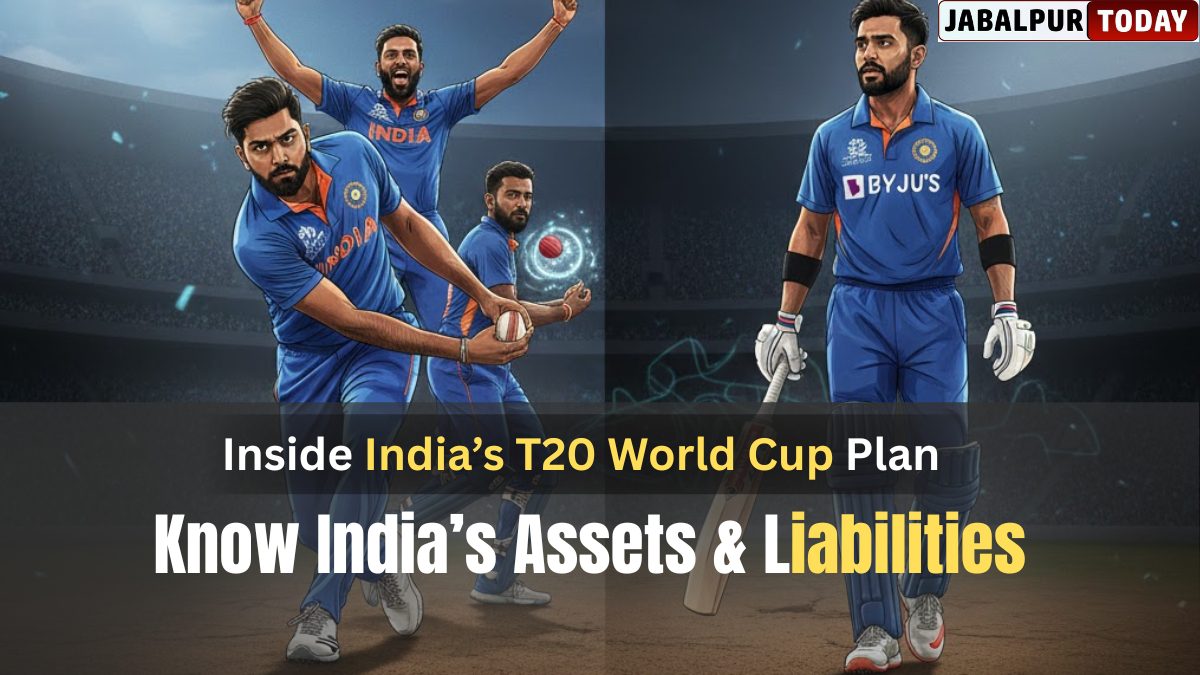
As India co-hosts the 2026 T20 World Cup, we break down the BCCI’s 15-member squad. From Jasprit Bumrah’s lethal pace to Suryakumar Yadav’s captaincy pressure, discover the assets and liabilities of the Men in Blue.
New Delhi: The stakes are really high. From February 7, to March 8 2026 the cricket world is going to India and Sri Lanka for the ICC Men’s T20 World Cup. For the team that is defending the title the ICC Men’s T20 World Cup, the goal is easy to understand but very hard to do: the team wants to be the country to win the ICC Men’s T20 World Cup three times and the first team to win the ICC Men’s T20 World Cup again when they are playing at home.
Led by Suryakumar Yadav, the BCCI has opted for a high-octane mix of fearless youth and battle-hardened veterans. But with high expectations come heavy questions. Can the “mystery” of India’s spin department mask the recent form slumps of its top stars? Let’s dive into the roster that carries the hopes of over a billion people.
Also read: ICC turns down Bangladesh’s appeal to shift T20 World Cup matches out of India
The Game changers “Assets for team INDIA”
Indias chance to do something is based on players who have that special something, the X-factor talent. These are the players who can change a game completely in one, over:
- Jasprit Bumrah: Jasprit Bumrah has a career economy of 6.39, which’s really good. Jasprit Bumrah is not a bowler Jasprit Bumrah is, like a weapon that gets inside the heads of the other team. This makes them want to take chances against all the bowlers, not just Jasprit Bumrah.
- Abhishek Sharma and Sanju Samson: Abhishek Sharma and Sanju Samson is what The New Guard is about. This opening duo is made for The New Guard to play in the era of cricket. Abhishek Sharma has a high strike rate of 188.02 and Sanju Samson has been doing great with three international centuries recently. The New Guard with Abhishek Sharma and Sanju Samson gives India the start that India has not had for a long time. The New Guard is important, for India.
- Varun Chakaravarthy: Varun Chakaravarthy is really something. He is the ranked T20I bowler in 2025. This is timing for Varun Chakaravarthy because the Spin Supremacy of Varun Chakaravarthy is perfect, for the subcontinental tracks. Varun Chakaravarthy teams up with Kuldeep Yadav. Together Varun Chakaravarthy and Kuldeep Yadav are very tough to handle in the overs. Few teams can deal with the Spin Supremacy of Varun Chakaravarthy and Kuldeep Yadav.
- Hardik Pandya: Pandya remains the glue. His ability to clock 140kph with the ball and strike at nearly 190 with the bat gives India the tactical flexibility to play an extra specialist where needed.
The Red Flags “Liabilities for team INDIA”
No squad is bulletproof, and several “what-ifs” hang over this 15-member list:
- Suryakumar Yadav: The biggest problem is Suryakumar Yadav. He is having a time changing from just a batsman to a captain who leads the team. This is happening when he is not scoring runs. In 2025 Suryakumar Yadav is only averaging 13.62 runs. This is a worry. India needs Suryakumar Yadav to start scoring again very soon. Suryakumar Yadav needs to find his form.
- Kuldeep Yadav and Harshit Rana: The Pacing Gap is an issue for the team. If you look beyond Bumrah and Arshdeep Singh the bowling department does not have many good bowlers. Harshit Rana is a talented player but he has not played in a big tournament, like the World Cup before. This means Harshit Rana lacks experience of playing on a stage. If Bumrah and Arshdeep Singh do not do well Harshit Rana will have to deal with a lot of pressure to stop world-class finishers from scoring runs. The team will be counting on Harshit Rana to do a job in this situation.
- Ishan Kishan: Ishan Kishan’s return after a long hiatus is a romantic comeback story, but his career T20I strike rate of 124.37 feels a step behind the 200+ cameos now common in the format. Whether he can translate domestic “intent” into international results remains to be seen.
High risk, high reward
India finds itself in Group A alongside Australia, Namibia, Zimbabwe, and Oman. While the path to the knockout stages seems clear, the real test will be maintaining consistency. The strategy is obvious: exploit home conditions with a spin-heavy attack and out-bat the opposition with a deep lineup of all-rounders like Axar Patel and Washington Sundar.
On paper, India is the team to beat. The squad boasts more “match-winners” than perhaps any other side in the tournament. However, T20 cricket is won on momentum, not resumes. If the middle order can find its spark and the support bowlers can hold their nerve in the death overs, a third star above the crest is well within reach.
