
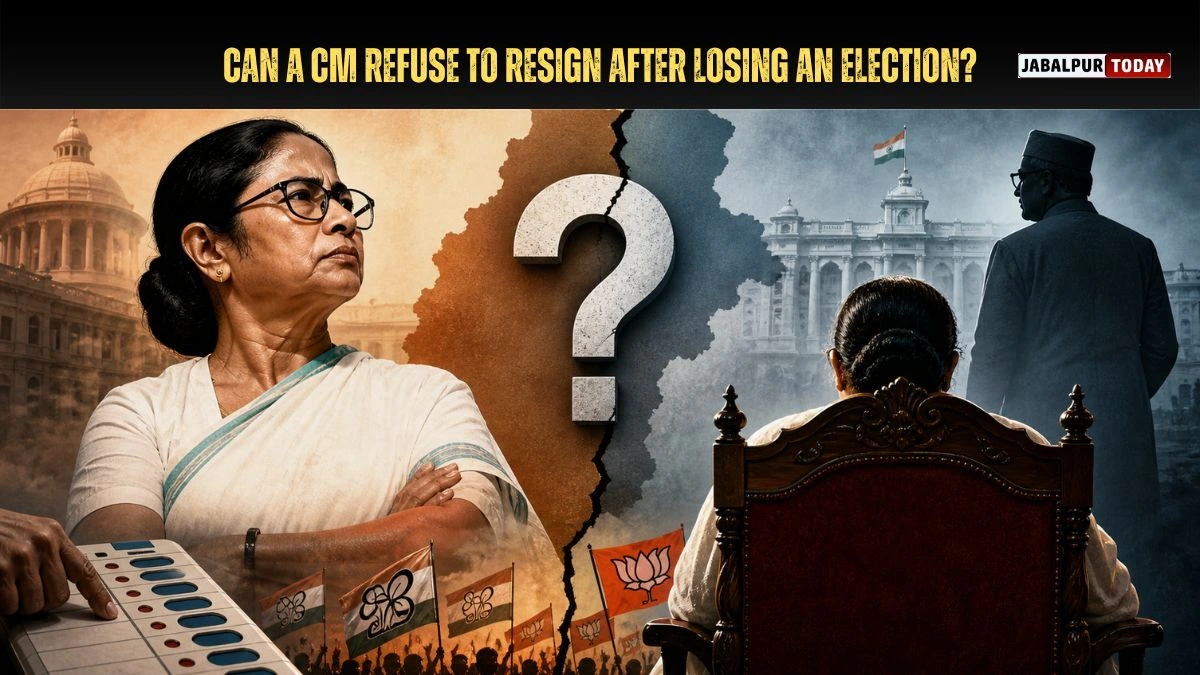
New Delhi: Elections in India determine who people want to rule. But elections don’t physically remove a government. This requires either a resignation or a constitutional process.
When a defeated Chief Minister refuses to step down, what mechanisms does the Constitution provide?
This question has gained fresh attention recently in West Bengal, where Mamata Banerjee declared she would not resign despite her Trinamool Congress (TMC) party’s heavy loss to the BJP in the 2026 Assembly elections
What If the CM Refuses to Resign?
Refusal doesn’t allow the CM to stay in power forever. Here’s what usually happens:
The Governor’s Discretionary Powers: The Governor can assess the situation based on election results and invite the leader of the party or coalition with a clear majority (in this case, the BJP) to form the government. The Governor can also ask the incumbent CM to prove majority through a floor test in the Assembly.
Dismissal Option: If the CM refuses to resign and clearly lacks support, the Governor has the power to dismiss the Council of Ministers.
New House Takes Over: Newly elected MLAs take oath. The process of government formation moves forward. The old government cannot block the transition indefinitely. Administrative machinery (like the Chief Secretary and DGP) shifts loyalty to the new setup as they serve the Constitution, not any individual.
In short, a refusal often creates political drama and a brief standoff, but it rarely alters the final outcome. This system is designed to ensure a smooth transfer of power to the elected majority.
What just happened in West Bengal
In a 294-member Assembly, the majority mark stands at 148 seats. The BJP crossed it comfortably with a margin of 59 seats, delivering a decisive mandate.
Meanwhile, polling in one constituency, Falta, is set for a repoll on May 21 after serious EVM irregularities. Notably, the election recorded a turnout of 92.93%, the highest in West Bengal’s history.
The results dealt a historic blow to Mamata Banerjee’s Trinamool Congress. It ended the party’s 15 years of uninterrupted rule in the state.
Most notably, Banerjee lost her Bhabanipur seat, long seen as her political bastion. She lost to her former aide, Suvendu Adhikari, by over 15,000 votes.
Of the 35 TMC ministers who contested, 22 lost. This marked a staggering wipeout of 63% of the sitting cabinet.
Despite this, Banerjee addressed the media the next morning. She refused to resign. Calling the results a “conspiracy,” she accused the Election Commission of India of acting as the “villain” and alleged that votes were “forcibly stolen.”
What does the constitution say?
The Indian Constitution does not set a strict deadline for a Chief Minister to resign immediately after election results. However, the rules are clear on one fundamental point: the CM and the Council of Ministers hold office “during the pleasure of the Governor” under Article 164(1).
Article 164(1) — Indian Constitution
The Chief Minister shall be appointed by the Governor and the other Ministers shall be appointed by the Governor on the advice of the Chief Minister, and the Ministers shall hold office during the pleasure of the Governor
Equally important is Article 172, which defines the lifespan of a State Legislative Assembly. The law scheduled the tenure of the current West Bengal Assembly to end on May 6, 2026—meaning Banerjee’s government would automatically cease to exist on that date, even without a formal resignation, regardless of her personal stance.
Historical Example
Uttar Pradesh — The Kalyan Singh Government
After the BSP withdrew support from the BJP-BSP alliance, the government held a vote of confidence. The proceedings soon descended into chaos as legislators hurled chairs and sound equipment.
Governor Romesh Bhandari controversially dismissed Kalyan Singh and appointed Jagdambika Pal as Chief Minister. The Supreme Court of India then ordered a “composite floor test” to determine the majority.
Uttarakhand — Harish Rawat, 2016
Rebel Congress MLAs alleged that the government passed the Budget Bill without majority support. Authorities imposed President’s Rule, but the Supreme Court later suspended it for two hours and ordered an immediate floor test. The Court also directed officials to video record the proceedings to dispel political uncertainty.
Maharashtra – Uddhav Thackeray, 2022
When the Eknath Shinde faction within the Shiv Sena rebelled and the Governor called for a vote of confidence, Thackeray resigned rather than proving his majority on the floor of the House. Subsequently, the Supreme Court ruled that the Governor’s order for a floor test was legally incorrect—but also observed that it could not reinstate Thackeray as Chief Minister, as he had resigned of his own volition. The Court further explicitly stated that had he remained in office and faced the floor test, it could have considered restoring his government.
“We have not lost the election; attempts were made to defeat us. There’s no question of resignation.”
— Mamata Banerjee, press conference, May 5, 2026 · (Her government’s constitutional mandate had already ended the following day under Article 172)
A Chief Minister can legally refuse to resign—but only for a very brief period. Without majority support, the Constitution vests the Governors, the Assembly, and ultimately the courts with every tool necessary to complete the transition. History demonstrates that these tools work. India’s democracy has survived every such standoff in the past, and it will survive this one as well.

Amulya Shrivastav is a journalist who loves cricket and enjoys telling stories around it. Her interest in the sport is what led her to choose journalism as a career. She holds a Master’s degree in Journalism and writes mainly on sports, while also exploring topics like politics, health, tech, and lifestyle. Her work focuses on simple, engaging storytelling that connects with readers.