

Why time differs across cities like Delhi, London, and New York? Explore time zones, their history, science, IST, and how global time works
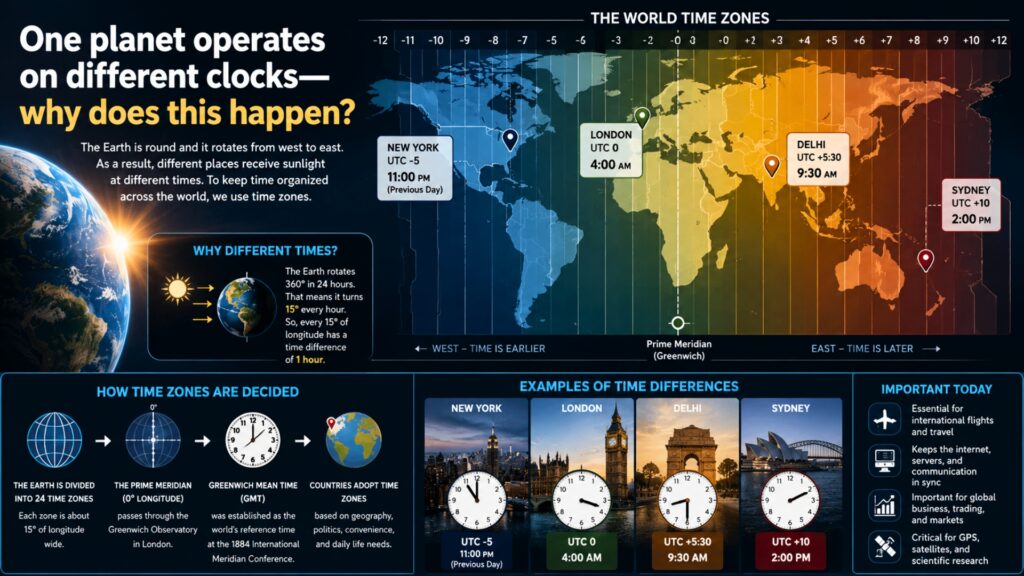
New Delhi: When offices open at 9:00 AM in Delhi, clocks in London show around 3:30 PM, while New York remains deep into the night. One planet operates on different clocks—why does this happen? Does time actually move differently across locations, or do humans define and control it?
The answer lies in time zones, a system that organizes time across the world. Time zones now regulate global time, but they did not exist forever. Science, technology, railways, trade, and international agreements shaped their development. Time zones do not just manage clocks—they support one of the most critical systems of the modern world.
How Did the World Function Before Time Zones?
People did not follow standard time in earlier periods. Each city and region set its own local time based on the sun’s position, which people called Local Solar Time.
People marked noon when the sun stood directly overhead. Time changed from city to city. Even a small distance between two places created slight time differences.
For example, if Delhi marked 12 noon, Agra or Mathura could show a slightly different time by a few minutes. People did not face major issues with this system as long as they lived and traveled within limited distances.
When Did Problems Begin?
The 19th century introduced railways and telegraph systems, and these advancements created new challenges for the public:
- Railways disrupted schedules across cities
- Passengers struggled to understand different local times
- Trade and communication created confusion
- Countries operated with dozens of different time systems
This disorder forced the world to adopt a uniform time system.
The Birth of Time Zones
The Industrial Revolution connected the world at an unprecedented speed. Railways and communication networks exposed the inefficiency of local time systems.
To solve this problem, global leaders held a major meeting in Washington, D.C. in 1884, known as the International Meridian Conference. Representatives from 25 countries participated and made key decisions:
- Leaders divided the Earth into 24 time zones
- Each zone covered approximately 15 degrees of longitude
- Leaders declared 0° longitude as the Prime Meridian
- The Prime Meridian passed through the Greenwich Observatory in England
This system introduced Greenwich Mean Time (GMT), which later became the foundation of global timekeeping.
Why Did Scientists Divide the Earth into 24 Time Zones?
Science directly explains this division. The Earth rotates 360 degrees in 24 hours, which means it rotates 15 degrees every hour.
This calculation creates the foundation of time zones. Each 15-degree segment represents a one-hour difference. This system divides the Earth into 24 parts and organizes time in a structured way.
The modern system still follows this principle, although political and social factors have introduced several modifications.
Why Don’t Time Zones Follow Straight Lines?
Pure mathematics would create straight time zone lines, but reality works differently.
Several factors shape time zones:
- Political boundaries influence decisions
- Trade convenience plays a role
- Administrative needs require adjustments
- Population distribution affects alignment
For example:
- China spans five geographical time zones but follows a single standard time called Beijing Time
- Spain falls within the GMT zone but follows Central European Time
- Russia spans multiple time zones, but authorities regulate them for administrative reasons
These examples show that geography alone does not define time zones—politics and society also shape them.
How Does India Decide Its Time Zone?
India ranks among the largest countries in the world, yet it follows a single time zone known as Indian Standard Time (IST).
India bases IST on the 82.5° East longitude. This longitude passes near Prayagraj (formerly Allahabad) in Uttar Pradesh, and authorities use this point to define the country’s time.
IST runs 5 hours and 30 minutes ahead of GMT. For example, when London shows 6:00 AM, India shows 11:30 AM.
Why Does India Follow Only One Time Zone?
India’s vast geography raises a natural question: why does the country follow one time zone?
Several reasons explain this decision:
- Administrative simplicity: A single time simplifies government operations. Offices, banks, and institutions follow the same schedule, which improves coordination between central and state authorities.
- Efficient transport systems: Railways and aviation operate smoothly under one unified timetable. Multiple time zones could increase confusion and raise the risk of serious operational errors.
- National unity: A shared time strengthens a sense of unity across the country. People across regions follow one clock, which supports social and cultural cohesion.
However, people in Northeast India have long demanded a separate time zone. Earlier sunrises and sunsets reduce effective daylight usage in that region.
Why Does UTC Matter in the Modern World?
The modern world no longer relies on GMT alone. It uses Coordinated Universal Time (UTC) as the global standard.
UTC supports critical global systems:
- It ensures accurate international flight operations
- It synchronizes internet and server systems
- It supports scientific research
- It maintains precision in GPS and digital networks
UTC connects the world through a reliable and highly accurate time framework.
What Are Positive and Negative Time Zones?
The world divides time zones into two categories based on UTC:
- Positive Time Zones (+):
Countries in the eastern hemisphere experience earlier sunrises, so they fall into positive time zones. Examples include:
- India: UTC +5:30
- Japan: UTC +9
- Australia: UTC +10
- Negative Time Zones (-):
Countries in the western hemisphere lag behind in time, so they fall into negative time zones. Examples include:
- New York: UTC -5
- Canada: UTC -6
- Brazil: UTC -3
Will the World Ever Abandon Time Zones?
Some experts propose a future global time system where the entire world follows one unified clock.
This idea could simplify international trade, improve coordination for global tech companies, and streamline digital operations.
However, practical challenges make this shift difficult. Each country follows its own daylight patterns, cultural routines, and daily schedules. These differences make it hard to implement a single global time.
For now, the traditional time zone system continues to balance global coordination with local realities.
Time zones may appear simple, but they combine science, history, politics, and human adaptation. They quietly ensure that everything—from flights to financial systems—operates on time in a fast-moving world.
