
As Indian women gain financial freedom and education, traditional marriages face new pressures. Is divorce a sign of progress or conflict?
New Delhi: At a wedding reception in South Delhi last month, a group of women in their early thirties — software engineers, lawyers, and a management consultant — started discussing a familiar topic. Three of them had already divorced. Two had filed for divorce. None of them felt the need to justify their decision. Ten years ago, such a conversation would have shocked people. Today, it has become increasingly common.
India, a country that once proudly pointed to its low divorce rate as proof of strong cultural values, is now going through one of the biggest social changes in its modern history. People are questioning, renegotiating, and increasingly ending marriages that society once treated as sacred, permanent, and worth preserving at any cost. At the center of this major change is one powerful force: the economic and educational freedom of Indian women.
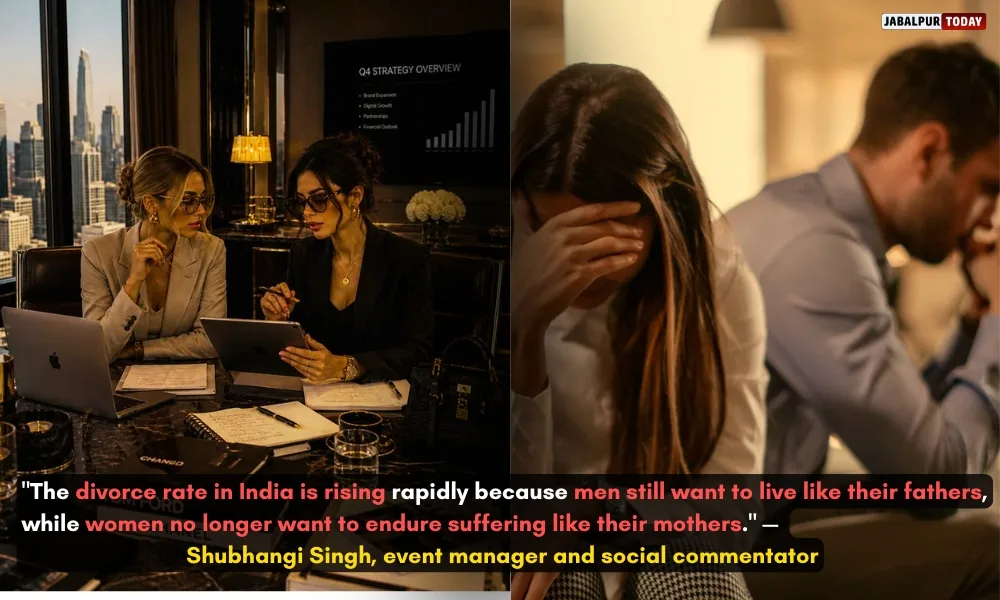
“The divorce rate in India is rising rapidly because men still want to live like their fathers, while women no longer want to endure suffering like their mothers.” — Shubhangi Singh, event manager and social commentator
A Quiet Revolution in Numbers
Women’s participation in India’s workforce has almost doubled in six years, rising from 23.3% in 2017-18 to 41.7% in 2023-24, according to the Periodic Labour Force Survey. In metropolitan cities, divorce rates have increased by 30 to 40% over the last decade. The PLFS Survey 2024 also confirmed that divorce rates among both urban men and women have risen compared to 2018. Women now initiate 58% of divorces, while men initiate 42%.
These numbers represent more than statistics. They represent millions of women who now have something their mothers often did not have: a choice.
A senior family court judge in Mumbai, speaking anonymously, explained the change:
“Twenty years ago, I saw women stay in terrible marriages because they had nowhere to go. Today, they come in holding their own payslips and their own lease agreements. The calculation has completely changed.”
The Shubhangi Statement: When a Sentence Went Viral
One sentence made thousands of Indians stop and think. Shubhangi Singh, a Delhi-based event manager and outspoken social commentator, posted an observation that captured what many people had felt but struggled to express. She suggested that rising divorce rates do not necessarily show family breakdown. Instead, they reveal a growing mismatch between expectations that has been building for generations.
“The divorce rate in India is rising rapidly because men still want to live like their fathers, while women no longer want to endure suffering like their mothers,” Singh wrote.
The statement quickly spread through WhatsApp groups, LinkedIn feeds, and family dinner conversations. Some people praised it. Others strongly disagreed.
Singh says she sees this tension regularly in her professional life.
“In my work, I meet successful women every day who are exhausted — not by their careers, but by the double burden of managing a career and a household that their husbands expect to run itself. Something has to give.”
Although Singh shared her views on social media rather than in an academic journal, researchers have been reporting similar findings for years.
The Education Fault Line: When She Outgrows the Marriage
A peer-reviewed study published in the International Social Science Journal in 2023 used data from India’s District Level Household Survey and found a striking trend. Women who are more educated than their husbands are significantly more likely to experience divorce or separation. The likelihood increases further as the education gap in the woman’s favor becomes larger.
This pattern is not unique to India.
A landmark study by Stockholm University, titled All the Single Ladies: Job Promotions and the Durability of Marriage, found that in Sweden — one of the world’s most gender-equal countries — a woman’s promotion to a top leadership position doubles her baseline risk of divorce. Men who receive similar promotions do not face the same risk.
The study also found that after eight years in office, only 75% of women in public leadership roles remained married, compared to 85% of men.
In private companies with more than 100 employees, married women who became CEOs were more than twice as likely to divorce within three years compared to their male counterparts.
Professor Johanna Rickne, one of the study’s authors, suggested that many husbands find it harder to adjust to their wife’s professional success than wives do to their husband’s success. As she bluntly stated, “the marriage market has not kept up with the labour market when it comes to gender equality.”
India appears to be following a similar path.
Highly educated women — including graduates from IITs, IIMs, and medical colleges — now marry four to seven years later on average, according to the National Family Health Survey (December 2024). When they marry, they often expect equal partnerships. Traditional family structures are frequently unprepared to meet those expectations.
The Double Burden: Doing Everything, Enduring Everything
Across Indian cities, women tell a similar story.
Women enter the workforce, but they rarely leave household responsibilities behind. Instead, they take on a second shift. They leave boardrooms and return home to make rotis. They manage client meetings and school tiffins at the same time. They earn salaries but often surrender major financial decisions to others.
Research consistently shows that while women’s professional participation has increased dramatically, the gap in household labor has changed very little.
Emma Heptonstall, a UK-based divorce coach who has worked with high-achieving women from different cultures, explains:
“They just feel really put upon — doing literally everything. They come home from work and still have to manage the shopping and the cleaning. They’re emotionally exhausted from work and physically exhausted at home. And resentment builds.”
Marriage counselors in Indian cities report hearing similar stories every day.
A study published in the Personality and Social Psychology Bulletin found that men experience the lowest levels of psychological stress when their wives contribute about 40% of household income. As the wife’s income rises beyond that level, tension within the marriage often increases.
The finding highlights an uncomfortable reality: many men still struggle psychologically to adjust to changing financial dynamics within marriage.
“Divorce is not always the failure. Sometimes it is the first honest decision a woman has made in years.” — Marriage counsellor, Bengaluru (name withheld)
The Gray Divorce Trend: It’s Not Just the Young
One of the most surprising developments in India’s changing marriage landscape is the rise of “gray divorce” — divorces among couples in their 50s and older.
In 2024, courts in Chennai reported a noticeable increase in older couples seeking divorce. Many of these couples began re-evaluating marriages that had lasted decades after their children became independent and women achieved financial stability.
Lucknow reported similar patterns nearly a decade earlier, suggesting that the trend is not entirely new. People are simply discussing it more openly now.
Around the world, gray divorce rates have doubled across OECD countries since 2000. Longer life expectancy, greater financial independence among women, and declining acceptance of unhappy marriages have all contributed to this change.
India may be reaching this stage later than many countries, but it is clearly moving in the same direction.
The Counter-Argument: Is Marriage the Problem, or the Expectations?
Not everyone views these developments as a straightforward victory for women’s empowerment.
Critics argue that India is witnessing a clash between changing expectations and outdated social structures rather than a simple story of liberation.
A 2024 survey on divorce trends found that 77% of divorce petitioners identified unwillingness to compromise as a major reason for marital breakdown.
Increasingly, people point to unrealistic expectations on both sides. Some men expect wives to behave like previous generations of women. Some women expect relationships very different from those they observed growing up.
Dr. Priya Menon, a sociologist at Delhi University who studies gender and family structures, explains:
“The problem is not women working. The problem is that we have changed one half of the equation — women’s roles — without changing the other half — men’s roles at home and their psychological relationship with their wife’s success.”
She adds:
“Egalitarian marriages work beautifully. The data shows dramatically lower divorce rates in genuinely equal partnerships. The crisis is in the middle — where a woman has grown but the marriage has not.”
A 2023 Pew Research poll found that 58% of Indian millennials now consider divorce socially acceptable, compared to only 32% in 2010.
Families are changing as well. More women now report receiving support from their parents instead of pressure to remain in unhappy marriages.
The stigma around divorce is weakening, even if it has not disappeared completely.
Progress, Pain, or Both?
The rise in India’s divorce rate tells a story of both progress and pain.
It represents progress because, for the first time in history, millions of Indian women have the economic, legal, and social power to leave relationships that once trapped them.
It also represents pain because every statistic reflects a real family struggling with changing expectations. Children, property, personal identity, and emotional loss often become deeply intertwined during the process.
The institutions that should help people navigate these challenges are also struggling to adapt
.
Family courts remain overcrowded. Mediation services lack resources. Mental health support for divorcing men and women remains limited outside major cities.
Yet one reality is impossible to ignore. For the first time, a generation of Indian women is refusing to accept conditions they never agreed to. They watched their mothers tolerate hardship. They no longer want to repeat that experience.
Whether this trend signals the decline of the Indian family or its long-awaited transformation depends largely on whether Indian men, institutions, and society can evolve as quickly as Indian women already have.
Experts from different perspectives agree on one point: the solution is not to push women out of the workforce, nor is it to celebrate divorce as the answer to every problem.
The real solution requires a deeper transformation of social norms, male identity, and the meaning of partnership itself.
A Bengaluru-based marriage counsellor explains:
“Communication, compromise, and a genuine willingness to redistribute the labour of life — that is what saves marriages in 2026. Not tradition. Not duty. Not fear. Those were never good reasons to stay.”

Mansi Sharma is a journalist covering Global Affairs, and wellness, known for turning complex ideas into sharp, engaging narratives. Her work is driven by curiosity, depth, and a constant urge to question and explore. When she’s not writing, you’ll often find her diving into new ideas—preferably with a cup of coffee in hand, one sip at a time.