
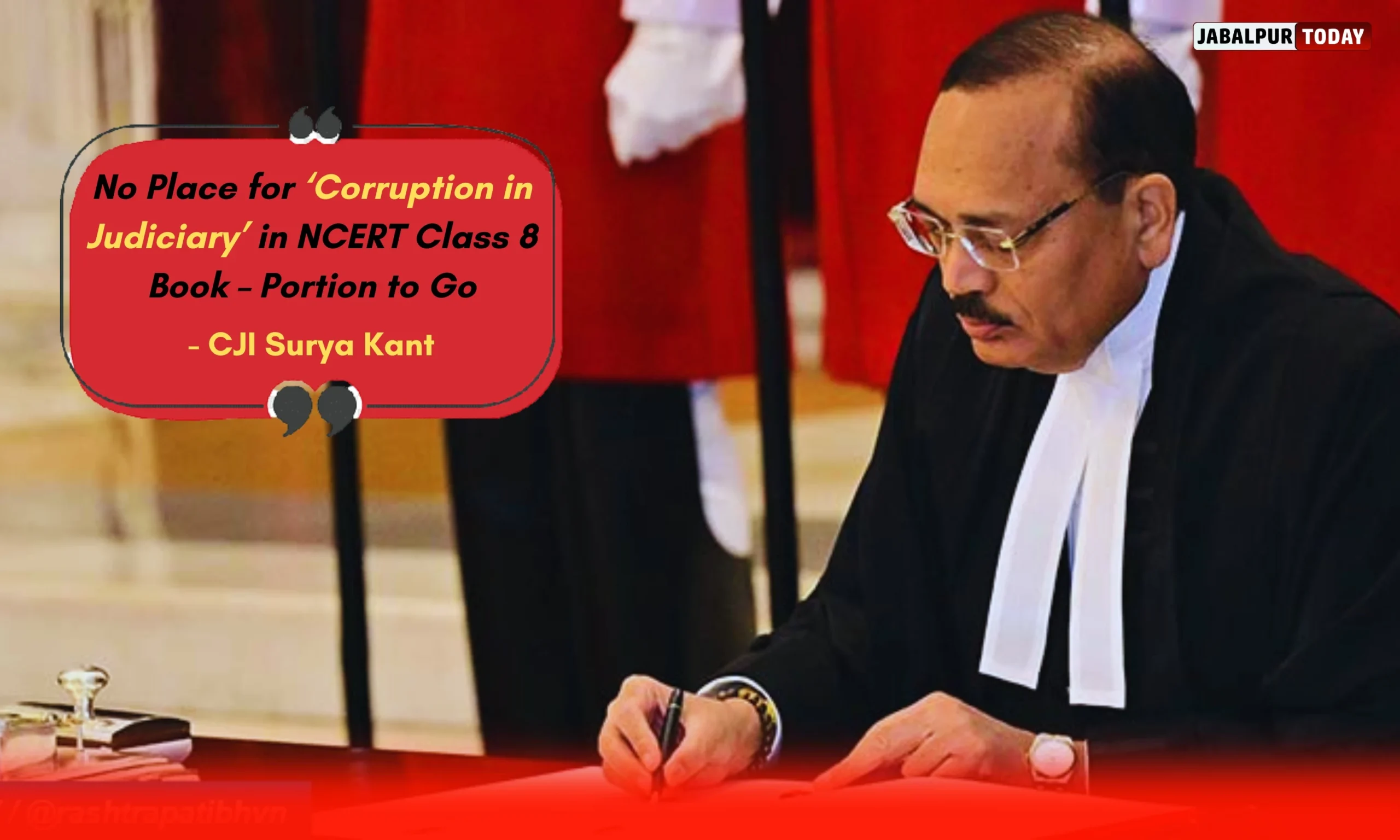
CJI takes suo motu action against an NCERT Class 8 textbook chapter mentioning “corruption in judiciary,” prompting swift government assurance to remove the controversial portion as the Supreme Court raises concerns over institutional integrity and constitutional balance.
New Delhi: In a rare intervention from the highest judicial office, CJI Surya Kant took suo motu cognisance of an NCERT Class 8 textbook chapter that mentioned “corruption in judiciary,” triggering immediate government action. He strongly objected to a chapter that mentions “corruption at various levels of the judiciary” as one of the problems faced by the justice system. Within a few hours, government sources confirmed that the controversial portion will be removed from the book.
What the NCERT Textbook Says
The revised chapter is titled “The Role of the Judiciary in Our Society.” Unlike earlier editions that mainly explained the structure of courts, independence of the judiciary, and access to justice, the new chapter also talks about challenges faced by the system.
It lists:
• “Corruption at various levels of the judiciary”
• A “massive backlog” of cases due to a shortage of judges, complicated legal procedures, and poor infrastructure
It also provides data on pending cases:
• Supreme Court of India – 81,000 cases
• High Courts – 62.4 lakh cases
• District and Subordinate Courts – 4.7 crore cases
The section on corruption says that people sometimes experience corruption at different levels of the judiciary. It adds that this especially affects poor and disadvantaged people and makes access to justice harder.The book says that authorities are making efforts to build trust and improve transparency by using technology and taking strict action wherever they find corruption.
The chapter also explains:
• Judges’ code of conduct
• The CPGRAMS grievance system (which received over 1,600 complaints between 2017 and 2021)
• The impeachment process for judges
It quotes former CJI B. R. Gavai, who in July 2025 said that there have been instances of corruption and misconduct within the judiciary, and that rebuilding trust requires swift, decisive, and transparent action.
How the Matter Reached the Supreme Court
During a routine hearing on February 25, senior advocates Kapil Sibal and Abhishek Manu Singhvi brought physical copies of the new textbook to the attention of the CJI-led bench.
Kapil Sibal said the legal community was deeply disturbed that the textbook teaches Class 8 students about corruption in the judiciary. He described it as “entirely scandalous.”
Singhvi pointed out that the chapter mentions corruption only in the judiciary and does not discuss corruption in other institutions, calling this “selective.”
CJI’s Strong Reaction
Chief Justice Surya Kant responded firmly. He said both the bar and the bench were upset, and that he had received many calls and messages from concerned judges, including High Court judges.
Then he stated that he would not allow anyone to damage the integrity or reputation of the institution. He said that no matter how powerful a person might be, the law would take its course.
Justice Joymalya Bagchi also observed that the content appeared to affect constitutional integrity and the principle of separation of powers.
Government’s Immediate Response
Within hours, senior government sources said they will remove the reference to “corruption at various levels of the judiciary.” They stated that the textbook should not have included the section and added that it should focus on inspiring content instead. They also said quoting the former CJI in this context was not appropriate.
Why This Issue Is Important
This controversy marks the first major dispute involving the National Council of Educational Research and Training’s new textbooks prepared under the National Education Policy, which authorities have released in phases since 2025.
Supporters of the chapter may argue that students should learn about real challenges in a democracy. However, critics say that describing the judiciary as “corrupt” in a Class 8 textbook could harm public trust, especially among young and impressionable students.
The situation has restarted an old debate: How much should school textbooks discuss the weaknesses of important institutions? While past Chief Justices, including B.R. Gavai, have spoken about isolated cases of misconduct, the present judiciary feels that highlighting this issue in a children’s textbook has crossed a line.
What Happens Next
The Supreme Court of India has started suo motu proceedings, and a formal order is expected soon. NCERT will likely release a revised version of the textbook shortly.
This development sends a clear message that any content seen as damaging the reputation of constitutional institutions — even in school textbooks — will face immediate legal scrutiny.
In a democracy, it is important to teach students about the role of the judiciary. At the same time, the Supreme Court has made it clear that such teaching should not weaken public faith in the institution itself.
Also Read on jabalpur today: If You Have Sex on Promise of Marriage, Kundali Mismatch Later is No Excuse: Delhi HC

Mansi Sharma is a journalist covering Global Affairs, and wellness, known for turning complex ideas into sharp, engaging narratives. Her work is driven by curiosity, depth, and a constant urge to question and explore. When she’s not writing, you’ll often find her diving into new ideas—preferably with a cup of coffee in hand, one sip at a time.