
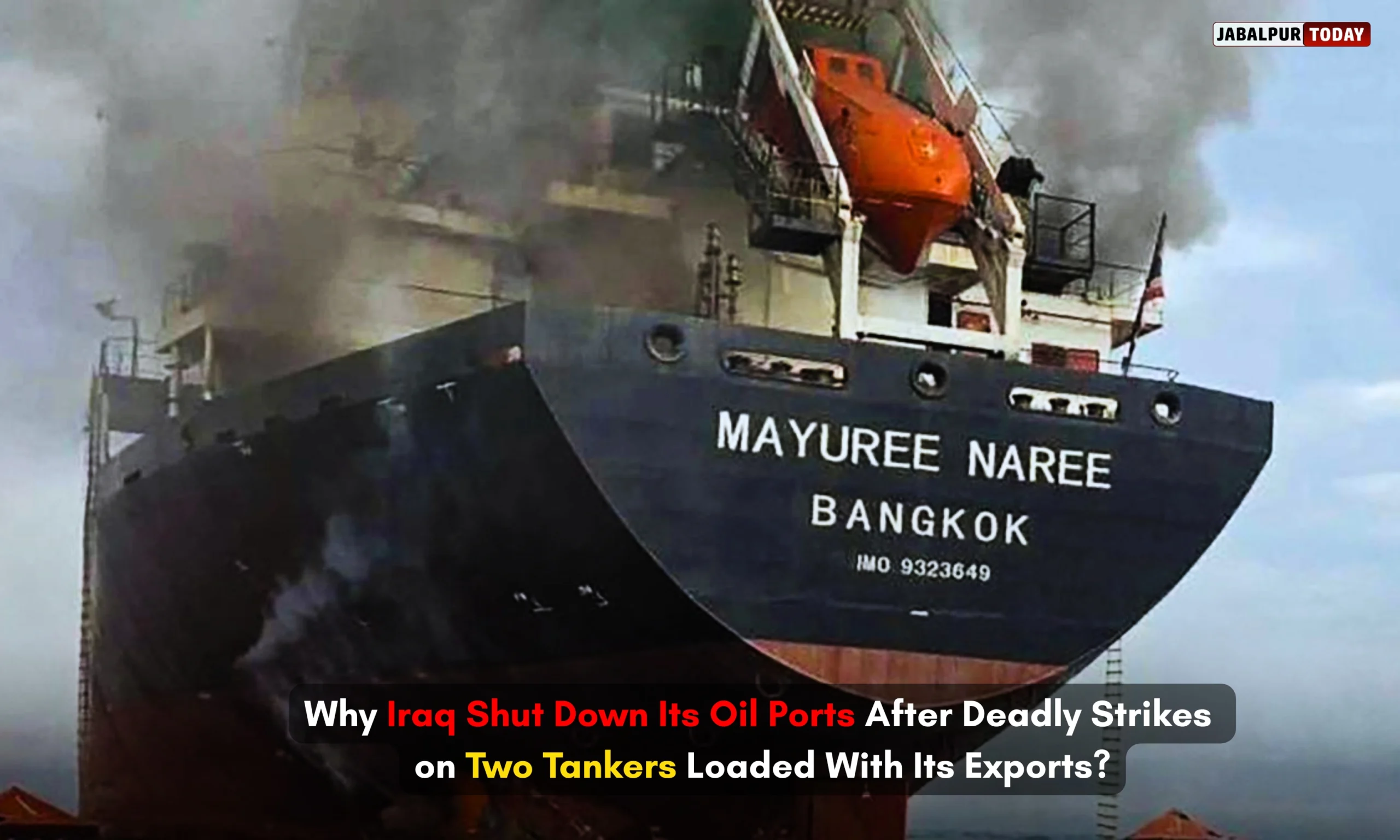
One crew member killed as Iraq shuts all oil export ports after Iranian attacks on two tankers carrying Iraqi oil in its territorial waters near Basra. Read Full report
New Delhi: In a serious escalation that has directly affected Iraq’s oil economy, authorities in Baghdad ordered the complete suspension of operations at all the country’s oil export terminals on Thursday. The decision came after attackers targeted two foreign-flagged tankers carrying Iraqi petroleum products and set them on fire in Iraqi territorial waters near Basra.
The incident happened overnight between March 11 and 12, 2026 — the 13th day of intensified strikes by the United States and Israel on Iran, along with Iran’s retaliatory actions across the Gulf region. The tankers were operating in a ship-to-ship (STS) transfer area about 5 nautical miles south of Basra, inside Iraqi waters and close to the major export terminals at Umm Qasr Port and Al-Faw Port.
The Vessels and the Attack
Attackers targeted two ships: Safesea Vishnu, a Marshall Islands-flagged tanker owned by a US company and chartered to an Iraqi firm, and Zefyros, which sails under the Malta flag.
The Safesea Vishnu was carrying Iraqi fuel oil supplied by the State Organization for Marketing of Oil (SOMO) to the Iraqi Oil Tankers Company. Meanwhile, the Zefyros was transporting condensate produced by the Basra Gas Company.
Both ships were in the sideloading area and preparing for cargo transfer when powerful explosions hit them.
Port officials and maritime security sources said the attack was carried out by boats filled with explosives. Later, Iran claimed responsibility through state media, saying an underwater drone attack had “blown up two oil tankers in the Persian Gulf tonight.”
The blasts caused large fires on the ships’ decks and oil spilled into the surrounding water. Thick black smoke could be seen rising from the vessels in videos released by Iraqi port authorities.
Human Cost
One crew member was killed in the attack — an Indian national who was working on the Safesea Vishnu. The Embassy of India in Baghdad confirmed the death and said that the remaining Indian crew members were safely evacuated.
According to Iraqi officials, a total of 38 foreign crew members from the two ships were rescued. Firefighting tugboats from Basra Oil Port quickly responded to the emergency, while naval search-and-rescue teams coordinated efforts to evacuate survivors and control the fires.
Iraq’s Immediate Response: Ports Suspended
Following the attack, Farhan al Fartousi, Director General of the General Company for Ports of Iraq (GCPI), announced that all oil port operations would be suspended immediately.
He stated:
“The operation of oil ports has been suspended, commercial ports continue operations.”
This means that loading and unloading activities at the commercial sections of Umm Qasr Port — both the North and South terminals — are continuing normally. However, all oil export terminals have been temporarily shut down for safety reasons.
SOMO strongly condemned the incident, describing it as a “cowardly act of sabotage” against ships operating inside Iraqi territorial waters.
Iraq’s Oil Ministry also expressed serious concern and issued a statement saying that international shipping routes and energy supply lines must not become targets in regional conflicts.
Visual Context of the Affected Area
The attacks took place near Iraq’s most important southern export infrastructure. This region handles the majority of the country’s crude oil and petroleum product shipments, making it a critical lifeline for Iraq’s economy.
A Direct Blow to Iraq
This is not a distant or indirect conflict for Iraq. The tankers involved were carrying Iraqi oil and condensate, and the explosions occurred inside Iraq’s own territorial waters.
Because of the security risk, Iraq — one of the world’s major oil suppliers — took the unusual step of shutting down its export terminals to protect workers, ships, and infrastructure.
The shutdown immediately disrupted oil loading at key southern facilities and pushed global oil prices higher, crossing $100 per barrel again.
For now, Iraq’s commercial ports remain open for regular cargo traffic, but the oil terminals — which are the main source of the country’s export revenue — remain closed.
According to Iraqi authorities, port officials, the Indian Embassy, and several international reports on March 12, 2026, oil terminal operations have not resumed yet. The incident highlights how quickly a regional conflict can disrupt a country’s most important export infrastructure — even within its own territorial waters.

Mansi Sharma is a journalist covering Global Affairs, and wellness, known for turning complex ideas into sharp, engaging narratives. Her work is driven by curiosity, depth, and a constant urge to question and explore. When she’s not writing, you’ll often find her diving into new ideas—preferably with a cup of coffee in hand, one sip at a time.