
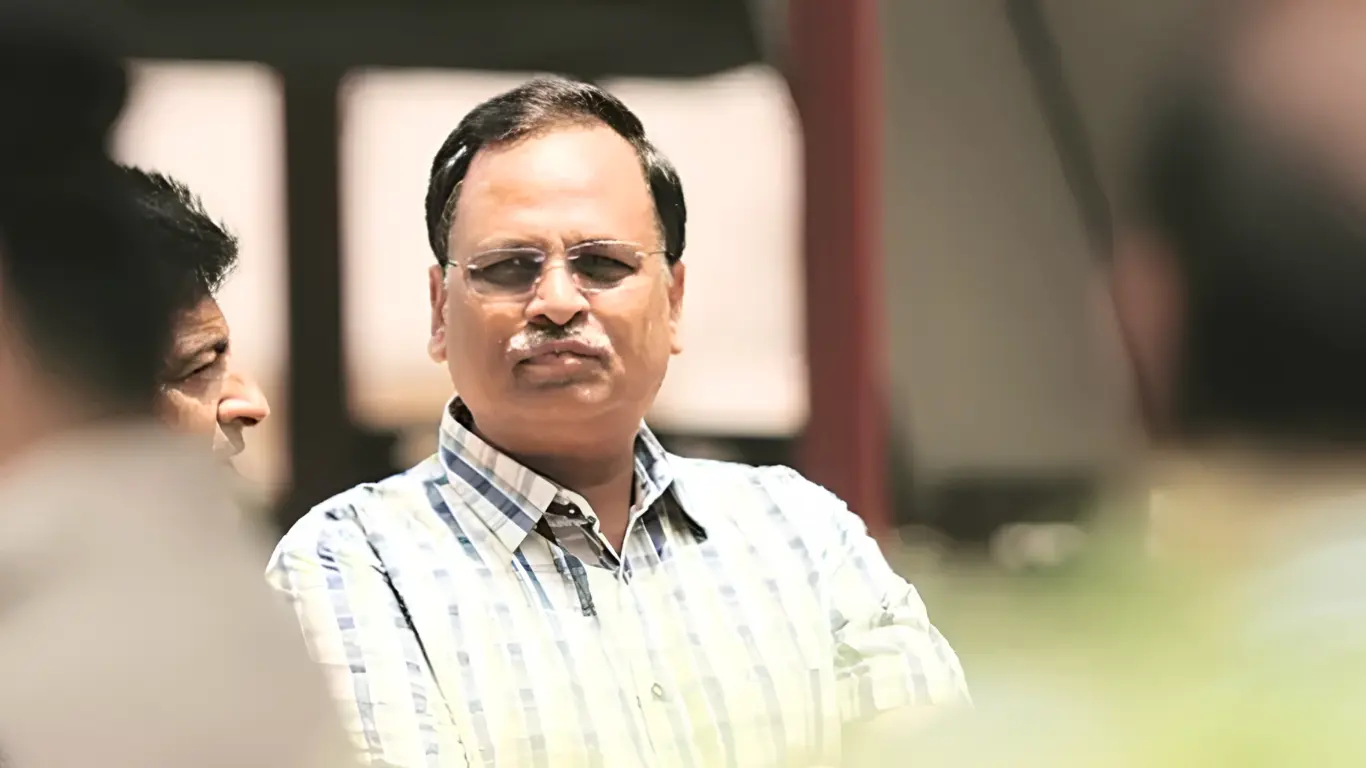
Satyendar Jain’s arrest in the Delhi Jal Board STP scam sparks a political row as AAP calls it a BJP ploy ahead of the 2027 Punjab Assembly elections
New Delhi: The Delhi government’s Anti-Corruption Branch arrested former Delhi minister and senior Aam Aadmi Party leader Satyendar Jain along with five others on the night of August 18, 2026. The agency arrested them in a case involving alleged corruption and irregularities in the tender process for sewage treatment plant projects under the Delhi Jal Board.
The arrest quickly turned into a political issue beyond Delhi. It also brought Punjab into the spotlight because the state will hold Assembly elections in early 2027.
Jain, whom AAP appointed as the party’s Punjab co-in-charge in March 2025, told reporters while police took him to court the next day that the action was linked to the upcoming Punjab election. “This is politics,” he said.
AAP national convenor Arvind Kejriwal, Punjab Chief Minister Bhagwant Mann, Manish Sisodia, Sanjay Singh and Atishi also attacked the arrest. They called it a deliberate “BJP ploy” and a “witch-hunt”. They said the BJP timed the action to disrupt AAP’s organisational work in Punjab, where the party currently runs the government.
The Bharatiya Janata Party rejected the allegation. BJP leaders said the Anti-Corruption Branch had found a clear money trail and that the case showed serious failures during AAP’s decade in power in Delhi.
Here is a detailed look at the case, its political timing, Jain’s legal history and the claims made by both sides.
Who Is Satyendar Jain and Why Does His Arrest Matter Now?
Satyendar Kumar Jain trained as an architect before entering politics. He became one of Arvind Kejriwal’s closest and most trusted colleagues.
Jain handled several important portfolios in different Delhi governments, including Health, Public Works, Power, Water and Urban Development.
The current case relates to his role as the minister responsible for the Delhi Jal Board when officials processed the disputed tenders.
However, his political importance now extends beyond Delhi. AAP appointed Jain as the party’s Punjab co-in-charge, giving him an important role ahead of the 2027 Assembly election.
Jain was expected to help with candidate selection, campaign planning and coordination of the party’s organisational work in Punjab.
AAP says his arrest could affect these responsibilities. The party argues that the real goal behind the action was to remove or restrict an important strategist months before the Punjab election.
What Does the Delhi Jal Board STP Case Involve?
The Anti-Corruption Branch registered an FIR on May 11, 2024, after receiving a complaint from the Directorate of Vigilance.
The complaint alleged “large-scale irregularities, manipulation of tender conditions and criminal conspiracy” during the process to expand and upgrade sewage treatment plants operated by the Delhi Jal Board.
According to the ACB, officials changed the tender specifications in a way that reduced competition and favoured a particular technology provider, Euroteck Environment Pvt Ltd, owned by Raja Kumar Kurra.
The agency has alleged that Ankit Srivastava, a former contractual consultant with the Delhi Jal Board, helped make these changes.
Investigators allege that money moved from Euroteck through AN Enterprises, owned by Nagendra Yadav, and reached accounts linked to then-DJB CEO Udit Prakash Rai and his relatives.
The investigators have put the amount at ₹1.52 crore. They allege that the recipients used part of the money to purchase immovable property.
The case also names Pankaj Verma of M/s Srijanhar as the sixth accused.
The ACB says digital communications between private parties and government officials contain discussions about tender conditions, corrigenda and meetings.
The Enforcement Directorate also opened a separate money-laundering investigation into the matter. The agency previously estimated that the four STP-related tenders generated around ₹17.7 crore in alleged proceeds of crime. The ED has also filed a prosecution complaint against several people, including Jain.
However, Jain’s exact role remains one of the biggest points of dispute.
AAP leaders argue that officials issued the key tender in October 2022, when Jain was already in judicial custody in an earlier money-laundering case.
His lawyers have also told the court that official records do not show that Jain arbitrarily changed the location or conditions of any sewage treatment plant.
Timeline: From the 2022 Money-Laundering Arrest to the 2026 ACB Action
Jain’s legal troubles began well before the current STP case.
In August 2017, the Central Bureau of Investigation registered a disproportionate-assets case against Jain and others.
The Enforcement Directorate later registered a money-laundering case under the Prevention of Money Laundering Act based on that FIR.
The ED arrested Jain on May 30/31, 2022.
He spent about 18 months in custody. Some reports count 872 days when they include periods of interim medical bail.
On October 18, 2024, a Delhi court granted Jain regular bail.
After his release, Jain returned to political activity. AAP later gave him responsibility as the party’s Punjab co-in-charge.
On August 18, 2026, the ACB arrested Jain again, this time in the Delhi Jal Board STP case.
On August 19, the agency produced Jain and the other accused before the Rouse Avenue Court.
The ACB sought judicial custody. Jain’s lawyers opposed the request and argued that authorities had not properly communicated the grounds of his arrest. They referred to Supreme Court guidelines while making their argument.
What Did Jain Say and Why Does AAP Call It a ‘BJP Ploy’?
Jain directly linked his arrest to the upcoming Punjab election.
“This is done because the Punjab election is coming up — this is politics,” he said while being taken to court.
AAP leaders quickly repeated the claim.
Arvind Kejriwal said the BJP had pushed for Jain’s arrest. He also claimed that authorities had fabricated the earlier case against Jain and said the new case would meet the same fate.
Manish Sisodia linked the timing of the arrest to the Punjab election. He accused the BJP of again using what he described as “ED-ACB-CBI” tactics whenever elections approach.
Sanjay Singh described the arrests of AAP leaders before elections as a settled “BJP policy”. He said the arrests disrupt the party’s election preparations.
Punjab Chief Minister Bhagwant Mann also accused the BJP of repeating the same approach that AAP leaders had faced in Delhi.
AAP leaders have repeatedly raised one key question: if Jain was already in jail when officials issued the disputed tender, how could he have personally directed or benefited from the alleged irregularities?
They have also argued that authorities have not shown the same urgency in investigating other alleged scams in Delhi under the current BJP-led government.
BJP’s Response: Money Trail Shows Corruption
The BJP has strongly rejected AAP’s allegations of political revenge.
Delhi BJP president Harsh Malhotra and other party leaders said the ACB acted after carrying out a detailed investigation.
They said investigators had established a money trail and had identified the alleged distribution of the money among the then minister, government officials and contractors.
Malhotra also connected the STP case to Delhi’s sewage and pollution problems.
He argued that AAP ruled Delhi for 10 years but failed to add meaningful sewage treatment capacity on major drains. He also said the Yamuna continued to deteriorate during that period.
“The law may take some time, but Satyendar Jain will certainly be punished,” he said.
BJP leaders have presented the arrest as an accountability issue rather than an election strategy.
They have also pointed out that the ACB works under the Delhi government and is not a central agency.
AAP, however, continues to argue that political influence from the Centre ultimately drives such actions.
Why Does Punjab Matter?
Punjab will hold its next Assembly election by early 2027, with February widely discussed as the likely election period.
AAP currently runs the Punjab government after winning the 2022 Assembly election by a large margin.
The BJP has also been strengthening its organisation in the state and has recently appointed new leaders to oversee its Punjab operations.
Against this backdrop, the arrest of AAP’s Punjab co-in-charge carries major political significance, regardless of what happens in court.
AAP says the timing follows a familiar pattern.
The party points to the Delhi Assembly election period, when several senior AAP leaders, including Arvind Kejriwal, Manish Sisodia, Satyendar Jain and Sanjay Singh, faced arrests in different cases.
AAP says those arrests disrupted the party’s campaign and diverted its resources.
The party now argues that the same strategy has moved to Punjab.
Whether voters accept that argument or view the arrests as legitimate investigations will ultimately depend on the evidence and the political response.
But the arrest has already triggered a major political confrontation between AAP and the BJP.
What Happens Next in the Legal Case?
The Rouse Avenue Court is now dealing with custody and bail proceedings involving Jain and the other accused.
Jain’s lawyers are expected to focus on his lack of an operational role during the period when he remained in custody.
They are also expected to argue that the ACB has not established a direct connection between Jain and the alleged irregularities.
The prosecution, meanwhile, will rely on the alleged money trail, digital communications and the chain of command within the Delhi Jal Board.
The ED’s separate money-laundering proceedings linked to the same set of allegations will also continue.
Earlier property attachments connected to Jain in the older PMLA case, including assets worth several crores, remain part of his wider legal history.
Such cases often take years to reach trial. In the immediate future, custody hearings, bail applications and possible challenges to the investigation will remain the main focus.
The Larger Debate: Investigative Agencies and Election Politics
Indian politics has repeatedly seen allegations that investigative agencies target opposition leaders before elections.
AAP has raised this issue particularly strongly because several of its senior leaders have faced arrests and long periods in custody.
The BJP and investigative agencies reject the allegation. They maintain that agencies investigate cases based on evidence and that politicians cannot claim immunity from criminal investigations.
Courts have sometimes granted bail because of delays in trials or limited progress in cases. In other situations, courts have allowed agencies to continue custody when they found sufficient grounds.
The Satyendar Jain case now sits at the centre of this larger political and legal debate.
The ACB has presented an FIR, an alleged money trail and digital evidence.
AAP has highlighted the timeline of the case, especially Jain’s incarceration during the period when officials issued the key tender. The party has also pointed to what it sees as a pattern of arrests before elections.
The court will now examine the evidence presented by the investigating agencies and the arguments made by Jain’s lawyers.
For AAP, the arrest raises questions about political timing and the party’s preparations for the Punjab election.
For the BJP, it represents an investigation into alleged corruption and accountability for decisions taken during AAP’s time in power in Delhi.
The legal proceedings will determine whether the allegations stand up in court. The political battle, however, has already begun.

Mansi Sharma is a journalist covering Global Affairs, and wellness, known for turning complex ideas into sharp, engaging narratives. Her work is driven by curiosity, depth, and a constant urge to question and explore. When she’s not writing, you’ll often find her diving into new ideas—preferably with a cup of coffee in hand, one sip at a time.