
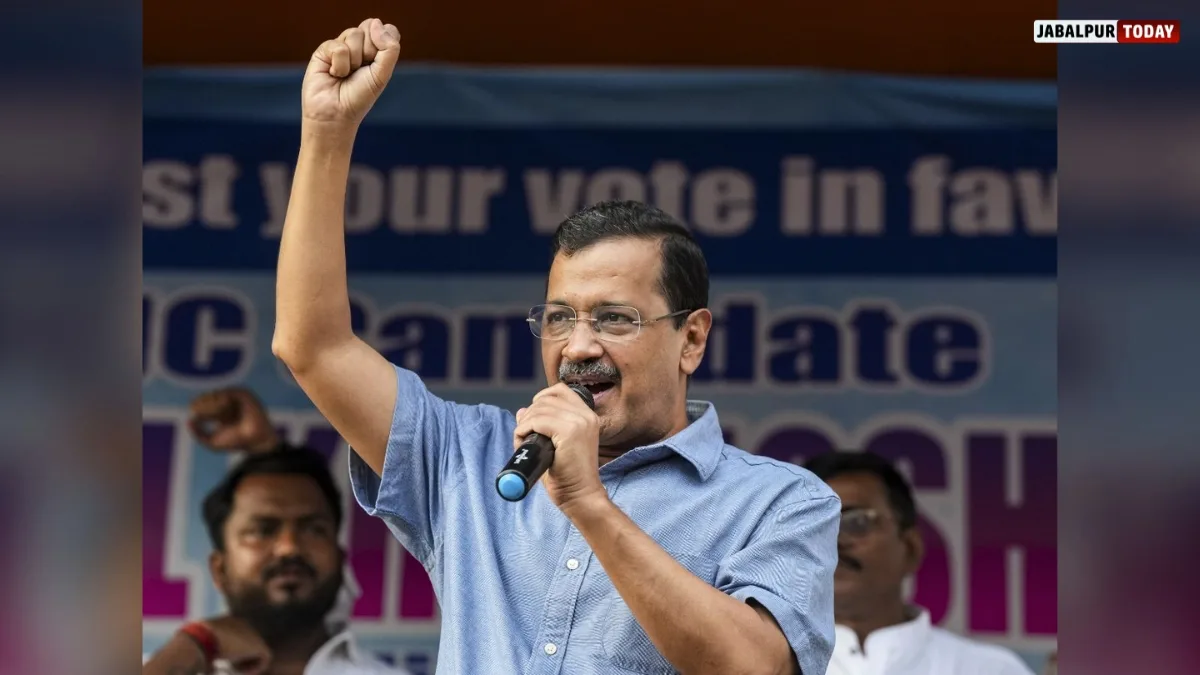
Kejriwal joins Mamata Banerjee in the Bengal campaign, alleges voter suppression, and frames the election as a battle to protect democracy and citizenship rights
New Delhi: In a major political move ahead of the final phase of the West Bengal Assembly elections, AAP national convenor and former Delhi Chief Minister Arvind Kejriwal arrived in Kolkata at the invitation of Chief Minister Mamata Banerjee to campaign for TMC candidates. He called the contest one of the most crucial battles for Indian democracy and accused Prime Minister Narendra Modi of misusing institutions, including the Chief Election Commissioner.
This visit came after a phone call between Kejriwal and Banerjee around April 22, where he expressed “complete support and solidarity.” He called her election fight “one of the toughest and most important battles for Indian democracy.” He also accused Prime Minister Narendra Modi of misusing government institutions, including the Chief Election Commissioner.
Kejriwal addressed public rallies in places like Beleghata (for TMC candidate Kunal Ghosh) and Ballygunge (for senior TMC leader Sobhandeb Chattopadhyay). He even tried speaking in Bengali, saying, “Ami ektu ektu Bangla bolte pari” (I can speak a little Bengali). He praised Mamata Banerjee’s simple lifestyle and presented the election as a larger fight.
Background: Voter List Revision Controversy
The main reason behind Kejriwal’s involvement was the Election Commission of India’s Special Intensive Revision (SIR) of voter lists in West Bengal. The Election Commission of India carried out this process in stages from late 2025 to early 2026.
According to official data, authorities removed around 91 lakh voter names across the state, reducing the total number of voters from about 7.66 crore to 6.75 crore, a drop of nearly 12%. Out of these, officials deleted about 27 lakh names under a category called “logical discrepancy,” which they introduced for the first time and had judicial officers review.
TMC leaders, including Mamata Banerjee, claimed that authorities had unfairly removed many genuine voters. fairly removed. They said this mainly affected Muslim-majority areas and TMC strongholds like Murshidabad, Malda, North and South 24 Parganas, and parts of Kolkata.
Many people said authorities deleted their names even though they had valid documents. In some families, officials kept one person’s name on the list while removing another’s. Banerjee had earlier asked people to “take revenge” by voting and to challenge the deletions in tribunals. The Supreme Court refused to directly interfere in some cases and told people to approach appellate tribunals.
On the other hand, the BJP defended the revision process. It said the aim was to clean the voter list by removing duplicate names, dead voters, shifted voters, and ineligible people (including alleged illegal immigrants).
The issue became more serious after Phase 1 voting on April 23, 2026 (covering 152 seats), saw a record turnout of over 92–93%. TMC said this showed anger over voter deletions, while BJP said it reflected dissatisfaction with the current government.
What Kejriwal Said in His Kolkata Rallies?
In his rallies on April 26, Kejriwal directly spoke to people whose names were deleted. He claimed there was a “BJP–Election Commission conspiracy” and said it was part of a “larger plan” related to citizenship and documents like ration cards.
He said that while 27 lakh names were removed under “logical discrepancy,” the total number affected could be around 90 lakh when all revisions are included.
Some of his key statements were:
“Go and tell your friends, relatives and neighbours to vote for TMC candidates. Didi has to win this fight against the BJP, which wants to take away your citizenship rights as part of a bigger plan to win elections.”
He urged those whose names were deleted to become “soldiers” for Mamata Banerjee, go door-to-door, and campaign for TMC. He assured them:
“She will stand with you… Remember, BJP can cancel your citizenship documents like ration cards, and only Mamata Banerjee can help you.”
Kejriwal also raised other issues. He questioned why the Centre deployed so many central and paramilitary forces, asking, “Are the people of Bengal terrorists?” He accused the government of treating citizens with suspicion.
Then he warned that voting for BJP (the lotus symbol) could put welfare schemes at risk, including monthly financial support like ₹1,500.
He appealed for unity across parties and told Congress, Left, and even BJP supporters to vote for TMC “this time.” He said, “I love my country more than my party. If the country survives, the party will survive.”
He described the election as a “fight to save democracy” and “save India” from “dirty politics” and misuse of institutions.
Why Kejriwal Campaigned for TMC
Kejriwal’s support for TMC was not part of any official alliance, as AAP is not contesting elections in West Bengal. His campaign reflects cooperation among opposition parties under the INDIA bloc and his ongoing criticism of BJP’s alleged use of central agencies and the Election Commission.
Earlier in March 2026, he had accused BJP of turning the Election Commission into a “weapon” to win elections unfairly, comparing it to what he claimed happened in Delhi.
His visit came at a time when other opposition leaders like Hemant Soren and Tejashwi Yadav were also supporting Mamata Banerjee.
The timing was important because it came after high voter turnout in Phase 1 and just before Phase 2 (covering 142 seats, including key areas in Kolkata where many deletions were reported).
Kejriwal positioned himself as supporting Banerjee against what he called misuse of power by the Centre, while also trying to turn voter anger over deletions into support for TMC.
Wider Political Situation
The 2026 West Bengal Assembly elections (total 294 seats, results on May 4) are a major contest between TMC, which is trying to win a fourth term under Mamata Banerjee, and BJP, which is mounting a strong challenge led by leaders like Suvendu Adhikari.
Prime Minister Narendra Modi and BJP leaders have been actively campaigning, accusing TMC of poor governance, corruption, “syndicate raj,” and illegal infiltration.
Kejriwal’s campaign happened alongside other big opposition leaders, including Tamil leader Vijay, showing wider support for TMC.
The voter list revision issue has led to protests, legal cases, and political arguments. While TMC calls it unfair, BJP says it is a transparent and necessary process.
The high turnout in Phase 1 (over 92%) was praised by the Election Commission but interpreted differently by different parties.
What This Means for Voters
Kejriwal’s campaign combined a specific issue (voter deletions and fear about documents) with a larger message about protecting identity, welfare schemes, and democracy.
By asking affected voters to actively campaign for TMC and appealing to people across party lines, he tried to turn public concern into votes for Mamata Banerjee in the April 29 phase.
Whether this strategy, along with the high turnout, will affect results in important constituencies will only be clear after counting.
This situation shows how a voter list update became a major political issue, turning a routine process into a larger debate about citizenship, inclusion, and trust in institutions.
Also Read on jabalpur today: Meet Mamta Kumari – Wife of Samrat Choudhary, Bihar’s Newly Appointed Chief Minister

Mansi Sharma is a journalist covering Global Affairs, and wellness, known for turning complex ideas into sharp, engaging narratives. Her work is driven by curiosity, depth, and a constant urge to question and explore. When she’s not writing, you’ll often find her diving into new ideas—preferably with a cup of coffee in hand, one sip at a time.