
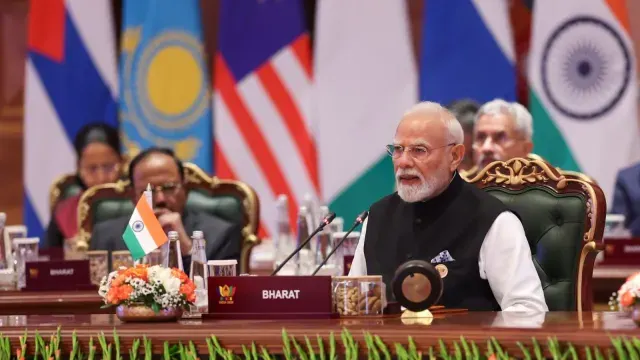
BRICS Summit 2026 in New Delhi brings Modi, Putin and Xi Jinping together as India pushes Global South cooperation, trade, energy and global reforms
New Delhi: India has placed the Global South, economic cooperation and a changing world order at the centre of the 18th BRICS Summit in New Delhi, bringing together leaders including Prime Minister Narendra Modi, Russian President Vladimir Putin, Chinese President Xi Jinping and Iranian President Masoud Pezeshkian.
India is hosting the two-day summit at Bharat Mandapam on September 12 and 13 as the current BRICS chair. The meeting comes at a time when wars, trade disruptions and tensions among major powers continue to reshape the global economy and international relations.
Modi Calls for a Stronger Voice for Global South
Prime Minister Narendra Modi opened the summit by calling for greater participation of developing countries in shaping global rules. He said BRICS should focus on practical outcomes and described the grouping as a platform for emerging and developing economies rather than an alliance against the West.
Modi also stressed the need to strengthen multilateralism and reform global institutions, including the United Nations system. He argued that the Global South should move beyond being a participant in global decision-making and play a larger role in shaping international rules.
The BRICS grouping now has 11 members and represents nearly half of the world’s population. Its agenda covers trade, investment, energy, food security, technology, supply chains and reforms in global governance. Members are also discussing ways to increase the use of national currencies in trade and reduce dependence on Western-dominated financial systems.
Modi-Putin Talks Focus on Trade, Energy and Defence
Before the main summit discussions, Modi held bilateral talks with Russian President Vladimir Putin in New Delhi. The meeting focused heavily on strengthening economic and strategic cooperation between India and Russia.
The two countries are working towards a target of $100 billion in bilateral trade by 2030. Discussions covered manufacturing, railways, tunnelling, steel, critical minerals, nuclear energy, fertilisers and skilled-worker mobility. Both sides also reviewed defence and energy cooperation.
India and Russia are also exploring expanded civil nuclear cooperation, including possible new nuclear power projects and cooperation involving the nuclear fuel cycle. The two sides discussed critical minerals and rare earth supplies, which have become increasingly important for electric vehicles, semiconductors and clean-energy technologies.
A symbolic moment from the meeting came when Modi presented Putin with a Russian translation of the Thirukkural, the classical Tamil text attributed to poet-philosopher Thiruvalluvar. After the talks, Modi and Putin also travelled together in the Russian president’s car.
Putin invited Modi to Russia for the next India-Russia Annual Summit, and Modi accepted the invitation.
Xi Jinping’s Delhi Visit Draws Global Attention
Chinese President Xi Jinping arrived in New Delhi on Saturday for the BRICS Summit, marking his first visit to India in nearly seven years. His arrival carries particular significance because India-China relations suffered a major setback after the 2020 military confrontation along the disputed Himalayan border.
Modi and Xi were scheduled to hold bilateral talks on Saturday evening. The meeting has attracted considerable international attention because both countries have recently taken steps to stabilise their relationship.
China has signalled its willingness to improve communication, expand cooperation and manage differences through dialogue. The two leaders are expected to examine bilateral ties as well as wider cooperation within BRICS.
The interaction between Modi, Xi and Putin has also produced striking visual moments from the summit, highlighting the diplomatic significance of the New Delhi gathering.
Wars and Trade Tensions Shape BRICS Agenda
The summit takes place against the backdrop of the Russia-Ukraine war, the conflict involving Iran and continuing tensions between major global powers. These crises have affected energy markets, shipping routes, trade and supply chains.
India has attempted to maintain dialogue with Russia and Iran while simultaneously expanding its relations with the United States and Europe. This balancing approach gives New Delhi a distinctive diplomatic position within BRICS.
The bloc is also discussing maritime security. Modi has proposed a BRICS seafarers’ network to improve the safety and welfare of maritime workers as geopolitical conflicts disrupt important shipping routes.
New Delhi Declaration Expected to Set the Tone
A major focus of the summit remains the New Delhi Declaration. BRICS members have agreed on a joint declaration that addresses global conflicts, trade concerns and the need for stronger multilateral cooperation. Reports indicate that the document will express concern over unilateral military action and trade barriers while avoiding direct naming of individual countries.
The declaration is expected to underline BRICS’ support for dialogue, diplomacy, international law and reforms in global institutions. The grouping also wants developing nations to gain greater representation in decision-making bodies.
For India, the summit represents more than a diplomatic gathering. New Delhi is using its BRICS chairmanship to promote economic resilience, technological cooperation and a stronger role for the Global South. With differences still existing among members, the real test will be whether BRICS can convert its growing influence into concrete cooperation.
As leaders gather in New Delhi, India is seeking to position BRICS as a practical platform for cooperation in an increasingly fragmented global order.
