
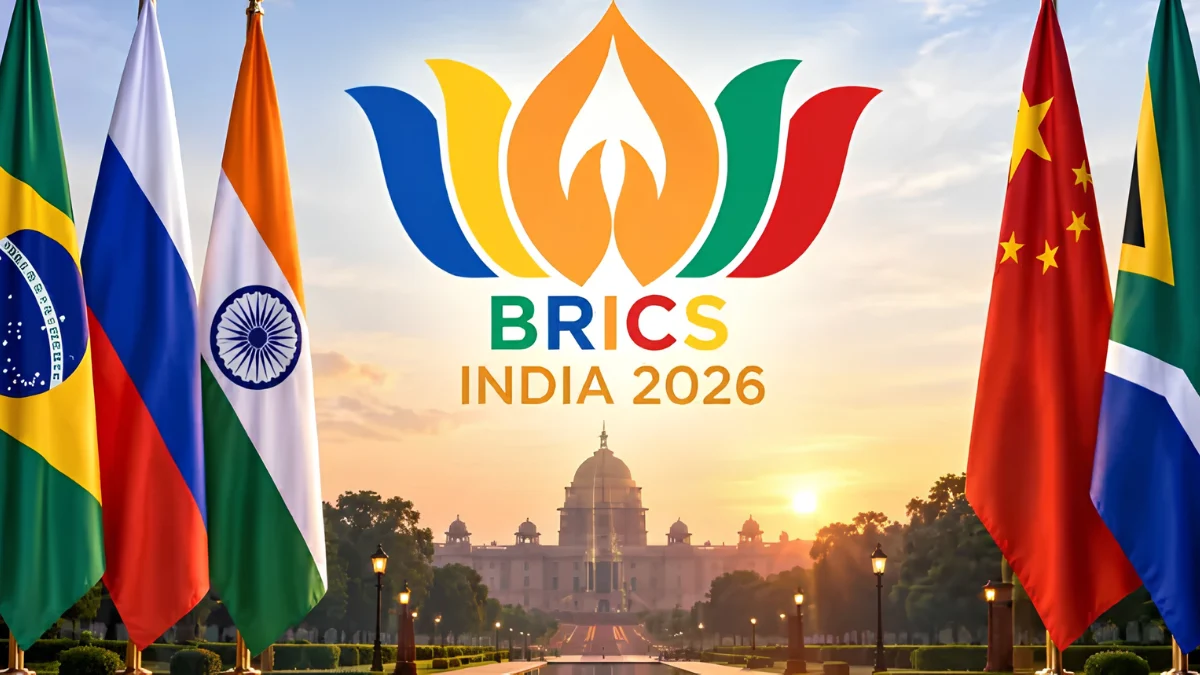
BRICS Summit 2026 will be held in New Delhi on September 12–13. Know the members, agenda, Delhi holiday, bank status, traffic rules and why the summit matters
New Delhi: Delhi is once again preparing for a major international summit. Therefore, if you have noticed more security personnel, barricades, traffic diversions and restrictions around central Delhi, there is a reason. The capital is getting ready to host the 18th BRICS Leaders’ Summit on September 12 and 13, 2026.
The summit will be held at Bharat Mandapam in New Delhi, bringing together leaders from BRICS member and partner countries, along with outreach invitees. As India holds the BRICS chairship in 2026, the summit will mark an important diplomatic event for New Delhi.
For Delhi residents, the summit means traffic restrictions, security checks and a holiday for schools and several government institutions on September 11. For the wider world, however, the meeting is about much more than road closures. It will focus on economic cooperation, global governance, technology, sustainability, development and the growing role of the Global South.
India’s BRICS chairship is guided by the theme “Building for Resilience, Innovation, Cooperation and Sustainability.” The year also marks two decades since the formal establishment of BRICS.
What Is BRICS?
BRICS is a group of major emerging economies that cooperate on economic, political, financial and development-related issues.
The term “BRIC” was first used in 2001 to describe Brazil, Russia, India and China. The four countries later began working together as a formal grouping. Their first leaders’ summit was held in Yekaterinburg, Russia, in June 2009.
South Africa joined the grouping, turning BRIC into BRICS. The group expanded again in 2024 when Egypt, Ethiopia, Iran and the United Arab Emirates became full members. Indonesia joined as a full member in January 2025.
Who Are the 11 BRICS Members in 2026?
The full members are:
- Brazil
- Russia
- India
- China
- South Africa
- Egypt
- Ethiopia
- Iran
- United Arab Emirates
- Saudi Arabia
- Indonesia
According to India’s Ministry of External Affairs, the 11-member grouping represents about 49.5% of the global population, around 40% of global GDP and roughly 26% of global trade.
This makes BRICS one of the most important platforms for emerging and developing economies.
Who Are the BRICS Partner Countries?
BRICS also has a separate partner-country category.
The countries included in the partner category are:
- Belarus
- Bolivia
- Cuba
- Kazakhstan
- Malaysia
- Nigeria
- Thailand
- Uganda
- Uzbekistan
- Vietnam
Partner countries can participate in different BRICS meetings and activities, but their status is different from that of full members. India’s BRICS programme in 2026 has already included participation from both member and partner countries.
When and Where Is the BRICS Summit 2026?
The 18th BRICS Leaders’ Summit will be held on:
- Dates: September 12–13, 2026
- Venue: Bharat Mandapam, New Delhi
- Host: India
India assumed the BRICS chairship on January 1, 2026. This is the fourth time India has chaired the grouping, following its earlier chairships in 2012, 2016 and 2021.
The 2026 summit is also significant because BRICS completes 20 years since its establishment.
What Is the Theme of BRICS 2026?
India has chosen the theme:
“Building for Resilience, Innovation, Cooperation and Sustainability.”
The theme reflects India’s emphasis on practical cooperation and a people-focused approach under the broader idea of “Humanity First.”
In simple terms, India wants BRICS cooperation to focus on making economies stronger, encouraging new technology, improving cooperation between countries and building a more sustainable future.
What Has India Done During Its BRICS Chairship?
The September summit is only the final stage of a much larger programme.
India has hosted more than 350 meetings and high-level engagements across more than 25 cities during its 2026 chairship. These meetings have covered political and security issues, economic and financial cooperation, culture and people-to-people exchanges.
Ministerial meetings, working groups, business events, youth programmes and other discussions have taken place throughout the year.
The BRICS Foreign Ministers’ Meeting in New Delhi in May 2026, for example, discussed global governance reform and other international and regional issues.
This means the Leaders’ Summit is not a standalone event. It is where leaders will review the work done throughout the year and decide the broader direction of BRICS cooperation.
What Will Leaders Discuss at the Summit?
The BRICS agenda is wide. Some of the major areas include:
1. Global Economic Cooperation
BRICS countries want to increase trade and investment among members and make global supply chains more resilient.
The discussion is particularly important at a time when geopolitical tensions, conflicts and disruptions can affect energy, food, manufacturing and international trade.
2. Local Currencies and Cross-Border Payments
One of the most closely watched issues is financial cooperation.
BRICS countries have discussed greater use of national currencies in trade and ways to make cross-border payments easier.
There has also been discussion around payment platforms and financial infrastructure. However, it would be inaccurate to describe “BRICS Pay” as an already operational single BRICS-wide payment system. The broader issue is cooperation on payment mechanisms and reducing some of the barriers to trade between member countries.
3. Technology and Artificial Intelligence
Technology is another major area.
India has highlighted digital public infrastructure, innovation and emerging technologies during its BRICS chairship. AI governance, digital cooperation and technology sharing are likely to remain important subjects as countries try to benefit from AI while dealing with its economic and regulatory challenges.
4. Energy and Food Security
Energy security is especially important for a group that includes major energy producers and large energy-consuming economies.
BRICS cooperation has also focused on food security, agriculture and resilient supply chains. These issues directly affect inflation, economic growth and the cost of living.
5. Climate Change and Sustainability
Climate action and sustainable development are also part of the BRICS agenda.
The focus is not simply on reducing emissions. Countries are also interested in clean technology, sustainable finance, energy transitions and making developing economies more resilient to climate-related risks.
6. Reform of Global Institutions
BRICS countries have repeatedly called for greater representation of developing countries in international institutions.
This includes discussions around reform of the United Nations, IMF and World Bank, as well as a stronger voice for countries from Africa, Asia and Latin America.
This is one reason BRICS is often linked with the wider debate about a changing global order.
Why Is September 11 a Holiday in Delhi?
This is probably the most immediate question for Delhi residents.
September 11, 2026, is a Friday, and Delhi has announced closures connected with arrangements for the BRICS Summit.
The Directorate of Education has declared the day a holiday for schools under its jurisdiction, including government, government-aided and recognised private schools. Delhi government offices, autonomous bodies and public sector undertakings are also closed.
Central government offices in Delhi and New Delhi are also scheduled to remain closed on September 11.
The reason is straightforward: the city needs additional security and traffic-management arrangements before the arrival and movement of international leaders and delegations.
Since September 12 is the second Saturday, the timing also creates a longer break for many students and government employees.
September 11 Bank Holiday: Will Delhi Banks Remain Open?
No. Banks in New Delhi are scheduled to remain open on September 11, 2026.
The BRICS-related government holiday does not automatically become a bank holiday. Banks follow the Reserve Bank of India’s holiday calendar, which is separate from government-office closure orders.
Recent reporting based on the RBI holiday calendar confirms that September 11 is not listed as a bank holiday for New Delhi.
So customers can generally expect bank branches to operate normally.
Digital services such as UPI, internet banking, mobile banking and ATMs should also continue to function. However, people travelling to branches should allow extra time because traffic restrictions may affect several parts of Delhi.
Will BRICS Summit Affect Traffic in Delhi?
Yes.
Delhi Traffic Police has issued a specific advisory for September 11–13 in connection with the 18th BRICS Summit.
Restrictions and diversions are expected around key areas connected with the summit and VIP movement.
Major roads and corridors across central and New Delhi may experience temporary restrictions or slower traffic depending on the movement of dignitaries.
Some important roads and areas that can experience congestion include parts of:
- Bhairon Road
- Mathura Road
- Ring Road
- Sardar Patel Marg
- Dhaula Kuan
- ITO and central Delhi
- Roads around Pragati Maidan
- Major routes connecting the airport and central Delhi
Delhi Traffic Police maintains a list of major congestion corridors across the city, and commuters should check the latest advisory before travelling.
What Should Delhi Commuters Do?
If you need to travel during the summit period:
- Check Delhi Traffic Police updates before leaving.
- Keep extra travel time.
- Use the Metro where practical.
- Avoid unnecessary trips towards central Delhi.
- Follow temporary diversion signs.
- Do not stop or park near restricted routes.
- Keep important documents and travel details ready if travelling through controlled areas.
The exact restrictions can change according to VIP movement and security requirements.
Is September 12 Also a Holiday?
September 12 falls on the second Saturday of the month.
Government offices and schools that normally observe second-Saturday closures will therefore already be closed.
However, this does not mean every private company or establishment will be closed. Banks and private workplaces follow their own schedules and applicable holiday rules.
What Happens at a BRICS Summit?
A Leaders’ Summit is the final stage of a year-long diplomatic process.
Before heads of government meet, diplomats and senior officials work on different issues. These officials are often called Sherpas. They help prepare discussions and negotiate the language of documents before leaders arrive.
Ministers also meet throughout the year on subjects such as finance, foreign affairs, health, culture, energy and other areas.
At the Leaders’ Summit, heads of government discuss major international and BRICS-related issues. They may also hold bilateral meetings on the sidelines of the main event.
The summit usually ends with an outcome document or declaration outlining areas of agreement and future cooperation.
Will the Summit Be Open to the Public?
No.
The BRICS Leaders’ Summit is a high-level diplomatic event. Access to the main venue is restricted to authorised officials, accredited media and other approved participants.
Ordinary visitors cannot simply enter Bharat Mandapam to watch the leaders’ meetings.
Some public-facing BRICS events and cultural activities may take place separately during India’s year-long chairship, but these should not be confused with access to the Leaders’ Summit itself.
Who Is Expected to Attend?
The summit is expected to bring together leaders of BRICS member countries, representatives of partner countries and outreach invitees.
India has officially described the summit as a gathering of BRICS Member and Partner Countries as well as Outreach Invitees.
Attendance by individual leaders can change because of diplomatic schedules, so it is better to rely on official announcements for the final list.
Will Vladimir Putin and Xi Jinping Attend?
Russia is a key BRICS member, and President Vladimir Putin is expected to be an important participant in the summit.
However, attendance by individual heads of state should be described as confirmed only after an official announcement from the relevant government or the Indian authorities.
The same applies to Chinese President Xi Jinping. He has been widely discussed in connection with the summit, but the final attendance list should be checked against official confirmation before publication.
Why Is BRICS Important for India?
Hosting BRICS gives India an opportunity to shape discussions involving some of the world’s largest emerging economies.
India is trying to present BRICS as a platform for practical cooperation rather than simply a political grouping.
For New Delhi, the benefits can include:
- Greater trade opportunities
- Stronger economic links with emerging markets
- Cooperation on technology
- Easier cross-border payments
- Energy and food security cooperation
- Support for developing countries
- Greater representation in global institutions
- Stronger diplomatic engagement with the Global South
India also has to balance relationships with countries that do not always agree with each other.
That makes BRICS diplomacy particularly important. The group includes countries with different political systems, economic interests and foreign-policy priorities.
BRICS Is Not a Military Alliance
One common misunderstanding is that BRICS works like NATO.
It does not.
BRICS is not a military alliance and does not have a collective defence arrangement. It is a platform for cooperation among its members on areas such as economics, finance, politics, development, culture and people-to-people exchanges.
India has also stressed that BRICS should not simply be viewed as an anti-Western grouping. Its approach has generally focused on cooperation, reform of global institutions and giving developing countries a greater voice.
Why Does the 2026 Summit Matter Globally?
The importance of BRICS has increased as the group has expanded.
With 11 full members, the grouping now includes major economies from Asia, Africa, the Middle East and Latin America.
The expansion has also changed the nature of the organisation. BRICS is no longer simply the original Brazil-Russia-India-China-South Africa group. It now includes major energy producers, large developing economies and countries from several regions.
That gives the grouping greater economic and diplomatic weight, although its members do not always share the same views.
The 2026 summit will therefore be closely watched for signs of how much practical cooperation BRICS can achieve.
What Could Come Out of the Summit?
The most important outcomes may involve practical cooperation rather than a single dramatic announcement.
Possible areas to watch include:
- Greater use of local currencies in trade
- Cooperation on cross-border payments
- Digital public infrastructure
- Artificial intelligence and technology
- Energy cooperation
- Food security
- Climate and sustainable development
- Support for MSMEs and startups
- Health cooperation
- Reform of international institutions
- Stronger cooperation among developing countries
The final outcome will depend on negotiations between all participating countries.
What Happens After India’s BRICS Chairship?
India’s chairship runs through 2026.
Brazil is set to take over the BRICS chairship in 2027.
The transition will allow Brazil to set its own priorities while continuing some areas of cooperation developed during India’s presidency.
