
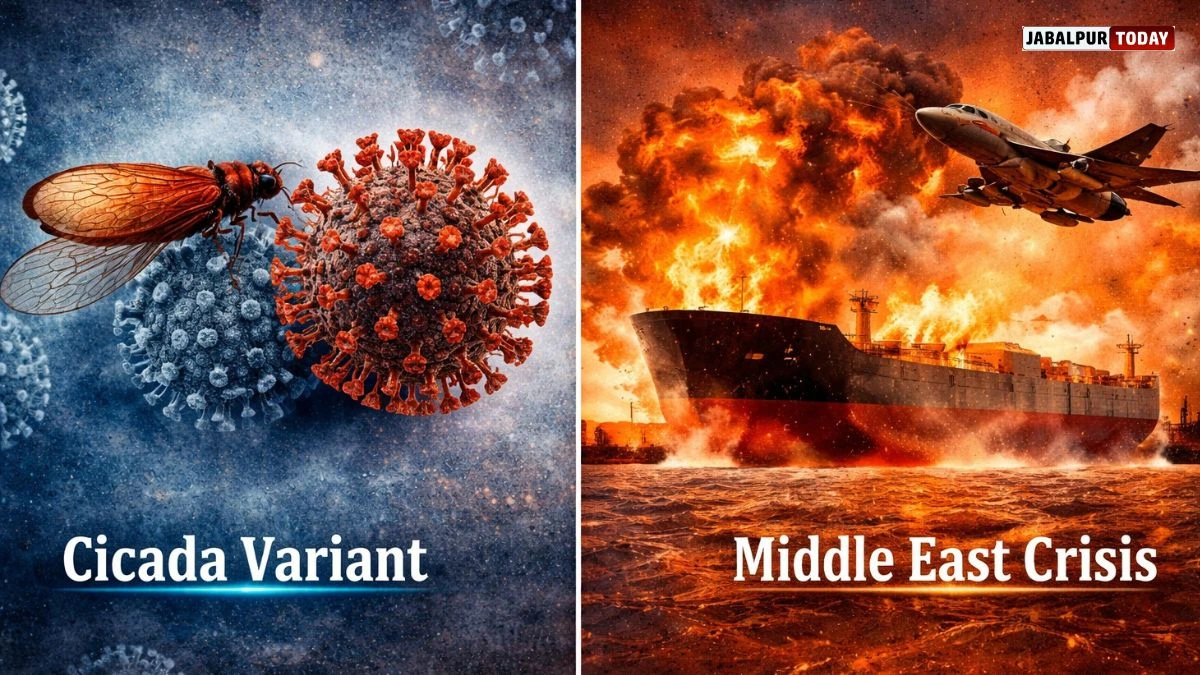
Global panic over “Lockdown 2.0” grew after two unrelated events: a new COVID-19 subvariant and a Middle East oil crisis. Here is a clear, fact-checked breakdown of what official data shows.
New Delhi: In the third week of March 2026, social media in India and worldwide was flooded with claims about “Lockdown 2.0.”
These rumors mixed two separate events: the rise of a COVID-19 subvariant called Cicada and an escalation in the Iran war that disrupted oil supplies.
Here is the full factual story. It is based on official records from the WHO, CDC, and IEA, along with statements from the Government of India. No speculation or predictions are included.
The Cicada COVID-19 Variant: What the Data Actually Shows
The variant known as Cicada (BA.3.2 or B.1.1.529.3.2) was first found on November 22, 2024, in a sample from a child in South Africa.
It is a highly mutated Omicron subvariant. It has about 70–75 changes in its spike protein compared to the JN.1 and LP.8.1 strains used in the 2025–2026 vaccines.
For more than a year, it spread at very low levels. On December 6, 2025, Canadian evolutionary biologist T. Ryan Gregory gave it the nickname “Cicada,” because, like the insect that stays underground for years, this variant remained mostly hidden before cases started increasing in September 2025.
By February 11, 2026, it had been detected in at least 23 countries. On February 23, 2026, the World Health Organization added it to its “variants under monitoring” list.
In the United States, the CDC shared detailed data in its report on March 19, 2026:
First U.S. case: June 27, 2025, in a traveler at San Francisco airport from the Netherlands.
• By February 11, 2026: found in 4 travelers, 5 patient samples, 3 airplane wastewater samples, and 132 wastewater samples across 25 states.
• Prevalence: 0.19% of 2,579 sequences studied between December 1, 2025, and February 11, 2026.
• COVID-19 levels remained low, with no rise in hospitalizations or severe cases.
• Symptoms matched recent variants: cough, fever or chills, sore throat, congestion, fatigue, shortness of breath, and loss of taste or smell.
Both the CDC and WHO have continued normal monitoring of the variant. No country has introduced travel bans, mask mandates, or lockdowns because of Cicada.
The Middle East Conflict: How It Triggered a Global Oil Shock
On February 28, 2026, the United States and Israel launched strikes on Iranian leadership and key infrastructure. Iran responded with missile and drone attacks on targets across the region, including commercial ships and oil and gas facilities in several Gulf countries. This included damage to Qatar’s LNG plant and the South Pars gas field.
Iran also restricted shipping through the Strait of Hormuz, a key route that carries about 20% of the world’s oil and a large share of liquefied natural gas. These actions reportedly included mining sea routes, charging new fees for ships, and attacking oil tankers.
The International Energy Agency later called this “the largest supply disruption in the history of the global oil market.”
As a result, global oil prices rose sharply, and shortages of diesel, jet fuel, and LPG were reported in some regions, including parts of Asia.
IEA’s Official Response: Energy Saving Steps, Not Lockdowns
On March 20, 2026, the IEA took two major steps:
• Released about 400 million barrels of emergency oil reserves — the largest release ever.
• Published a report called “Sheltering From Oil Shocks,” listing ten quick and voluntary steps to reduce oil use.
These suggestions focused mainly on transport (which uses 45% of global oil) and included:
• Encouraging work from home where possible
• Reducing highway speed limits
• Using public transport more
• Cutting down on non-essential air travel
The IEA clearly said these were voluntary measures to reduce pressure on energy supply. They were not mandatory rules, not movement restrictions, and not related to public health.
How “Lockdown 2.0” Rumors Started in India
Soon after the IEA report and Prime Minister Narendra Modi’s comments on global energy concerns, social media users in India began mixing the Cicada variant news with the oil crisis.
Posts started claiming that either the new COVID variant or the Middle East conflict would force the government to impose another nationwide lockdown like in 2020.
These rumors spread quickly on platforms like X (Twitter), WhatsApp, and Instagram. Many people misunderstood the IEA’s energy-saving suggestions as signs of an upcoming lockdown.
Indian Government’s Clear Response
On March 27, 2026 — the same day the rumors peaked — Parliamentary Affairs Minister Kiren Rijiju made an official statement:
• Lockdown rumors are “completely false and misleading.”
• Fuel and LPG supplies are under control.
• People should not panic.
No central or state government in India has announced, planned, or even suggested any COVID-style lockdown or movement restrictions related to either the Cicada variant or the oil crisis.
The Situation as of March 27, 2026
Two separate things happened at the same time:
- A COVID-19 subvariant under monitoring, with very low spread and normal symptoms.
- An energy crisis from Middle East conflict, managed through oil releases and voluntary energy-saving steps.
Social media combined these two events and created panic about “Lockdown 2.0.”
Official data from the WHO, CDC, and IEA, along with statements from the Indian government, clearly show that authorities have not announced and are not considering any lockdown anywhere in the world.
