
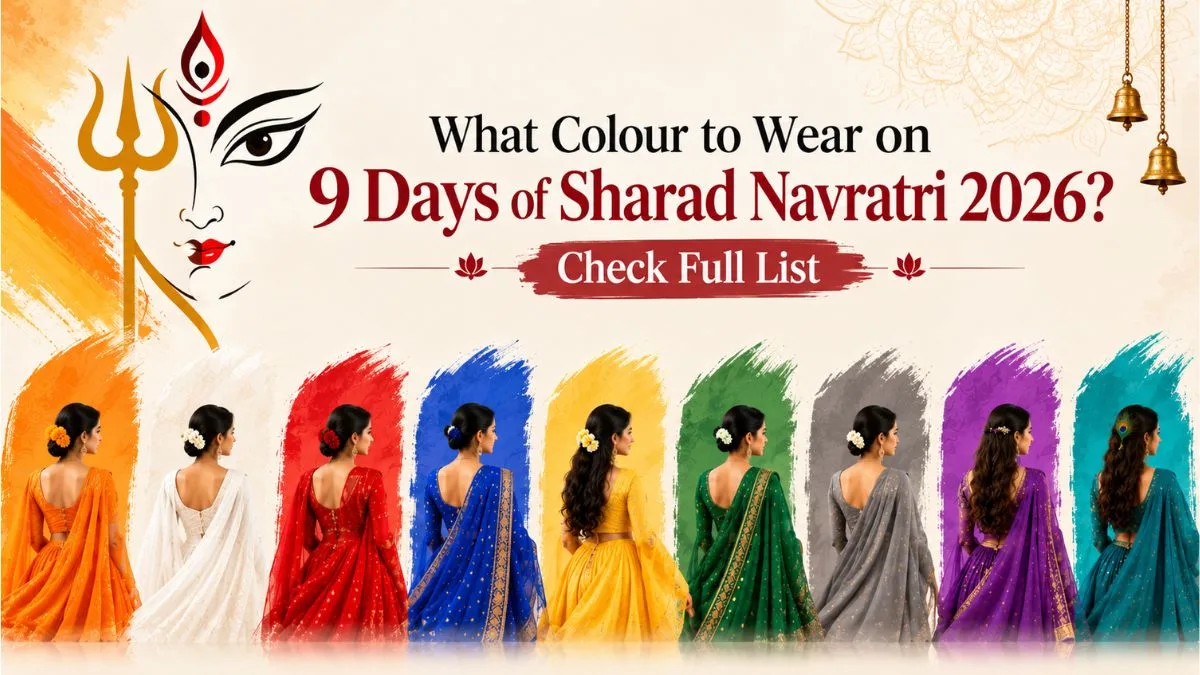
What colour to wear on 9 days of Sharad Navratri 2026? Check the complete Navratri colour list, Devi names and festive outfit ideas for each day
New Delhi: Sharad Navratri 2026 is almost here, and if you are already planning your festive wardrobe, the nine-day colour list can make outfit selection much easier. From bright orange on the first day to peacock green on the final day, each day comes with a popular colour associated with Navratri celebrations. The festival runs from October 11 to October 19, followed by Vijayadashami on October 20. Here is the complete Navratri 2026 colour list, along with the Devi worshipped each day and simple styling ideas for puja, Garba and Dandiya nights.
What colour to wear on 9 days of Sharad Navratri 2026?
The widely followed Navratri colour sequence assigns one colour to each of the nine days. The colour tradition gives devotees a simple way to participate in the festive spirit, whether they attend a puja at home or dance the night away at a Garba event.
For 2026, Sharad Navratri begins on a Sunday, October 11. The commonly published sequence therefore starts with orange and ends with peacock green on October 19.
Navratri 2026 colours: Complete 9-day list
| Day | Date | Devi | What Colour to Wear? |
|---|---|---|---|
| Day 1 | October 11, Sunday | Maa Shailputri | Orange |
| Day 2 | October 12, Monday | Maa Brahmacharini | White |
| Day 3 | October 13, Tuesday | Maa Chandraghanta | Red |
| Day 4 | October 14, Wednesday | Maa Kushmanda | Royal Blue |
| Day 5 | October 15, Thursday | Maa Skandamata | Yellow |
| Day 6 | October 16, Friday | Maa Katyayani | Green |
| Day 7 | October 17, Saturday | Maa Kalaratri | Grey |
| Day 8 | October 18, Sunday | Maa Mahagauri | Purple |
| Day 9 | October 19, Monday | Maa Siddhidatri | Peacock Green |
Note: This is the widely published 2026 colour sequence, but Navratri colours can vary between regions and publications. Some sources, for example, list pink instead of purple for Day 8. The colour code is a popular festival custom rather than a universally fixed scriptural rule.
Day 1: October 11 — Orange | Maa Shailputri
What to wear: Orange
Navratri begins with the worship of Maa Shailputri, the first form of Goddess Durga. Orange gives the opening day a bright and energetic festive feel.
For your Navratri outfit, try an orange chaniya choli, saree, kurta set or lehenga. Gold jewellery works particularly well with the shade. Heading for Garba at night? Add a small marigold hair accessory for a traditional touch.
Day 2: October 12 — White | Maa Brahmacharini
What to wear: White
Day two honours Maa Brahmacharini, and white creates a clean and elegant festive look.
A white saree, anarkali, lehenga or chaniya choli can work for both puja and celebrations. Add oxidised silver jewellery for a traditional contrast. Jasmine flowers can complete the look if you want a softer festive style.
Day 3: October 13 — Red | Maa Chandraghanta
What to wear: Red
Red takes over Day 3 as devotees worship Maa Chandraghanta.
If you want one dramatic outfit during the nine days, this could be it. Pick a red chaniya choli or saree and pair it with statement Kundan jewellery. Gold embellishments, mirror work and colourful bangles can make the look perfect for Dandiya night.
Day 4: October 14 — Royal Blue | Maa Kushmanda
What to wear: Royal Blue
Day four celebrates Maa Kushmanda, while royal blue brings a rich and regal touch to the wardrobe.
Try a royal blue lehenga or chaniya choli with gold embroidery. Temple jewellery can add a traditional finish, while gold bangles and jhumkas can easily take the look from puja to Garba night.
Day 5: October 15 — Yellow | Maa Skandamata
What to wear: Yellow
The fifth day honours Maa Skandamata, and yellow brings a cheerful burst of colour to the festive calendar.
A yellow Bandhani dupatta can instantly add a Gujarati touch to a simple outfit. You can also pair yellow with green or emerald accents. Keep your Garba look comfortable with lightweight jewellery and breathable fabrics.
Day 6: October 16 — Green | Maa Katyayani
What to wear: Green
Day six is dedicated to Maa Katyayani, with green taking centre stage.
Bottle green and emerald shades work especially well for an evening Garba look. Add red accents through your bangles, dupatta or bindi for a striking contrast.
In some regional traditions, unmarried women also wear green on this day, adding another layer of cultural significance to the colour.
Day 7: October 17 — Grey | Maa Kalaratri
What to wear: Grey
Day seven brings Maa Kalaratri, one of the fierce forms of Goddess Durga, and grey becomes the day’s popular colour.
Grey does not have to look dull. Choose charcoal, steel grey or silver-grey and add silver jewellery for a stylish festive combination. A small red bindi can provide a bright contrast without changing the day’s main colour.
Day 8: October 18 — Purple | Maa Mahagauri
What to wear: Purple
Ashtami, the eighth day of Navratri, honours Maa Mahagauri. The widely published 2026 colour for the day is purple.
Deep purple with gold detailing can create a rich traditional look, while lavender offers a softer daytime option. Choose a purple saree, lehenga or suit and complete it with gold earrings or a traditional necklace.
Day 9: October 19 — Peacock Green | Maa Siddhidatri
What to wear: Peacock Green
The nine-day colour journey ends with Maa Siddhidatri and peacock green.
You can interpret the shade through teal, turquoise-green or blue-green outfits. Pearl jewellery pairs beautifully with these tones and can give your final Navratri look an elegant finish.
For the last Garba night, a peacock-green chaniya choli with mirror work can bring together the festive and traditional sides of the celebration.
Why does Navratri have a different colour every day?
The nine-colour tradition has become a popular part of Navratri celebrations, particularly through community events, social media and festive fashion. Devotees often coordinate their clothes with the day’s colour, turning the colour calendar into a fun way to participate in the celebration.
However, the colour sequence does not follow one universally prescribed scriptural rule. Different regions and publications may follow different combinations.
So, if your family or local Garba group follows another colour order, there is no need to worry about being “wrong”. The tradition remains flexible.
Where does the planet-and-chakra idea come from?
You may also find Navratri colour guides connecting each shade with a planet and chakra. For example, some modern spiritual interpretations connect orange with the Sun and the Root Chakra, while other interpretations assign different planets or energy centres to the nine colours.
It is important to separate this modern symbolism from established Navratri tradition.
These planet-and-chakra connections represent one popular symbolic interpretation followed by some spiritual practitioners. Standard panchang and mainstream religious sources do not establish one universally accepted planetary or chakra system for the nine Navratri colours.
You can enjoy the symbolism as part of your personal celebration, but it should not be presented as a fixed or ancient Vedic rule.
Can colours really affect your mood?
Colour psychology explores how different colours can influence perception, emotions and associations. Some research suggests that people often connect colours such as red with energy or alertness, while other shades can create different emotional associations.
However, that does not mean a particular Navratri colour will produce a guaranteed physical or medical effect.
Claims about specific hormones, brain regions or electromagnetic effects are not necessary to enjoy the colour tradition. For Navratri fashion, think of colour primarily as a way to create a festive mood and express your personal style.
What if you don’t own the day’s colour?
Don’t rush to the market just because your wardrobe lacks one of the nine shades.
A small accessory can easily bring you into the colour theme. Try a dupatta, stole, bindi, bangles, earrings, hair accessory or scarf in the day’s shade.
You can also use colour blocking. For example, pair a neutral outfit with an orange dupatta on Day 1 or add a green stole on Day 6.
For Garba and Dandiya, remember that comfort matters. Pick secure footwear, lightweight jewellery and fabrics that allow you to move freely.
Do men follow the Navratri colour code too?
Yes. The colour tradition is not limited to women’s fashion.
Men can wear the day’s shade through kurtas, shirts, jackets, stoles or turbans. In Gujarat, men often choose a traditional kediyu for Garba nights.
A colour-coordinated kediyu with a comfortable pyjama and traditional footwear can create a festive look without requiring an elaborate wardrobe.
Why can the Navratri colours differ by region?
Navratri traditions vary across India, and the colour calendar can vary too. Different communities and publications may assign different colours to the same day.
The 2026 list used in this guide represents the widely published sequence beginning with orange on October 11. A few sources use another order, including a different colour for Ashtami.
So, follow the colour tradition that your family, temple or local community observes if it differs from this list.
When does Sharad Navratri 2026 end?
Sharad Navratri 2026 will conclude on Monday, October 19, with Maa Siddhidatri worshipped on the ninth day. Vijayadashami/Dussehra falls on Tuesday, October 20, 2026.
Whether you plan nine elaborate outfits or simply add one small colour detail each day, Navratri gives you plenty of opportunities to celebrate your personal style. Pick your favourite shades, get your Garba outfit ready and enjoy the nine festive nights with music, dance, devotion and plenty of colour.
Also Read: When are Navratri 2026 and Durga Puja? Find out the complete dates and significance
