
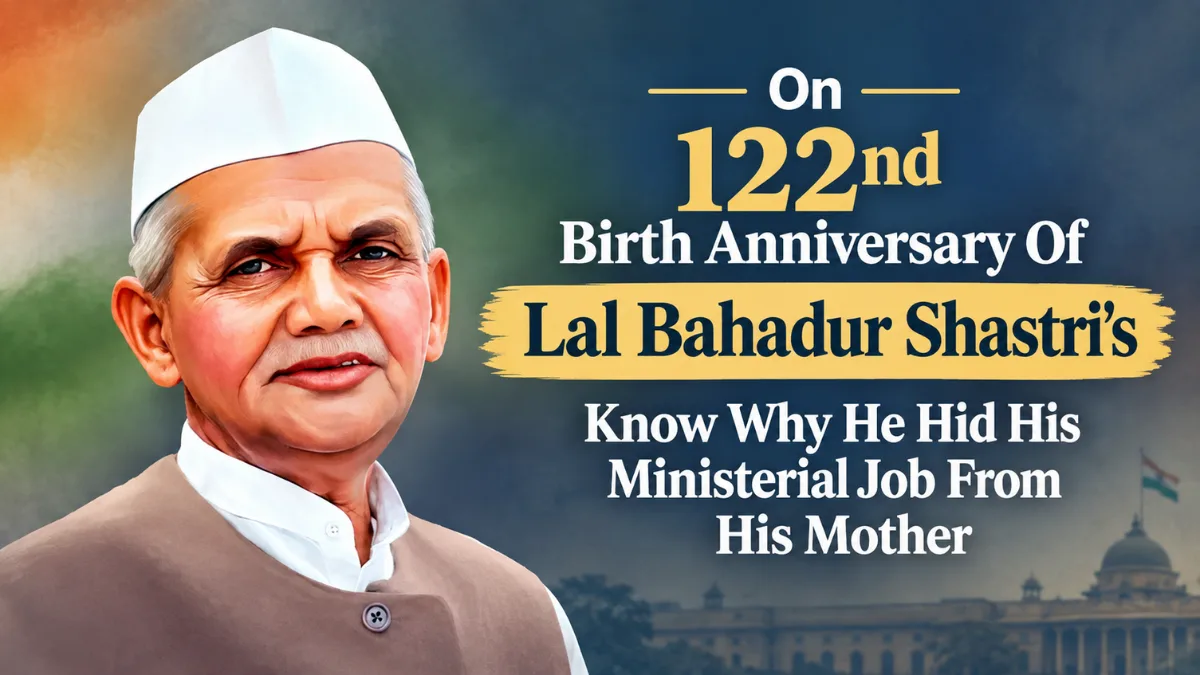
Lal Bahadur Shastri’s birth anniversary recalls the little-known stories of the leader who swam the Ganga, hid his ministerial post and lived simply
New Delhi: October 2, 2026, marks the 122nd birth anniversary of Lal Bahadur Shastri, who shared his birthday with Mahatma Gandhi. India remembers Shastri as its second Prime Minister, but some of the most revealing stories about him happened far away from the Prime Minister’s office. One popular oral anecdote says he never told his own mother that he had become the Railway Minister, telling her only that he “worked in the railways.” Years earlier, the same boy had reportedly swum across the Ganga to reach school because he could not afford the boat fare. Together, these stories capture the quiet humility that followed Shastri from childhood to the highest office in the country.
A birthday shared with Gandhi Jayanti
Lal Bahadur Shastri was born on October 2, 1904, in Mughalsarai, a small railway town near Varanasi in what was then the United Provinces under British rule. His birthdate placed him on the same day as Mahatma Gandhi, whose birthday India observes as Gandhi Jayanti.
Shastri grew up in circumstances very different from the power and privilege associated with the office he would eventually hold. His father, Sharada Prasad Srivastava, worked as a school teacher and died when Shastri was about a year and a half old. His mother then took her children to her father’s home.
At home, his grandfather affectionately called him “Nanhe,” or little one. Family accounts also preserve a remarkable childhood incident in which the young Shastri briefly disappeared from his family during a crowded gathering and was later found safe with another family. Such stories offer a glimpse of the ordinary child behind the national figure.
The boy who swam across the Ganga to reach school
Poverty shaped Shastri’s childhood in very practical ways. One of the most widely repeated stories from his school years says that he sometimes crossed the Ganga by swimming because he did not have enough money to pay the boatman.
He would reportedly keep his books above his head and swim across the river to reach school. Accounts of the incident differ in small details, but the central story has remained part of his popular biography: when money stood between him and his education, he found another way.
The image is striking because it says something about his character without needing a grand speech. The future Prime Minister first learned to deal with difficulty as a schoolboy, one river crossing at a time.
A difficult, humble childhood
After his father’s death, Shastri’s family lived with limited means. He later went to Varanasi to continue his education and walked long distances to school, sometimes without shoes, according to the official Prime Minister’s Office biography.
He eventually joined Kashi Vidyapeeth, a national institution associated with the freedom movement. In 1926, he received the title “Shastri,” meaning scholar, after completing his studies there. He later dropped “Srivastava” from his name as a personal rejection of caste identity. “Shastri” therefore began as an academic title rather than a family surname.
From the freedom struggle to Delhi
At 16, Shastri responded to Mahatma Gandhi’s call for the Non-Cooperation Movement and left his studies. He later joined the freedom struggle and spent periods in prison. His activism also came with painful personal costs. During one period of imprisonment, his daughter Suman became seriously ill. Authorities granted him parole, but she died before he could return to her.
After independence, his administrative ability brought him into the political leadership of Uttar Pradesh. Govind Ballabh Pant appointed him Parliamentary Secretary and later gave him ministerial responsibilities. Shastri eventually moved to New Delhi in 1951 and handled several important Union portfolios, including Railways.
His time as Railway Minister also showed another side of his public life. After a major railway accident, Shastri resigned from the post, accepting ministerial responsibility even though Prime Minister Jawaharlal Nehru said he did not consider Shastri personally responsible for the accident.
The story of a mother who never knew her son was a minister
This is perhaps the most revealing story associated with Shastri’s private life.
A widely repeated oral anecdote says that while Shastri served as Railway Minister, he never told his mother what position he actually held. Instead, he simply told her that he worked in the railways.
According to the popular version of the story, his elderly mother once travelled to meet him. She told railway staff that she had come to see her son, whom she knew as “Lal.” When she gave his full name, officials realised that she meant the Railway Minister himself.
She eventually met Shastri, and the people around him learned that this unassuming woman had not known that her son headed the Railway Ministry.
The story appears repeatedly in later recollections and popular tributes, but it should be treated as an oral family anecdote rather than as a firmly documented primary-source episode.
Why he hid his position from his own family
The reason traditionally attached to the story makes it even more unusual.
According to the same oral account, Shastri feared that if his mother knew he was a minister, people might approach her for recommendations and favours. He believed she might then ask him to help them, making it difficult for him to refuse.
The story also says that he did not want his position to create a sense of pride or status within his family. Whether every detail of the anecdote can be independently established is difficult to determine, but the story has survived because it fits the larger public record of a leader known for a simple personal life.
The man who took a loan to buy his only car
Even as Prime Minister, Shastri did not rush to buy a private car.
His family eventually wanted one, and a Fiat reportedly cost around ₹12,000 in 1964. Shastri had about ₹7,000 in his account, so he took a loan of roughly ₹5,000 from Punjab National Bank to cover the difference. His son Anil Shastri later recalled that the family repaid the remaining loan after Shastri died.
The story has become one of the clearest examples of his modest lifestyle. He did not treat the Prime Minister’s office as a reason to live beyond his personal means.
“Jai Jawan Jai Kisan”: a slogan born from crisis
Shastri became India’s second Prime Minister in 1964 after Nehru’s death. He soon faced serious challenges, including food shortages and the 1965 war with Pakistan.
During the food crisis, Shastri appealed to citizens to voluntarily give up one meal a week. He first asked his own family to follow the practice, turning a national appeal into a personal example. The practice became popularly associated with “Shastri Vrat.”
During the 1965 war, he gave India another phrase that outlived the crisis: “Jai Jawan, Jai Kisan” — honouring the soldier defending the country and the farmer feeding it. The slogan remains closely associated with Shastri’s public legacy.
After the ceasefire, Shastri travelled to Tashkent and signed the Tashkent Declaration with Pakistan’s President Ayub Khan on January 10, 1966.
A death that still raises questions
Shastri died in Tashkent on January 11, 1966, only hours after signing the declaration. The official account attributed his death to a heart attack.
His sudden death in a foreign country has continued to generate public and historical discussion. Questions about the circumstances of his death have appeared in Parliament and in later public debates, while members of his family have at different times sought greater access to related records. Parliament’s own digital archive contains material concerning a commission to inquire into the cause of his death.
The continuing debate does not, by itself, establish an alternative cause of death. The circumstances remain a subject of discussion, and claims beyond the official account require evidence rather than assumption.
Why his story still resonates today
Shastri’s life is remembered not only because he became Prime Minister during a difficult period. People also remember the details that seem almost too ordinary for a national leader: a boy who struggled to pay for a boat, a student who walked long distances, a minister who reportedly kept his position from his own mother, and a Prime Minister who borrowed money to buy a family car.
Those details connect the beginning and end of his journey. The boy who crossed the Ganga because he could not afford the fare grew into a leader who did not want public office to change how his family saw him.
That may be why the stories surrounding Lal Bahadur Shastri still feel personal more than six decades after his death. His power grew, but the stories suggest that his sense of self did not grow with it. He remained, in the most human sense, the same “Nanhe” his family had known.
