
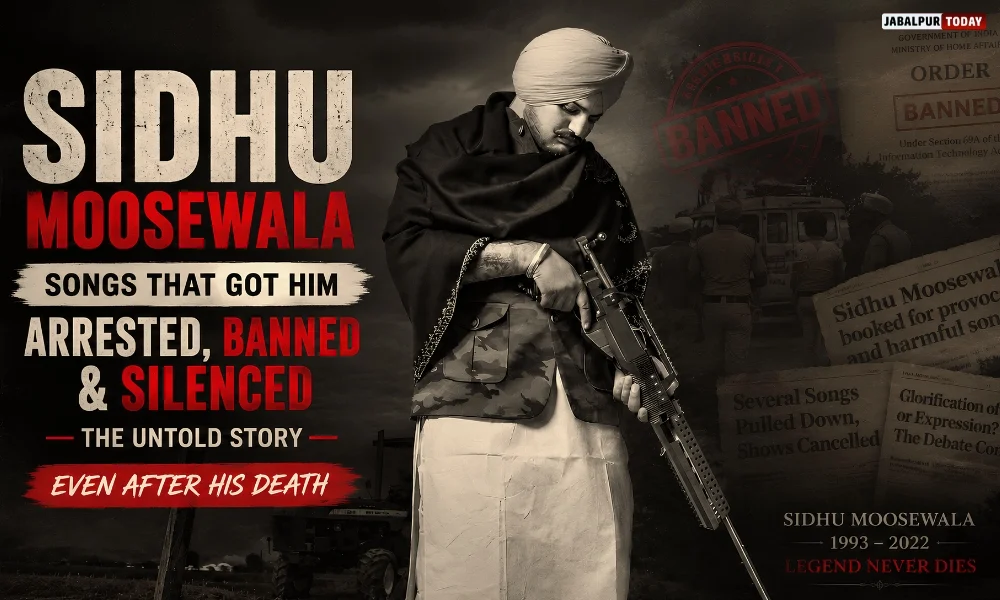
On his birth anniversary, June 11, here’s the story of a singer whose music was always too loud for those in power
New Delhi: Legends never die — they challenge power even after death. Shubhdeep Singh Sidhu, born June 11, 1993, in Moosa village, Mansa, Punjab, didn’t just write songs—he turned them into flashpoints. By the time he was shot dead on May 29, 2022, at the age of 28, Sidhu Moosewala had already collected more FIRs than most gangsters, more government complaints than political critics, and more bans than any Punjabi artist—even after his death.
The mainstream conversation around Moosewala has always been about his murder — the withdrawal of his security cover, the Lawrence Bishnoi gang, the 19 bullet injuries confirmed in the autopsy. But buried beneath that tragedy is a parallel story: the story of a singer whose songs were so politically and socially charged that the government kept trying to silence him while he was alive — and then continued doing so after his death.
On what would have been his 33rd birthday, here is that other story.
The Song That Made Him a Criminal: ‘Sanju’ (2020)
In May 2020, two videos went viral showing Sidhu Moosewala firing an AK-47 and a personal pistol at a shooting range in Badbar, Punjab — with five police officers standing by, helping him. The Punjab police registered a case against Moosewala and the five policemen under Section 188 of the IPC and the Disaster Management Act. The Arms Act was later added to the FIR. Police conducted multiple raids to arrest him. Moosewala went underground for weeks.
When he finally got bail, he did what no ordinary person would dare to do. He released a song about it.
The song was called ‘Sanju’ — and it directly compared him to Bollywood actor Sanjay Dutt, who had famously been convicted under the Arms Act and sentenced for possessing weapons linked to the 1993 Bombay blasts. The music video opened with an actual news clip of Moosewala being booked under the Arms Act, then merged it with news reports of Sanjay Dutt’s conviction. The lyrics glorified the FIRs and cases against him, framing them openly as a badge of honour.
The Punjab Crime Branch promptly booked him again — this time for promoting violence and gun culture through the very song about being booked for violence and gun culture. The ADGP at the time, Arpit Shukla, confirmed that the police were moving the Punjab and Haryana High Court to cancel Moosewala’s anticipatory bail. In the history of Punjabi music, it is difficult to find another instance where a singer was arrested for writing a song about being arrested.
The Song That Summoned Him to the Akal Takht: ‘Jatti Jeonay Morh Di Bandook Wargi’ (2019)
In September 2019, Moosewala released the promotional song ‘Jatti Jeonay Morh Di Bandook Wargi’ for the film Ardab Mutiyaran. Buried in its lyrics was a reference to Mai Bhago — the 18th-century Sikh woman warrior who led a group of forty Sikh soldiers in battle and is revered as a saint-soldier in Sikh tradition.
The Shiromani Akali Dal called for Moosewala’s arrest. The Sikh community was outraged at what they perceived as the inappropriate use of a sacred historical figure in a commercial song. The controversy reached the highest temporal seat of Sikhism — the Akal Takht in Amritsar.
Moosewala had no choice but to tender a public apology in September 2019. He edited the line out of the final song. But the matter didn’t end there. In March 2020, Moosewala and his father physically appeared before the Akal Takht chief, Giani Harpreet Singh, and personally apologised. His letter to the Akal Takht had read: “I am humble servant of the Guru and fully believe in Akal Takht Sahib. I tender an apology and assure that I will not repeat such mistake again.”
He was a singer who routinely boasted of defying authority in his music. Standing before the Akal Takht and bowing his head was the most public act of humility of his career.
The Song That Accused Punjab of Betrayal: ‘Scapegoat’ (April 2022)
In February 2022, Moosewala contested the Punjab Assembly elections on a Congress ticket from the Mansa seat. He lost to AAP’s Vijay Singla by a crushing margin of 63,323 votes. In April 2022 — just five weeks before his murder — he released ‘Scapegoat’.
The song was a direct political response to his election defeat. The AAP government and its supporters alleged that the lyrics contained the word “gaddar” (traitor) directed at Punjab voters who had voted against him. Punjab minister Harjot Singh Bains publicly called the lyrics “shameful” and said “defeat should be taken as a lesson of introspection.”
What makes this song significant is its timing. Moosewala released ‘Scapegoat’ as a sitting Congress politician who had just lost. He was now a political enemy of the ruling AAP government in Punjab. Five weeks later, the AAP government withdrew his security cover as part of a broader crackdown on what they called VIP culture — pulling protection from over 400 individuals. The very next day, Moosewala was dead.
Whether the two events were connected remains a matter of legal and political dispute. What is not disputed is the sequence.
The Song That Got Banned by the Government of India — Twice Over: ‘Punjab: My Motherland’ (2020) and ‘SYL’ (2022)
In December 2020, Moosewala released ‘Punjab: My Motherland’. The song opened with archival footage of Jarnail Singh Bhindranwale — the militant Sikh leader killed during Operation Blue Star in 1984, declared a terrorist by the Indian government but revered as a martyr by a significant section of Sikhs. The song also included visuals from a 1980 speech by Khalistan supporter Bhoopar Singh Balbir. Criticism came swiftly. The song was accused of glorifying Khalistani separatism.
But the full weight of government censorship came with ‘SYL’ — the song Moosewala had planned to release on June 6, 2022, the anniversary of Operation Blue Star. He was murdered on May 29, 2022, before he could release it. His family released it posthumously on June 23, 2022.
The song — named after the Sutlej-Yamuna Link canal, the decades-long water dispute between Punjab and Haryana — was political in every frame. It raised the SYL canal issue, the release of Sikh political prisoners, justice for victims of the 1984 anti-Sikh pogrom, and the storming of the Golden Temple. It included visuals of Bhindranwale and, according to reports, showed a distorted map of India.
Within 30 minutes of release, ‘SYL’ crossed one million views on YouTube. Within three days, it had 27 million views and was trending number one worldwide on YouTube’s music charts. Then the Indian government filed a legal complaint, and YouTube pulled it from being viewable inside India. The message displayed read: “This content is not available on this country domain due to a legal complaint from the government.”
The song remained accessible outside India. The Punjab Assembly passed a resolution condemning the ban. The Shiromani Akali Dal’s youth wing, the Youth Akali Dal, organised tractor marches across Punjab playing the song in open defiance. Moosewala’s uncle Chamkaur Singh said: “They can ban the song but they cannot take Sidhu out of the hearts of the people.”
A government had just spent weeks mourning the murder of a singer, while simultaneously banning his final creative work. The contradiction was not lost on anyone.
The Song That United Two FIRs Into One: ‘Panj Golian’ (2020)
Before ‘Sanju’, before ‘SYL’, there was ‘Panj Golian’ — a collaboration between Moosewala and singer Mankirt Aulakh. Both artists were booked under an FIR lodged at Mansa Sadar police station on a complaint by a Chandigarh-based advocate, H.C. Arora, who argued the song promoted weapons and violence in violation of existing High Court orders. The Punjab and Haryana High Court had previously passed orders restricting songs that glorified gun culture — and ‘Panj Golian’ was found to be in direct violation.
This FIR was notable because it was a formal legal mechanism — not a political complaint, not a religious objection — but a court-order violation. It established clearly that Moosewala was not just pushing social boundaries but crossing documented legal lines.
295: The Song That Predicted His Own Death Date
Released on July 14, 2021, as part of his album Moosetape, 295 is the song that defines Sidhu Moosewala’s entire artistic philosophy in a single number.
The title refers to Section 295 of the Indian Penal Code, which makes it an offence to deliberately injure or defile a place of worship with the intent to insult a religion. Moosewala had personally felt the weight of that law — the complaints after Jatti Jeona Morh Wargi, the online threats referencing Section 295A, his own reply to a critic on Instagram that read: “295A chhad, bhave 302 hove, sach keha ta sach e kahu.” (Forget 295A, even if it’s 302 — murder — I’ll still speak the truth.)
That reply became the seed of the song.
The chorus translates plainly: “Every day you’ll get a bag full of controversy. You’ll get debate in the name of religion. If you speak the truth, you will get 295. If you succeed, you will get hate.”
It is not a brag. It is not gangster posturing. Infact It is a protest song wrapped in a rap beat — a young man from Punjab telling the world that truth-telling in India has a legal price tag. The song also attacked the media directly, calling out news channels that manufacture outrage and run controversy as entertainment.
295 became Moosewala’s biggest song. But what happened after his murder on May 29, 2022 gave the song a dimension no one had anticipated.
The date of his death — 29/5 — mirrored the song’s title, 295. Fans across the world noticed it simultaneously. The coincidence was so striking that it became one of the most widely shared moments of grief on Indian social media that year. And then 295 entered the Billboard Global 200 chart at position 154, making Moosewala the first-ever Punjabi artist in history to chart on that list — alongside Harry Styles, Ed Sheeran, Dua Lipa, and Justin Bieber. Drake played the song on his radio show Table for One as a tribute.
A song about being silenced for speaking the truth became the loudest thing he ever said — after he was gone.
The Posthumous Song That Stirred a New Controversy: ‘Vaar’ (2022)
Even after his death, Moosewala’s music kept landing in controversy. ‘Vaar’, the second posthumously released song, celebrated the 19th-century Sikh general Hari Singh Nalwa.
Members of the Muslim community raised objections to certain lyrics, specifically a reference to the name “Muhammad.” Moosewala’s father Balkour Singh spoke directly with Punjab’s Shahi Imam, Maulana Muhammad Usman Ludhianvi, to clarify that the word was used in a historical context and did not refer to the Prophet. The Imam confirmed this after reviewing the historical facts and the controversy was defused.
A dead man’s music was still requiring live damage control.
What the Songs Actually Tell Us
Sidhu Moosewala was not simply a rapper who glorified guns. He was an artist who used guns, Punjab, Sikh history, and political anger as the same instrument — a blunt, loud, impossible-to-ignore instrument. Some songs were reckless. Some were provocative for provocation’s sake. But ‘SYL’ was a different kind of work: it was a political document recorded by a man who knew he was living under threat, scheduled for release on a politically charged anniversary, about issues that have defined Punjab’s relationship with the Indian state for decades.
That the government moved to silence that song within three days of its release, even after its creator was already dead, says as much about the song as anything Moosewala ever said about himself.
He was born on June 11. He died on May 29. The songs live on — some of them on YouTube, some only outside India, and one forever at the top of a list of things a government didn’t want 27 million people to hear.
Shubhdeep Singh Sidhu was 28 years old at the time of his death. He had an electrical engineering degree from Punjab Technical University and had lived in Ontario, Canada, before returning to build his music career. He is survived by his parents, Balkour Singh and Charan Kaur.
Also Read: New to Football? Here’s Everything You Need to Know About FIFA World Cup 2026

Mansi Sharma is a journalist covering Global Affairs, and wellness, known for turning complex ideas into sharp, engaging narratives. Her work is driven by curiosity, depth, and a constant urge to question and explore. When she’s not writing, you’ll often find her diving into new ideas—preferably with a cup of coffee in hand, one sip at a time.