
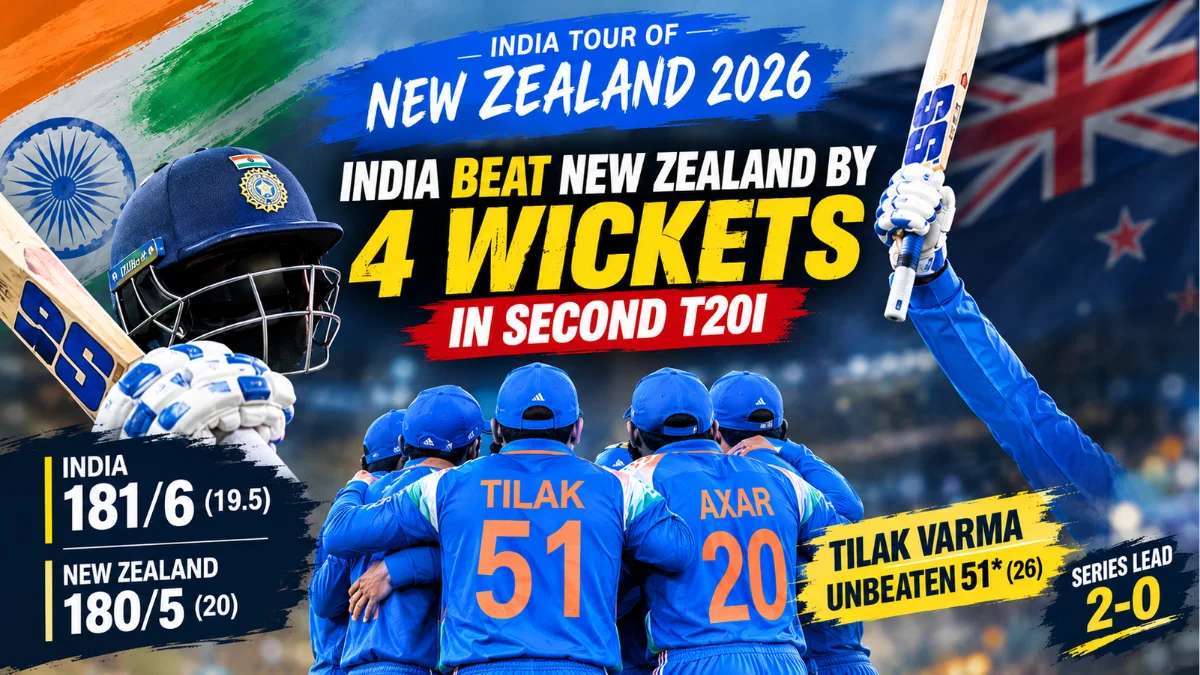
India vs New Zealand: Tilak Varma’s unbeaten 51 powers India to a four-wicket win in the second T20I, sealing a dramatic chase with one ball left
New Zeland/India: India pulled off a remarkable four-wicket victory over New Zealand in the second T20I at Hagley Oval, Christchurch, on October 24, to take a 2-0 lead in the five-match series. Tilak Varma produced an unbeaten 51 off 26 balls as India chased 181 with one ball to spare, finishing at 181/6 in 19.5 overs. The match looked almost lost when India slumped to 113/6 after 15 overs, but Tilak and Nitish Kumar Reddy launched a stunning late recovery to turn defeat into victory.
India pull off a stunning chase in Christchurch
India needed 181 runs to win after New Zealand posted 180/5 in their 20 overs. The visitors had already chased down 226 to win the opening T20I by four wickets, but this contest demanded another fightback after their middle order collapsed.
New Zealand captain Mitchell Santner looked to have put his side in control with a four-wicket haul. However, Tilak held his nerve under pressure, found boundaries when India needed them most and guided the chase alongside Nitish. India completed their second successful chase in three days, once again winning by four wickets.
Team changes: Sooryavanshi in, Kishan out
India captain Shreyas Iyer won the toss and chose to bowl on the same pitch that hosted the first T20I. The match began at 8 PM local time, or 12:30 PM IST.
Ishan Kishan missed the game because of a low-grade strain in his right adductor muscle. India brought in 15-year-old Vaibhav Sooryavanshi, who batted at No. 3 and managed four runs off eight balls before Nathan Smith caught him at cover. Prince Yadav also replaced Mayank Yadav, while Shivam Dube did not feature.
New Zealand brought in Jacob Duffy for Adam Milne. Santner described the change as part of the team’s rotation plans rather than a response to performance.
New Zealand lose three early, then Phillips and Jacobs rebuild
India made an excellent start with the ball. Arshdeep Singh removed Tim Seifert for seven, Bhuvneshwar Kumar dismissed Daryl Mitchell for six, and Prince Yadav bowled Finn Allen for 16. New Zealand lost all three top-order batters during the powerplay, the first six overs of the innings.
Glenn Phillips and Bevon Jacobs then rebuilt the innings with patience before accelerating. Phillips struck 70 off 43 balls, including four fours and four sixes, while Jacobs contributed 58 off 46 balls, with five fours and a six.
The pair added 116 runs for the fourth wicket. According to Cricbuzz, this became New Zealand’s first century partnership for the fourth wicket or lower against India in T20Is, surpassing the previous record of 99 set by Seifert and Ross Taylor in 2020.
Arshdeep, Prince and the bowlers fight back
New Zealand reached 81/3 after 13 overs, but Phillips and Jacobs made the most of the final seven, scoring 99 runs to lift their team to 180/5.
Arshdeep finished with 2/33, taking the important wicket of Phillips after Naman Dhir held the catch. Prince returned figures of 1/30, while Bhuvneshwar conceded 50 runs and took one wicket. Nitish also claimed a wicket by dismissing Jacobs, whom Axar Patel caught.
India had chances to limit the damage further. Iyer dropped Jacobs, while the fielders missed an earlier opportunity involving Sooryavanshi. Jacobs survived long enough to build the crucial partnership with Phillips.
Santner’s spell puts India in deep trouble
India began the chase with intent, but New Zealand’s bowlers kept taking wickets. Sanju Samson made 14, Abhishek Sharma scored 27 off 16 balls, and Sooryavanshi fell cheaply. Santner then took control of the middle overs.
The New Zealand captain dismissed Abhishek, bowled Iyer for seven, removed Axar Patel for 11 and sent Naman Dhir back for 31 off 17 balls. Dhir struck one four and three sixes before Phillips caught him.
Santner finished with 4/21. ESPNcricinfo noted that these were the third-best figures of his T20I career. Cricbuzz also reported that Santner became the first bowler to take multiple four-wicket hauls against India in T20Is, following his 4/11 in Nagpur in 2016.
113/6: the match looks gone
Dhir’s dismissal left India at 113/6 after 15 overs, with another 68 runs required from the final five overs. New Zealand had seized the momentum, and India needed an extraordinary finish to stay in the contest.
Dhir’s contribution mattered because he kept the chase alive during the collapse. His innings gave Tilak and Nitish a platform, but the pair still faced an asking rate that demanded regular boundaries and smart running between the wickets.
The pressure also exposed the importance of New Zealand’s missed chances. Jacobs had earlier dropped Dhir, a costly error that allowed the Indian batter to make 31. India now needed Tilak to turn that lifeline into a match-winning finish.
Tilak and Nitish turn the chase
Tilak refused to let the required rate dictate his approach. He rotated the strike, picked the right deliveries to attack and found a reliable partner in Nitish, who finished unbeaten on 26 off 13 balls.
The pair added urgency without allowing the pressure to force another mistake. They scored 13 runs in the 16th over, nine in the 17th, and 17 in the 18th. Tilak then took apart Nathan Smith in the 19th over, hitting three fours and a six.
His scoop, a shot in which a batter uses the bat’s face to lift the ball over or around the wicketkeeper, helped him beat the field. He also punished a slower delivery by sending it over long-off for six. India entered the final over needing 11 runs from six balls.
During a brief mix-up over a second run, Tilak and Nitish communicated in Telugu before refocusing on the chase. Their understanding proved vital as India approached the finish.
The final over: 11 needed off six balls
Jacob Duffy took responsibility for the final over, but Tilak immediately put him under pressure with a boundary through extra cover. The shot also brought up Tilak’s half-century, which he reached in 26 balls.
New Zealand’s slow over rate brought an additional fielding restriction into play. A slow over rate means a team fails to bowl its overs within the permitted time. As a penalty, New Zealand could keep only four fielders outside the inner circle, leaving more space for India to exploit.
Duffy then bowled a high bumper that the umpire called wide. India kept their composure and collected the remaining runs with a flick off a full toss, running two to complete the chase at 181/6 in 19.5 overs. Tilak remained unbeaten on 51, while Nitish finished on 26 not out. India won by four wickets with one ball to spare, and Tilak earned Player of the Match honours.
Milestones and numbers
The match also produced several notable individual records
Tilak Varma: His two catches took his tally to 26 catches in T20Is in 2026, the most by a fielder in a calendar year. He moved ahead of Indonesia’s Danilson Hawoe, who recorded 25 in 2025.
Arshdeep Singh: His two wickets took him to 38 T20I wickets in 2026, the highest calendar-year tally by an Indian. Bhuvneshwar Kumar previously held the Indian record with 37 in 2022.
Abhishek Sharma: He reached 100 sixes in the powerplay across T20Is, the highest total by any player where ball-by-ball data is available.
India’s opening pair: Samson and Abhishek as the best T20I opening pair by run rate, at 11.45 runs per over among partnerships with at least 15 innings.
These numbers added another layer to a contest that demanded both early discipline and late hitting from India.
What it means for the series
India now lead the five-match T20I series 2-0 after winning both matches by four wickets. The opening match required them to chase 226, while the second demanded a recovery from 113/6 against a New Zealand attack led by Santner.
The results give India a strong start to the tour, but the second match also highlighted areas for improvement, particularly their middle-order resistance against spin. New Zealand will look to recover after letting a strong position slip away.
The third T20I will take place at Hnry Stadium in Wellington on October 27, with the first ball scheduled for 12:30 PM IST. Tilak and Nitish have given India a timely reminder of how quickly a T20 chase can change when a partnership catches fire.
Also Read: India tour of New Zealand 2026: IND Beat NZ by 4 Wickets in Christchurch in First T20I
