
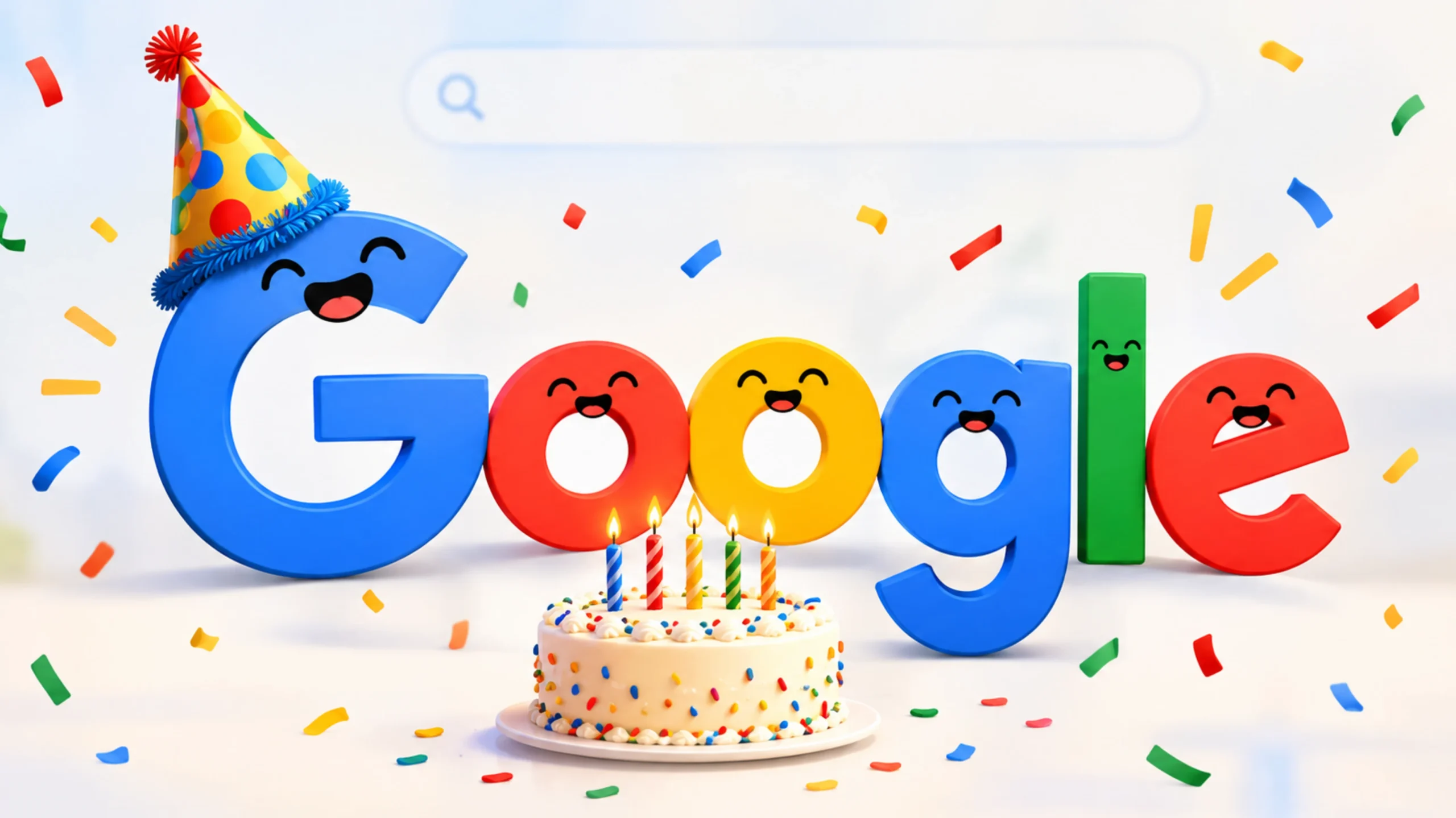
On its 28th birthday today, Google looks back at the garage, the $100,000 cheque and the Stanford idea that eventually transformed the digital world
New Delhi: Google is celebrating its 28th birthday on September 27, 2026, with a nostalgic Doodle that brings back an early logo from the company’s formative years. The simple, blocky, 3D-style design takes users back to the late 1990s, when Google was still a small search project. The Doodle also features an interactive trivia quiz that lets people explore Google’s history, culture and major milestones.
The celebration comes as Alphabet Inc., Google’s parent company, holds a market value of more than $4 trillion. Recent trading puts its market capitalisation at around $4.17–4.21 trillion, making it one of the world’s most valuable companies. Google started with two Stanford graduate students, a research project called BackRub and a hastily written $100,000 check. Today, it influences how billions of people search for information, communicate, use maps, watch videos and interact with artificial intelligence.
Here is the full story behind Google’s birthday, the different dates linked to its founding, the famous check, its garage origins, its name, the Doodle tradition, key milestones and some of the questions people often ask about the company.
Why September 27 and Not September 4?
Google Inc. officially incorporated on September 4, 1998. That date marks the company’s legal birth. However, Google has celebrated its birthday on September 27 for most of the past two decades.
In its early years, Google used different dates for its birthday celebrations. Birthday Doodles appeared on September 7, September 8, September 26 and other days in September. By the mid-2000s, the company settled on September 27.
One widely cited explanation connects the date to an important company milestone. In 2005, Google announced a major expansion of its web index. The company’s index had grown far beyond those of rivals such as Yahoo during what the industry called the “index size war”. Google later connected its birthday celebrations to this symbolic display of its growing scale.
From 2006 onward, September 27 became Google’s fixed public birthday.
Google has also acknowledged that several dates could qualify as its birthday. These include the registration of the Google domain on September 15, 1997, the first Doodle in August 1998, the incorporation date, the first major funding and the day Google removed its index counter from the homepage.
September has effectively become Google’s birthday month, while September 27 remains the day the company celebrates publicly.
The $100,000 Check That Forced Google Into Existence
The turning point came in the summer of 1998. Larry Page and Sergey Brin were still PhD students at Stanford. They had developed a search technology based on the PageRank algorithm, which ranked web pages according to the quality and number of links pointing to them.
Their technology performed better than many existing search engines, but Page and Brin had not yet decided to build a full-fledged company. They needed money to move forward.
Through their Stanford connections, they met Andy Bechtolsheim, the co-founder of Sun Microsystems and an early technology investor. The founders demonstrated their search engine early one morning. Accounts place the meeting on a porch or in a garage setting in Palo Alto.
Bechtolsheim did not wait for a formal pitch. He had seen enough. He wrote a $100,000 cheque to “Google Inc.” and left for work.
There was one problem: Google Inc. did not legally exist yet.
Page and Brin celebrated the investment at Burger King. They could not deposit the cheque immediately because they did not have a company bank account or an incorporated business.
The cheque effectively forced them to make Google a legal company. On September 4, 1998, they filed the paperwork to create Google Inc.
Other early investors, including David Cheriton and Ram Shriram, soon joined them. The initial seed funding reached roughly $1 million. Bechtolsheim’s investment eventually became worth more than $1 billion after Google went public in 2004.
The story later became a Silicon Valley legend: an investor wrote a cheque to a company that did not yet exist, and the founders then made the company real.
From BackRub to Google: Stanford Origins and the Name
Page and Brin met at Stanford in 1995. Page developed a dissertation idea around mapping the links between websites. Together, they built a web crawler and ranking system.
They initially called the project BackRub because the system analysed “back links”.
By 1997, the project had grown so large that it began putting pressure on Stanford’s network.
The founders then looked for a new name. Sean Anderson, another Stanford student, suggested “googolplex”. Page preferred the shorter “googol”. The word refers to the number 1 followed by 100 zeros. Mathematician Edward Kasner introduced the term after his young nephew came up with the name.
When they checked domain availability, “google.com” was available. The name came from a misspelling of “googol”.
The playful spelling stayed. It eventually became one of the world’s best-known brand names and even entered everyday language as a verb.
Google also created its first Doodle before the company officially incorporated.
On August 30, 1998, Page and Brin prepared to attend the Burning Man festival. They placed a simple stick figure behind the second “o” in the Google logo to tell users that they were away from the office.
That small idea later grew into thousands of Google Doodles.
Garage Days and Rapid Early Growth
After incorporation, Google operated from Susan Wojcicki’s garage in Menlo Park. Wojcicki later became the CEO of YouTube.
Google’s search engine already handled thousands of searches every day while it remained in beta.
In 1999, Google moved into a proper office in Palo Alto. The company raised $25 million from Sequoia Capital and Kleiner Perkins and began growing rapidly.
By 2000, Yahoo had made Google its default search provider. Google also launched AdWords, its pay-per-click advertising system. Advertising later became the company’s main source of revenue.
Eric Schmidt joined Google as CEO in 2001. He helped manage the growing company while Page and Brin concentrated on products and technology.
Google then launched or acquired several major products and companies. These included Image Search, Google News, Blogger and Gmail.
Image Search partly grew from public demand for pictures of Jennifer Lopez wearing her famous green Grammy dress.
Google launched Gmail on April Fools’ Day in 2004 and offered 1 GB of free storage at a time when that amount seemed enormous.
Google Maps and Google Earth arrived in 2005. The company also acquired Android that year.
In 2006, Google bought YouTube for $1.65 billion.
Google launched Chrome in 2008, while Android developed into the open-source platform that helped drive the smartphone revolution.
Going Public, Restructuring and the Alphabet Era
Google went public in August 2004. Its initial public offering raised around $1.67 billion and created dozens of millionaires among its early employees.
The company used a dual-class share structure that allowed its founders to retain control.
In 2015, Google reorganised under a new parent company called Alphabet Inc. The restructuring gave greater independence to businesses known as “Other Bets”, including Waymo, which works on self-driving technology, and Verily, which focuses on life sciences.
The restructuring also allowed the main Google business to focus more closely on its core products.
Sundar Pichai became Google’s CEO and later took over as CEO of Alphabet as well.
Today, Alphabet’s portfolio includes Google Search, YouTube, Android, Chrome, Google Cloud, advertising, Pixel phones, Nest devices, Maps and artificial intelligence products such as Gemini and its underlying AI models. Alphabet also has autonomous-driving operations through Waymo.
Search and advertising remain major profit engines, while Cloud and AI represent important areas for future growth.
The Doodle Tradition and Google’s Culture
The 2026 birthday Doodle continues a tradition that began with the simple Burning Man stick figure in 1998.
Over the years, Google’s Doodle team has created more than 5,000 artworks. These include static designs, animations, interactive experiences and games.
The Doodles celebrate holidays, historical figures, scientific discoveries, cultural events and important Google milestones.
Google released its first animated Doodle for Halloween in 2000. Interactive Doodles, including the famous Pac-Man game, later became cultural events in their own right.
Google also became known for its playful, engineering-focused workplace culture. The company popularised its informal “Don’t be evil” motto, which it later softened.
Google also promoted 20% time, which encouraged employees to work on side projects. The company became known for free food, colourful campuses such as the Googleplex and its strong focus on data.
As Google grew into a global corporation, its culture changed. The company now faces antitrust cases, privacy debates and intense competition in artificial intelligence.
Even so, the birthday Doodle continues to connect the company with its early, experimental roots.
Google’s Impact and Scale
Google Search now handles billions of searches every day.
Android powers the majority of smartphones around the world. YouTube has become a leading global video platform. Google Maps has changed how people navigate cities and travel.
Gmail transformed the way people use email, while Chrome became the main browser for hundreds of millions of users.
Google Cloud now supports businesses and organisations around the world. Gemini and other AI tools have also become part of Google Search and several other products.
People still ask many questions about Google’s history.
How did Google get its name? It came from the mathematical term “googol”, although the company used the misspelled version “Google”.
Did Google really start in a garage? Yes. The company operated from Susan Wojcicki’s Menlo Park garage during its early days.
Why does Google celebrate its birthday on September 27? The company has used several dates, but it eventually settled on September 27, partly because of an important web-index milestone.
How much is the original $100,000 investment worth today? It grew by several orders of magnitude, and Bechtolsheim’s stake eventually became worth more than $1 billion.
How much is Alphabet worth today? Its market value has crossed $4 trillion.
Who runs Google today? Sundar Pichai serves as CEO of both Alphabet and Google. Larry Page and Sergey Brin remain controlling shareholders, although they no longer handle the company’s daily operations.
Other common questions focus on Google’s first logo, which the founders created with basic tools before later refining it. People also ask how Google moved from being a search company to becoming an AI-focused technology company.
The company now competes with major technology firms including Microsoft, OpenAI and Meta. It also faces regulatory challenges in the United States, Europe and other parts of the world.
Looking Ahead at 28
At 28, Google no longer plays the role of a small startup challenging the major web portals of the late 1990s. It has become one of the world’s biggest technology platforms, while new companies continue to compete with it.
Google continues to invest heavily in artificial intelligence, cloud infrastructure, quantum computing research, autonomous vehicles and new hardware.
The nostalgic 2026 Doodle works as both a birthday celebration and a reminder of Google’s early days. The same curiosity that pushed two Stanford graduate students to study the links between websites still influences the company, even though its size and responsibilities have changed dramatically.
Google’s journey from a $100,000 cheque written to a company that did not yet exist to a business valued in the trillions remains one of the most remarkable stories in the technology industry.
Every September 27, Google’s homepage briefly returns to the colours and shapes of its early years, giving people a chance to remember how the company began—and, fittingly, to keep searching.

Mansi Sharma is a journalist covering Global Affairs, and wellness, known for turning complex ideas into sharp, engaging narratives. Her work is driven by curiosity, depth, and a constant urge to question and explore. When she’s not writing, you’ll often find her diving into new ideas—preferably with a cup of coffee in hand, one sip at a time.