
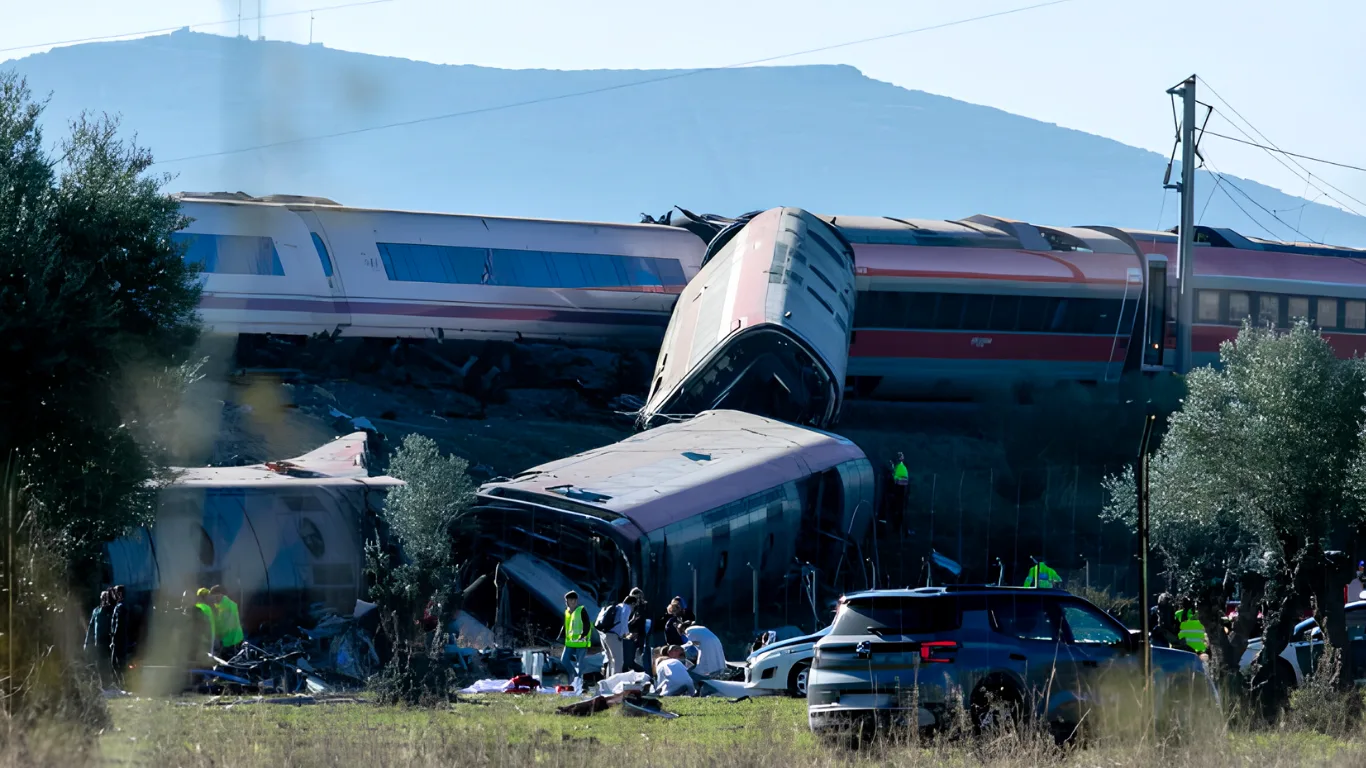
More than 64 dead as a Renfe AVE train collides with a stationary Iryo train near Toledo, triggering a major rescue operation and safety investigation
Spain: Two high-speed trains collided on the Madrid–Seville rail corridor in central Spain on Wednesday morning, October 28, 2026. The accident killed at least 64 people and injured dozens more, making it one of Spain’s deadliest rail disasters in more than a decade. The crash occurred near Urda, between Urda and Los Yébenes in the province of Toledo. The location lies around kilometre 118 of the railway line, roughly 130–150 km south of Madrid. A Renfe AVE train hit the rear of a stationary Iryo train. Rescue teams continued searching the wreckage throughout the day as the death toll rose.
Spain has not witnessed a deadlier rail accident since the 2013 Santiago de Compostela disaster, which killed 80 people. The latest crash also claimed more lives than the January 2026 Adamuz accident on the same rail corridor, which reportedly killed around 46 people. More than 500 passengers were travelling on the two trains. Authorities suspended services on the Madrid–Andalusia high-speed line, and Spanish Prime Minister Pedro Sánchez travelled to the crash site.
What Happened: The Sequence of the Collision
Both trains were travelling south from Madrid towards Seville on the high-speed railway line. The Renfe AVE service, identified as train 2080 or AVE 02080, left Madrid Atocha station at around 8 am with approximately 397 passengers. The Iryo service, identified in reports as train 6076 or 7076, carried around 146–147 passengers, including a baby, along with a small crew. The total number of people involved in the accident approached 544.
At around 8:30 am local time, a communications problem affected the LZB (Linienzugbeeinflussung) continuous train control and signalling system across more than 60 km of track. The failure automatically stopped several trains, including the two trains involved in the collision.
At approximately 8:36 am, the Adif (Administrador de Infraestructuras Ferroviarias) control centre at Atocha issued a manual instruction that overrode the stop and allowed trains to resume normal operations. According to the initial account, the instruction did not include the required speed limits or the safety procedure that requires drivers to proceed while checking the track ahead.
The Iryo train remained stationary, although investigators are still examining why it did not move. The Renfe AVE continued along the track and hit the rear of the stationary train shortly before 9 am. Reports place the collision between 8:54 am and 9 am.
The impact derailed several carriages from the Iryo train and at least one carriage from the Renfe train. Some carriages fell down an embankment. Images and drone footage showed overturned and badly twisted carriages, with debris scattered across the rural landscape of the Montes de Toledo. In at least one image, a section of rail appeared to pierce a carriage.
Transport Minister Óscar Puente described the control centre’s decision as having been made under “inexplicable circumstances.” He said officials had reconstructed the sequence of events and reviewed communications. According to his account, the control centre should not have authorised the trains to resume normal operations. The trains should have remained stationary or moved only under strict low-speed restrictions, at a maximum of around 40 km/h while drivers checked the track ahead.
Investigators are examining the person responsible for the decision. Rear-end collisions of this kind are extremely rare on Spain’s high-speed rail network.
Casualties, Injuries and the Rescue Effort
Regional authorities in Castilla-La Mancha confirmed at least 64 deaths. Early reports gave different figures for the number of people killed on each train. Some reports attributed 40 deaths to the Iryo train and 24 to the Renfe AVE.
Authorities reported between 58 and 80 injured people at different points during the day. Around 50 people reportedly suffered serious injuries, while 15 remained in critical condition in some updates. The death toll continued to rise as rescuers reached deeper into the damaged carriages. Officials warned that the final number could increase further.
Emergency services launched a large-scale rescue operation involving firefighters, civil protection teams, helicopters, mobile intensive-care units and medical personnel. Rescue teams treated injured passengers at the scene in temporary medical tents. They also transported or airlifted casualties to nearby hospitals and medical facilities in Madrid, approximately 140 km away.
Relatives gathered near the crash site and waited for information about their loved ones. The remote rural location made it difficult for emergency teams to reach parts of the wreckage and carry out rescue operations.
Eyewitness Accounts
Survivors described a sudden and violent impact that threw passengers around the carriages. They recalled suitcases flying through the air, shattered glass, smoke and widespread confusion.
One passenger on the train that the AVE struck described a “terrible, terrible impact” and recalled broken bones and smoke after the collision. Another passenger remembered a “massive roar” followed by what they described as “horrible scenes,” with injured people, blood and dead passengers outside the carriages.
A journalist travelling on one of the trains said the collision completely destroyed the carriage. Some passengers escaped through windows with the help of emergency hammers. A 17-year-old survivor described the scene as a “catastrophe” and said complete chaos followed the impact.
These accounts highlight the force of the collision and the difficult conditions that passengers and rescuers faced in the immediate aftermath.
Official Response and Political Context
Prime Minister Pedro Sánchez expressed shock over the accident and offered support to the victims and their families. He remained in contact with the transport minister and travelled to the crash site near Urda with other officials to support emergency teams and affected families.
King Felipe VI also expressed sorrow and solidarity with those affected by the disaster. Authorities in Andalusia and other areas announced periods of mourning. Officials also postponed football matches, including Copa del Rey fixtures, following the tragedy.
The accident occurred as Spain approached a general election. Most political parties suspended their election campaigns in response to the disaster. Some political figures connected the crash to wider concerns about railway infrastructure maintenance and safety.
The European Union offered support for the investigation. Meanwhile, authorities kept high-speed rail services between Madrid, Ciudad Real and Andalusia suspended, disrupting travel across the affected corridor.
Broader Context: Spain’s High-Speed Rail Network and Previous Disasters
Spain operates Europe’s largest high-speed rail network and the world’s second-largest network after China. Thousands of kilometres of high-speed track connect major cities and carry tens of millions of passengers every year.
The Madrid–Seville line, which opened in stages beginning in the early 1990s, remains one of Spain’s flagship railway routes. The country has built a reputation for operating a modern high-speed rail system with a relatively strong safety record.
However, the latest collision marks the second major fatal accident on the Madrid–Andalusia corridor in 2026.
In January 2026, an Iryo train derailed near Adamuz in Córdoba. An approaching Renfe train then struck it, killing around 46 people. That accident involved different circumstances, including a derailment on a straight section of track that led to the train entering the path of the oncoming service. Investigators continue to examine that crash.
The 2013 Santiago de Compostela derailment remains Spain’s deadliest modern rail disaster, with 80 fatalities. In that accident, a train entered a curve at high speed.
Reports have also highlighted earlier problems on sections of the Madrid–Andalusia line. These include signalling faults, concerns about ageing equipment, modernisation work and the transition from the LZB system towards the European Rail Traffic Management System (ERTMS).
These issues do not, by themselves, explain the latest collision. However, investigators and railway authorities are likely to examine them as part of a broader review of the network’s safety and reliability.
Investigation and What Happens Next
A judicial investigation is underway in the Orgaz court district in Toledo. Railway authorities and the relevant accident investigation body are also conducting technical inquiries to establish what caused the collision and whether anyone failed to follow safety procedures.
Investigators are examining several key questions:
- What exactly caused the LZB signalling and train control system to fail?
- Why did the Adif control centre authorise trains to resume normal operations?
- Why did the Iryo train remain stationary?
- How fast was the Renfe AVE travelling when it hit the Iryo train?
- Did railway staff use any alternative signalling or operating procedures after the system failure?
- Did the staff involved follow the required safety protocols?
The transport ministry has already reviewed audio recordings of communications and reconstructed the sequence of events. Investigators will use this information, along with technical evidence and witness accounts, to establish responsibility.
Authorities must also identify the victims, support their families, recover any remains still trapped in the wreckage and assess the damage to the railway line. Restoring normal rail services could take time.
Officials may also consider compensation for victims and their families. Depending on the findings, the investigation could lead to criminal or administrative action against those responsible. Authorities may also recommend changes to high-speed signalling systems, railway maintenance and traffic management procedures.
Questions Readers Are Asking
How many people died or suffered injuries?
Authorities confirmed at least 64 deaths, while reports placed the number of injured passengers between 58 and 80 at different points during the day. Officials warned that the figures could change as rescue teams continued searching the wreckage.
Which trains were involved, and how many people were on board?
The collision involved a Renfe AVE train carrying approximately 397 passengers and an Iryo train carrying around 146–147 passengers and a baby. The total number of people involved, including crew members, approached 544.
Why did one train stop while the other continued?
A communications problem affected the LZB train control and signalling system, automatically stopping several trains. The Adif control centre then authorised trains to resume normal operations. The Iryo train remained stationary, while the Renfe AVE continued towards it. Investigators are examining why the Iryo did not move and whether staff followed the correct procedures.
Did human error or technical failure cause the accident?
Investigators have not yet established the full cause. The initial account points to a signalling system failure followed by a decision to allow normal rail operations to resume. Transport Minister Óscar Puente questioned that decision and described the circumstances as inexplicable. Investigators will determine whether technical problems, human decisions or a combination of both contributed to the crash.
How does the accident compare with previous rail disasters in Spain?
The crash ranks among Spain’s deadliest rail accidents in recent history. It is the country’s deadliest rail disaster since the 2013 Santiago de Compostela derailment, which killed 80 people. It also caused more deaths than the January 2026 Adamuz accident, which reportedly killed around 46 people.
How has the accident affected rail travel?
Authorities suspended high-speed services on the Madrid–Andalusia line, including services connecting Madrid, Ciudad Real and other destinations in Andalusia. Passengers may need to use alternative transport arrangements until officials restore services.
What does the accident mean for the safety of Spain’s high-speed rail network?
Spain’s high-speed network has maintained a relatively strong safety record despite carrying millions of passengers. However, two major fatal accidents on the same corridor in 2026 have raised urgent questions about signalling systems, maintenance, modernisation work and operational procedures. Investigators must establish whether these wider concerns played any role in the latest collision.
What Happens Next?
The full technical and judicial investigations could take weeks or months. For now, emergency teams must continue recovery operations, medical teams must care for injured passengers, and authorities must support families who have lost loved ones.
Spain has long considered its high-speed railway system a symbol of modern infrastructure and national progress. However, the latest tragedy has renewed scrutiny of railway safety, signalling reliability and operating procedures. The findings of the investigations will help determine what went wrong and whether authorities need to introduce further safeguards to prevent similar accidents.
This report draws on official statements attributed to Castilla-La Mancha regional authorities, the transport ministry, Adif, Renfe and Iryo, as well as eyewitness accounts carried by major news outlets and live coverage available on October 28, 2026. Authorities may revise casualty figures and other details as rescue operations and investigations continue.
