
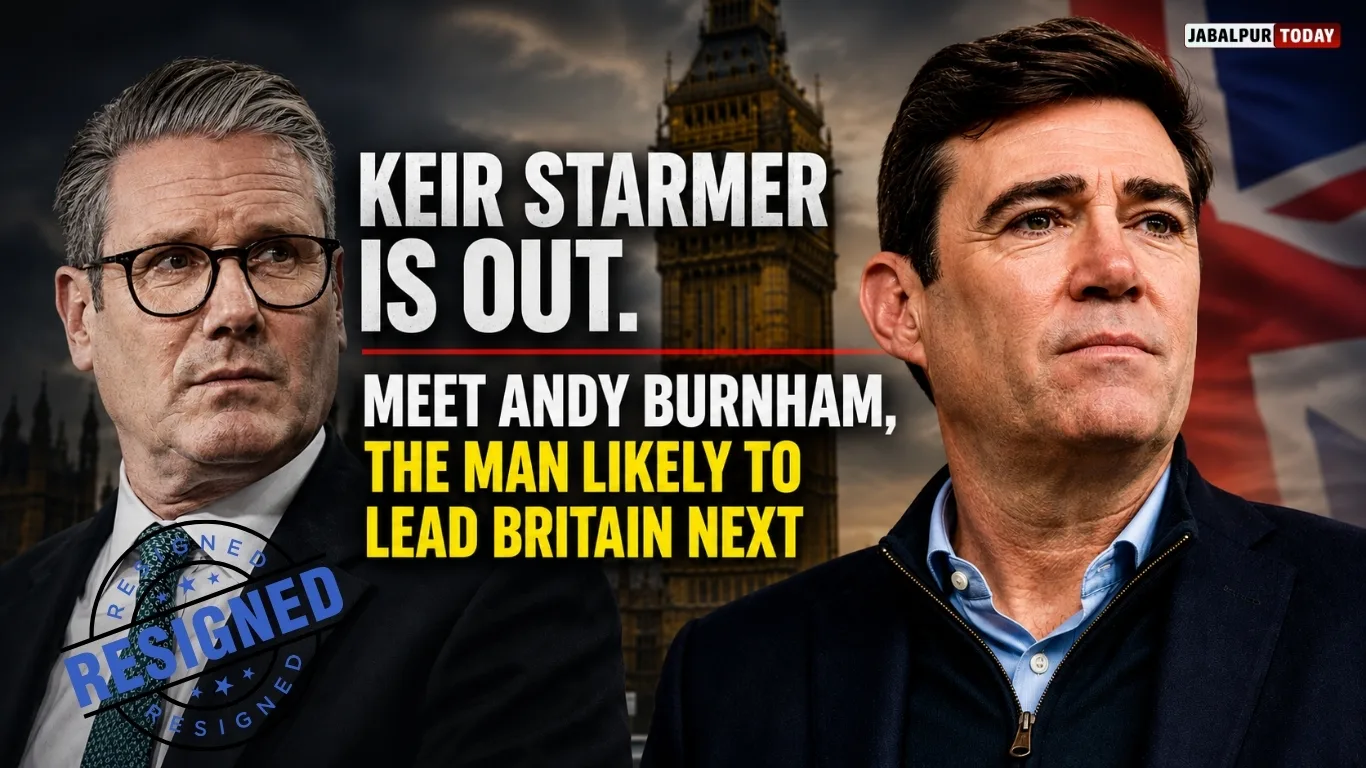
Keir Starmer has become the sixth British Prime Minister to resign in just ten years. Now Andy Burnham, a working-class boy from Merseyside who spent years waiting in the wings, stands on the verge of entering 10 Downing Street
London: British Prime Minister Keir Starmer resigned on Monday after mounting pressure from within the Labour Party and a sharp decline in public support, triggering a leadership contest that could hand power to Andy Burnham, the Mayor of Greater Manchester and one of the party’s most prominent figures.
The announcement came only days after Andy Burnham, the Mayor of Greater Manchester, won a decisive victory in the Makerfield by-election on June 18, 2026. The result strengthened Burnham’s position and made him the leading candidate to replace Starmer.
Starmer led Labour to a landslide victory in the July 2024 general election, ending 14 years of Conservative rule. However, his government soon faced growing criticism over economic problems, poor local election results, ministerial resignations, and declining approval ratings.
His resignation marks another major leadership change in British politics. Many political observers now see Burnham as the most likely person to become Britain’s next Prime Minister, provided he wins the Labour leadership contest.
Why Keir Starmer Resigned: The Sequence of Events
Although Starmer spent less than two years in office, he faced several major political challenges.
• Local Election Losses
In May 2026, Labour suffered heavy losses in local elections across England. The party lost nearly 1,500 councillors. At the same time, Reform UK and the Green Party made significant gains.
The poor results alarmed many Labour MPs. They feared that Labour could lose large numbers of seats in the next general election if public support continued to fall.
• Ministerial Resignations
Several senior ministers resigned from Starmer’s government during 2026. In June, Defence Secretary John Healey and Armed Forces Minister Al Carns stepped down after disagreements over defence spending.
Other senior figures, including Health Minister Wes Streeting, also left their positions. These resignations exposed growing divisions within the government over policy decisions and Starmer’s leadership.
• The Makerfield By-Election
Andy Burnham’s victory in the Makerfield by-election became the immediate trigger for Starmer’s departure. Burnham won around 55% of the vote, giving him a clear path back into Parliament and allowing him to challenge for the Labour leadership.
Reports later revealed that Starmer spent the weekend before his resignation at Chequers, the Prime Minister’s official country residence, discussing his political future with advisers and allies.
On June 22, he announced his decision. Starmer said he accepted “with good grace” that he was no longer the best person to lead Labour into the next election. He promised a smooth transition and an orderly transfer of power.
Downing Street confirmed that Starmer informed King Charles III about his decision. As of June 22, Starmer continues to serve as caretaker Prime Minister until Labour elects a new leader.
Who Is Andy Burnham?
Early Life and Education
Andrew Murray Burnham was born on January 7, 1970, in Aintree, near Liverpool. He grew up in Culcheth, a village located between Manchester and Liverpool. Burnham attended St Aelred’s Catholic High School before studying English at Fitzwilliam College, Cambridge.
His father worked as a telephone engineer, while his mother worked as a medical receptionist. Burnham became one of the first members of his working-class family to attend university.
Parliamentary Career
Burnham entered Parliament in 2001 when voters elected him as the Labour MP for Leigh. He represented the constituency until 2017. During Gordon Brown’s government, Burnham held several senior Cabinet positions. He served as Chief Secretary to the Treasury between 2007 and 2008. He then became Culture Secretary from 2008 to 2009.
From 2009 to 2010, he served as Health Secretary. Burnham also sought the Labour leadership twice. In 2010, he finished fourth in the leadership race. In 2015, he finished second behind Jeremy Corbyn.
Mayor of Greater Manchester
In 2017, Burnham left Parliament and stood for election as the first directly elected Mayor of Greater Manchester. Voters elected him to the position in 2017. They re-elected him in 2021. They elected him again for a third term in 2024.
During his time as mayor, Burnham earned the nickname “King of the North.” He became one of Britain’s strongest advocates for regional devolution and local decision-making. Then He promoted major public transport reforms, including bus franchising. He launched policies aimed at reducing rough sleeping and homelessness. He also supported environmental and green development initiatives.
During the COVID-19 pandemic, Burnham gained national attention when he publicly challenged the UK government’s funding arrangements for Greater Manchester.
Many people viewed him as a strong defender of northern England’s interests.
Personal Life and Political Style
Burnham is married and has children. He supports Everton Football Club and frequently speaks about his roots in north-west England. Political observers often describe him as approachable, optimistic, and pragmatic.
Burnham describes his own political philosophy as “aspirational socialism.” He supports redistribution and public investment while also maintaining a business-friendly approach to local economic development.
Burnham’s Policies and the Idea of “Manchesterism”
Burnham’s supporters often describe his political vision as “Manchesterism.”
The approach focuses on giving more power to local communities and reducing the concentration of power in London.
Devolution and Local Control
Burnham wants the national government to transfer more powers to regional authorities. He supports giving local governments greater control over housing, transport, skills training, and public budgets. He argues that these reforms would help reduce the economic gap between London and other parts of England.
Economy and Taxation
Burnham has pledged not to increase income tax, National Insurance contributions, or Value Added Tax (VAT) in the short term.
He has also discussed reducing employers’ National Insurance contributions and expanding business rates relief for sectors such as pubs and hospitality.
Over the longer term, he has shown interest in reforms that could increase taxes on wealth, land, and high-value assets. He has also expressed support for reforming council tax.
Public Services
Burnham supports greater public influence and control over key services. He has advocated stronger public involvement in energy, water, rail transport, and housing. He strongly supports investment in council housing and has backed proposals for rent controls.
Other Policy Positions
Burnham supports electoral reform and proportional representation. He supports stronger systems for returning people who enter the country illegally. He has voiced support for transgender rights. Also He supports infrastructure investment as a way to drive economic growth.
Supporters point to his record in Manchester as evidence that these policies can deliver results. Critics, however, argue that he has faced challenges in planning, development, and financial management.
The Leadership Contest and the Road Ahead
Burnham returned to Parliament after his Makerfield victory and is expected to launch a formal leadership campaign. To enter the contest, he must secure nominations from Labour MPs.
Several other names have appeared in discussions about the race.
Former Deputy Prime Minister Angela Rayner could decide to run.
Former Health Secretary Wes Streeting has also attracted attention as a possible candidate.
Despite that competition, Burnham currently leads opinion polls and betting markets. If he wins the contest, he will face several immediate challenges. He must restore confidence in the economy. Then He must address public concerns over immigration. He must tackle rising energy costs. Also He must reunite Labour after months of internal divisions.
And he must prepare the party for the next general election, which must take place by 2029.
Britain’s Continuing Leadership Turmoil
Starmer’s resignation adds another chapter to Britain’s recent history of political instability. Several Prime Ministers have left office after relatively short periods in power. The rapid turnover highlights how difficult British voters have found it to support long-term political leadership during a period of economic uncertainty and political change.
The transition also highlights a growing debate about the relationship between Westminster and Britain’s regions. Burnham has built his career around arguing that London holds too much power and that regional leaders deserve a greater voice in national decision-making.
Many supporters believe his rise could shift more attention toward the priorities of northern England.
What Happens Next?
As of June 22, 2026, Labour has begun preparing for a leadership contest that will determine who succeeds Keir Starmer. The party will open nominations before selecting its next leader.
The outcome will decide who leads Labour into the next general election and who becomes Britain’s next Prime Minister. For now, political attention remains focused on Andy Burnham.
A man who spent nearly a decade leading Greater Manchester now stands closer than ever to the doors of Number 10 Downing Street.
Whether he can translate his regional success into national leadership remains one of the biggest questions in British politics today.
Also Read: Explosion at Qatar’s Barzan Gas Plant Injures 54, 18 Missing

Mansi Sharma is a journalist covering Global Affairs, and wellness, known for turning complex ideas into sharp, engaging narratives. Her work is driven by curiosity, depth, and a constant urge to question and explore. When she’s not writing, you’ll often find her diving into new ideas—preferably with a cup of coffee in hand, one sip at a time.