
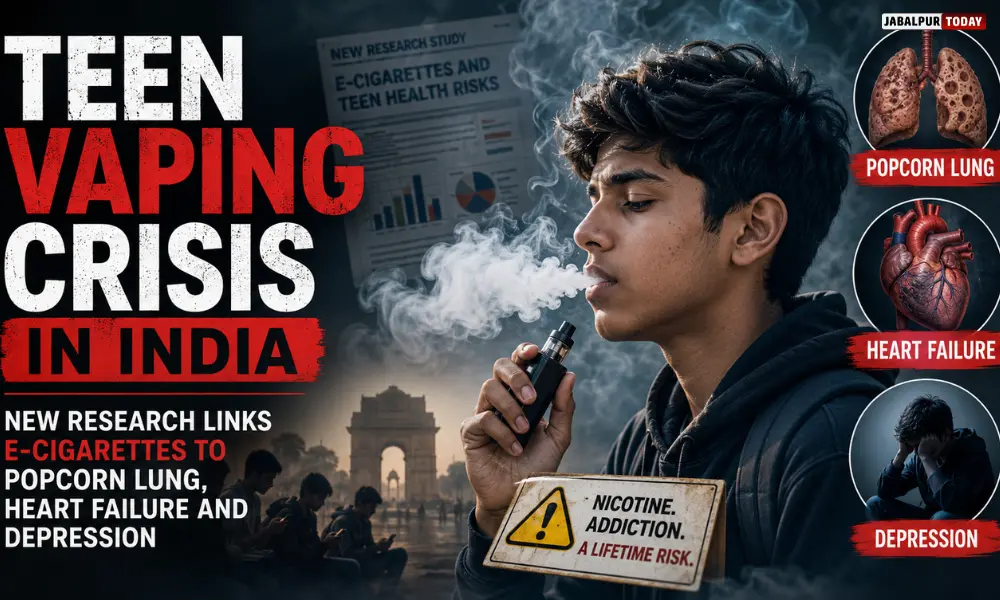
Are teens aware vaping can cause popcorn lung, heart failure, and depression? New research reveals rising risks despite India’s e-cigarette ban
New Delhi: A teenage cheerleader in the United States lost her ability to breathe. A major international study involving more than 175,000 people found that vaping increases the risk of heart failure by 19%. In India, e-cigarettes have been banned since 2019, yet vapes remain easily available in schools, colleges and online markets. Scientific research is increasingly revealing the dangers of vaping, but many teenagers remain unaware of the risks.
The Girl Who Could No Longer Breathe
Brianne Cullen was a healthy 17-year-old cheerleader. One day, she called her mother from school in distress and said she could not breathe. Doctors soon diagnosed her with bronchiolitis obliterans, a rare and serious lung disease commonly known as “popcorn lung.”
Doctors linked the condition to her vaping habit. Brianne had been vaping every day since she was 14 years old.
Popcorn lung causes permanent damage. It inflames and scars the tiny airways in the lungs, making it increasingly difficult for a person to breathe. Rest and medication cannot reverse the damage. For three years, Brianne had unknowingly exposed her lungs to harmful chemicals through a device that looked harmless and came in sweet flavours like bubblegum.
Her case, which gained attention in April 2025, highlights a growing global health concern that experts believe many people, especially teenagers, still underestimate.
What Is Popcorn Lung and How Does Vaping Cause It?
The term “popcorn lung” first appeared in the early 2000s when workers at a microwave popcorn factory in the US developed severe lung disease. Investigators traced the illness to diacetyl, a chemical used to create buttery flavours.
When people inhale diacetyl over long periods, it can inflame and scar the bronchioles—the smallest airways in the lungs. This damage is permanent and can seriously affect breathing.
Manufacturers also use diacetyl in many flavoured e-cigarette liquids, including caramel, cotton candy and cream flavours. While these flavouring agents are considered safe to eat, inhaling them is very different. Chemicals that enter the lungs directly can cause significant harm.
A 2025 report found that long-term exposure to chemicals in e-cigarettes increases the risk of popcorn lung and other respiratory diseases. Studies also show that teenagers who vape report more breathing problems than non-users. Researchers linked certain flavours, nicotine salts and frequent vaping to worsening symptoms.
The Hidden Threat to the Heart
While popcorn lung receives public attention, researchers have also discovered serious risks to heart health.
Scientists at MedStar Health in Baltimore studied 175,667 participants through the National Institutes of Health’s “All of Us” research programme. During a follow-up period of nearly four years, 3,242 participants developed heart failure.
The researchers found that people who had used e-cigarettes at any point in their lives were 19% more likely to develop heart failure than people who had never vaped. The increased risk remained even after researchers considered factors such as age, smoking, alcohol use and existing health conditions.
The study linked vaping most strongly to heart failure with preserved ejection fraction, a condition in which the heart becomes too stiff to fill properly with blood. Doctors consider this a chronic disease with no cure.
Dr Yakubu Bene-Alhasan, the study’s lead author, said the difference was substantial and urged people to consider the impact of vaping on heart health.
Researchers presented the findings at the American College of Cardiology’s Annual Scientific Session in April 2024. Other studies have also connected vaping to atherosclerosis, the narrowing of blood vessels that can lead to heart attacks. Researchers have additionally found that vaping can reduce exercise capacity.
A Chemical Mix Targeting Young Users
Most vape liquids contain nicotine, propylene glycol, vegetable glycerin and a range of flavouring chemicals.
Research from MD Anderson Cancer Center found that some vaping devices contain up to 2,000 different chemicals. These include cancer-causing substances such as formaldehyde and acetaldehyde, along with heavy metals like lead and nickel that enter the aerosol when the device heats up.
Contrary to popular belief, vape clouds are not harmless water vapour. They are fine aerosols that travel deep into the lungs, irritate tissues and deposit toxic substances.
Teenagers face additional risks because their brains continue developing until around age 25. Nicotine can interfere with brain development and affect attention, learning, impulse control and mood regulation.
Young people also become addicted to nicotine more easily than adults. Studies show that teenagers can develop signs of nicotine dependence even before they start vaping daily.
Some disposable vapes contain nicotine levels equivalent to 15 or more packs of cigarettes, a fact many young users do not realise.
The Mental Health Risks
Many vape companies have promoted the idea that vaping helps reduce stress and anxiety. Surveys show that about one in four young users started vaping because they believed it would help them relax.
However, research suggests the opposite.
According to the CDC Foundation, young people who vape are twice as likely to report symptoms of depression compared to those who do not vape. A 2025 study by the New York City Department of Health found that 48% of teen vapers reported symptoms linked to depression, compared with 30% of non-vapers.
Researchers analysing data from more than 60,000 middle and high school students for PLOS Mental Health also found significantly higher rates of anxiety and depression among vapers.
In a survey conducted by the American Heart Association, more than half of nicotine vapers reported symptoms of depression during the previous week.
Experts explain that nicotine withdrawal creates a cycle of anxiety, irritability and low mood. Vapers often seek temporary relief through another puff, reinforcing both addiction and mental health problems.
Studies further show that nicotine exposure during adolescence can increase the risk of mood disorders later in life.
In India, a 2025 paper published in the Indian Psychiatry Journal warned that vaping alongside other substances could worsen psychiatric conditions and increase the risk of multiple substance addictions.
India’s Ban Exists, But Vaping Continues
India imposed one of the world’s strictest bans on e-cigarettes in September 2019.
Under the Prohibition of Electronic Cigarettes Act (PECA), authorities banned the production, manufacture, import, export, transport, sale, storage and advertising of e-cigarettes and vaping products. First-time offenders can face up to one year in jail or a fine of ₹1 lakh. Repeat offenders can face up to three years in prison and fines of up to ₹5 lakh.
The government’s intention was clear, but enforcement has faced challenges.
A 2025 systematic review and meta-analysis found that vaping prevalence in Indian study populations after the ban stood at 14%, higher than levels reported before the ban.
Researchers identified weak and inconsistent enforcement as a major reason. Illegal markets, online sellers and smuggling networks continue supplying vaping products to young consumers.
Authorities seized 4.2 lakh e-cigarettes across India between April and November in one recent year. Customs officials have repeatedly intercepted illegal shipments, and police have conducted raids on retailers. Despite these efforts, vapes remain widely available.
Public health experts say the ban exists on paper, but it has not effectively reached school campuses, neighbourhood markets or social media networks where many sales take place.
A Global Shift Against Vaping
India is not the only country tightening restrictions.
The United Kingdom, which once promoted vaping as a tool to help smokers quit, changed its approach in 2025. The government banned tobacco products and vapes for anyone born after January 1, 2009, creating a gradual phase-out for future generations. The UK also banned disposable vapes from June 2025.
In the United States, health authorities continue to describe youth vaping as a public health crisis. More than 1.6 million American youths reported using e-cigarettes in 2024. Nearly 90% used flavoured products, and one in four used them daily.
By September 2025, the US Food and Drug Administration had authorised only 39 e-cigarette products for sale, and only to adults aged 21 and above.
Globally, around 11 million adolescents aged 13 to 15 use e-cigarettes, accounting for roughly 30% of all vapers worldwide.
What Parents and Schools Need to Know
Teenagers do not start vaping by accident.
For decades, tobacco companies have studied how to attract young users. Colourful packaging, sweet flavours, discreet designs and social media promotion all make vaping appealing to teenagers.
When announcing India’s vaping ban in 2019, Finance Minister Nirmala Sitharaman said many young Indians had begun treating e-cigarettes as a style statement.
Doctors across India are now seeing the consequences. Pulmonologists report more cases of chronic cough, wheezing and breathing difficulties among teenagers. Psychiatrists increasingly find vaping histories among adolescents struggling with anxiety and depression.
The Indian Psychiatry Journal’s 2025 paper urged immediate action, warning that peer pressure and social media influence are driving vaping among young people.
The reality in schools, colleges and cafés has moved faster than the conversation happening in homes and classrooms. Popcorn lung, higher risks of heart failure, increased rates of depression, brain development concerns and exposure to toxic chemicals are not distant possibilities. Scientific studies have documented these effects and continue to report them among young users.
A vape does not produce harmless water vapour. It delivers nicotine and a complex mix of chemicals directly into the body. The scientific evidence is becoming increasingly clear: vaping carries serious risks, especially for teenagers.

Mansi Sharma is a journalist covering Global Affairs, and wellness, known for turning complex ideas into sharp, engaging narratives. Her work is driven by curiosity, depth, and a constant urge to question and explore. When she’s not writing, you’ll often find her diving into new ideas—preferably with a cup of coffee in hand, one sip at a time.