
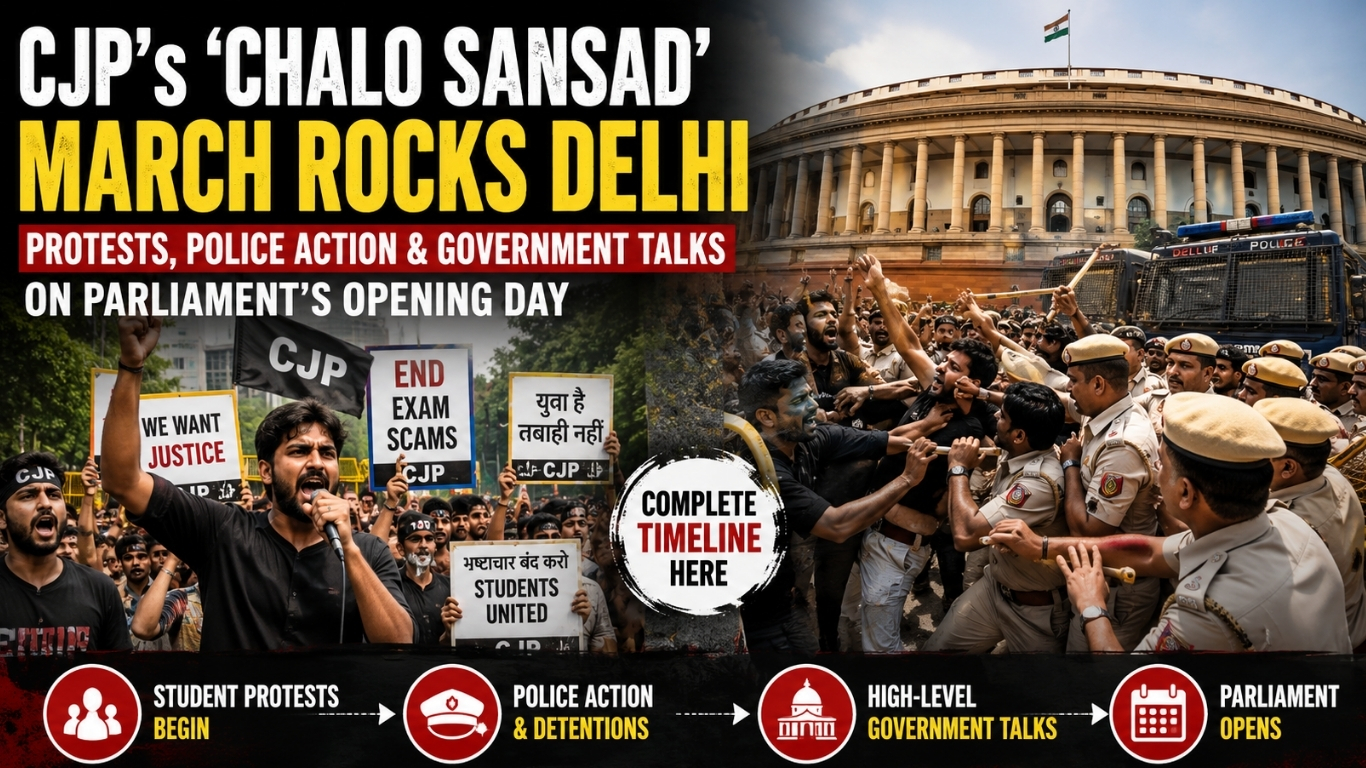
Know what happened during CJP’s ‘Chalo Sansad’ march on July 20, including police action, protests, JP Nadda talks and the latest developments
New Delhi: The Cockroach Janta Party (CJP), founded by Abhijeet Dipke, started as a youth movement against repeated irregularities in competitive exams, especially the NEET-UG 2026 paper leak. What began as a satirical online campaign soon turned into a nationwide protest demanding accountability in the education system. Protesters demanded the resignation of Union Education Minister Dharmendra Pradhan, ₹1 crore compensation for the families of students who died by suicide during the crisis, and major reforms in the education system.
The movement gained strength through an indefinite protest at Jantar Mantar. Climate activist Sonam Wangchuk joined the protest and began an indefinite hunger strike on June 28, 2026, giving the movement greater visibility. On July 18–19, police shifted Wangchuk to a hospital, citing health concerns. After his hospitalization, Abhijeet Dipke continued the hunger strike. Protesters called the police action an attempt to suppress their movement.
On July 20, the opening day of the Monsoon Session of Parliament, CJP announced its “Chalo Sansad” (March to Parliament) campaign to take its demands directly to Parliament.
Timeline of Events on July 20, 2026
Morning Gathering at Jantar Mantar (Around 9 AM Onwards)
Thousands of protesters, mostly students and young people, gathered at Jantar Mantar even though authorities had not granted permission for the march. Delhi Police had already imposed prohibitory orders under Section 163 of the Bharatiya Nagarik Suraksha Sanhita (BNSS) across New Delhi. The order banned gatherings of five or more people outside designated protest sites.
Police deployed heavy security, including multiple barricades, Rapid Action Force (RAF), CRPF personnel, and riot-control units. Authorities also closed Metro stations near Parliament and restricted movement on Kartavya Path and nearby roads.
Abhijeet Dipke addressed the crowd while holding a copy of the Constitution. Protesters raised slogans such as “Go Pradhan Go” and demanded justice for students. Many also demanded the release of Sonam Wangchuk after his hospitalization.
Protesters Move Towards Parliament; Police Respond
As the day progressed, protesters tried to march towards Parliament. Some crossed police barricades and reached areas near Vijay Chowk, Rail Bhavan, the RBI office, and Connaught Place.
Delhi Police used lathi charges, tear gas shells, and detentions to stop protesters from entering high-security areas. Several protesters suffered injuries, and police detained many people. Some reports claimed that a few protesters threw stones, while protesters maintained that their march remained peaceful.
Authorities tightened security around Parliament by closing several gates. Reports also said that Prime Minister Narendra Modi left the area during the heightened security situation. The Lok Sabha proceedings also witnessed disruptions and adjournments.
Government Begins Talks (Around Noon to Evening)
As clashes increased, the government initiated talks with the protesters. CJP spokespersons Saurav Das and Ashutosh Ranka met Union Minister JP Nadda. Reports said the meetings took place around 2 PM and later in the day.
The CJP leaders submitted a memorandum with three key demands:
- Immediate release of Sonam Wangchuk and permission for him to address supporters through a video message.
- Resignation or removal of Union Education Minister Dharmendra Pradhan.
- ₹1 crore compensation for the families of students who died by suicide due to the NEET crisis.
JP Nadda appealed to the protesters to end the agitation and restore normalcy. He assured them that he would discuss their demands with the senior leadership. Both sides described the meeting as cordial. During these developments, Abhijeet Dipke ended his hunger strike.
Police Clear Protest Sites
Later in the evening, Delhi Police cleared Jantar Mantar and nearby areas. Police again used lathi charges and tear gas to disperse the remaining protesters. Traffic gradually returned to normal. Several protesters reportedly suffered injuries, and police detained many participants. Senior officials also held high-level security review meetings after the operation.
Key Impact and Reactions
- Human Impact
Police action injured several protesters, most of them young students. Different reports gave different figures for the number of injured people and detainees.
- Political Response
Opposition parties, including the Samajwadi Party (SP), expressed support for the protesters. The protest drew attention to growing concerns over education, unemployment, and government accountability.
- Public Mood
The protesters said their movement was not only about removing one minister but about bringing long-term reforms to the education system. They also used rap performances, poetry, and slogans to express the frustration of young people across the country.
- Government’s Position
The government focused on maintaining law and order during the Parliament session. At the same time, it opened a channel for dialogue with CJP leaders but did not announce any immediate decision on their main demands.
Situation as of the Evening of July 20
Police stopped the “Chalo Sansad” march before it could reach Parliament and dispersed the protesters from the protest sites. However, the government’s decision to hold talks with CJP leaders through JP Nadda marked an important step towards dialogue.
CJP formally submitted its demands, but the government did not announce any immediate action, including the resignation of Dharmendra Pradhan. Abhijeet Dipke ended his hunger strike after the talks began, and both sides appealed for a peaceful resolution.
Although fewer protesters remained at Jantar Mantar by the evening, the movement continued to draw support because of issues such as student suicides, examination paper leaks, and demands for accountability in the education system. CJP supporters said their campaign would continue in different forms even after the day’s events.
The developments of July 20 highlighted the growing frustration among young people over transparency and accountability in education, while the government focused on maintaining security during Parliament’s Monsoon Session. The success of the dialogue—and whether it leads to meaningful reforms or remains only a temporary pause—will determine the future course of the movement.

Mansi Sharma is a journalist covering Global Affairs, and wellness, known for turning complex ideas into sharp, engaging narratives. Her work is driven by curiosity, depth, and a constant urge to question and explore. When she’s not writing, you’ll often find her diving into new ideas—preferably with a cup of coffee in hand, one sip at a time.