
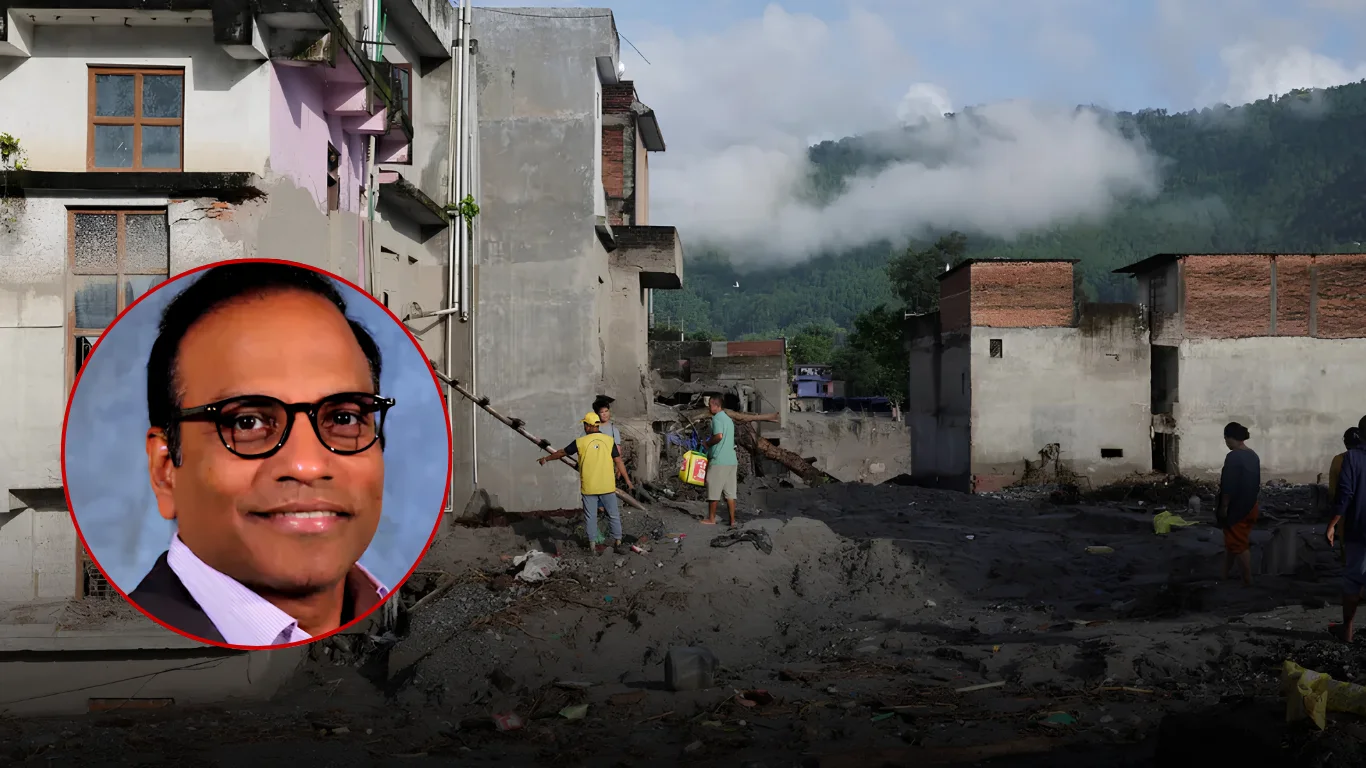
Nepal flash floods leave 626 dead and thousands missing, while Infosys Public Services CEO Lax Gopisetty remains unreachable amid rescue operations
New Delhi: Nepal is facing one of its worst natural disasters in recent years after devastating flash floods swept through several parts of the Himalayan nation, leaving hundreds dead and thousands missing. Among those currently unaccounted for is Lax Gopisetty, President and CEO of Infosys Public Services, who was visiting Nepal on a personal trip.
Infosys confirmed that Gopisetty has been unreachable since the floods struck. The company said it is working with relevant authorities and agencies to establish contact with him and determine his whereabouts. Infosys is also in close contact with his family and providing them with necessary support.
Lax Gopisetty Remains Unreachable
According to Infosys, Gopisetty was travelling in Nepal in a personal capacity when the disaster occurred. The company has not confirmed where he was when communication was lost or when he was last contacted.
Gopisetty heads Infosys Public Services, a subsidiary that primarily works with public-sector organisations in the United States and Canada. He advises public sector clients on strategy, technology, operations and digital transformation and oversees the company’s overall strategy and execution.
Before taking his current position, Gopisetty held senior leadership roles at Infosys, including serving as a Global Vice President. He has also worked with major global consulting and technology companies, including Accenture, IBM, PwC, HCL and BearingPoint.
Nepal Floods Leave 626 Dead
The scale of the disaster has continued to grow as rescue teams search for survivors across affected regions.
Nepal’s disaster authorities reported 626 deaths, while thousands of people remain unaccounted for. More than 3,700 people have reportedly been rescued so far, but difficult terrain, destroyed roads and bridges, heavy debris and bad weather are making rescue operations extremely challenging.
The disaster has also affected areas across the Nepal-China border. In Tibet, Chinese authorities have reported additional deaths and hundreds of missing people, taking the overall number of people unaccounted for across the region to nearly 3,000.
What Triggered the Flash Floods?
The floods were reported after a major ice-and-rock avalanche linked to a glacial collapse in the Himalayan region. The sudden movement of ice, rocks and debris sent enormous volumes of water and mud through mountain valleys and river systems.
The disaster severely damaged settlements and critical infrastructure in areas including Rasuwa and Nuwakot. Roads, bridges, hydropower facilities and border infrastructure were destroyed or buried under debris.
Scientists are continuing to examine satellite and ground data to determine the exact sequence of events. Experts have also warned that rising temperatures could increase the vulnerability of glaciers and high-altitude regions, although the precise relationship between climate change and this particular disaster remains under investigation.
Hundreds of Indians Also Affected
The disaster has also left a large number of Indian nationals stranded or unaccounted for.
India’s Ministry of External Affairs previously said that hundreds of Indians were missing or stranded in the affected region. Some Indian nationals trapped on the Chinese side have already been brought to safety, while evacuation efforts continue. India has also offered assistance to Nepal as rescue and relief operations intensify.
The situation has been particularly difficult for families waiting for information about relatives who travelled through the region, including pilgrims and tourists.
Rescue Operations Face Major Challenges
Rescue teams are working through thick layers of mud and debris in search of survivors and missing people. In several areas, debris has piled up several feet deep, while damaged roads and bridges have made many locations difficult to access.
Poor weather has also disrupted helicopter operations. One of the biggest rescue challenges is at the Upper Trishuli-1 Hydropower Project, where authorities fear that more than 100 people could be trapped inside a tunnel filled with debris. Specialised teams are being deployed to support the complex rescue operation.
Authorities are also monitoring a newly formed glacial lake in the Himalayan region amid concerns that a sudden release of water could trigger another dangerous flood. Although the immediate threat has reportedly eased, officials remain on alert.
More Than 93,000 People Need Assistance
The disaster has created a major humanitarian crisis, with more than 93,000 people reportedly affected and in need of assistance.
Children have also been severely impacted. UNICEF has estimated that around 17,000 children require urgent humanitarian support. Several schools and healthcare facilities have been damaged, further increasing pressure on an already difficult relief operation.
For survivors, the immediate needs include food, clean drinking water, medical care, temporary shelter and restoration of communication and transportation networks.
India Steps Up Relief Assistance
India has offered extensive support to Nepal as rescue and relief efforts continue. Assistance includes relief supplies as well as specialised support for difficult rescue operations.
India has also provided a portable prefabricated bridge to help restore connectivity in areas where floods destroyed existing bridges and roads. An Indian team, including medical personnel and tunnel-rescue specialists, has also reached Nepal to assist local authorities.
Meanwhile, Nepal’s government is accelerating relief and rehabilitation measures as authorities continue to search for missing people.
For now, the focus remains on rescuing survivors, recovering bodies and locating those still missing. The search for Infosys Public Services CEO Lax Gopisetty is also continuing amid the wider rescue operation.
